Trump tells Oval Office Diwali event he asked Modi to avoid war with Pakistan

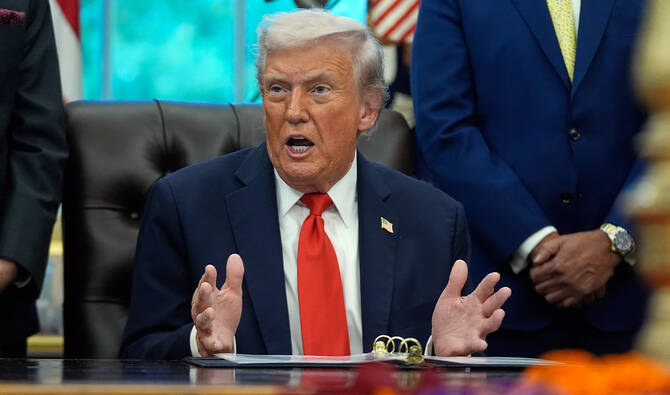
President Donald Trump answers questions from reporters during a Diwali celebration in the Oval Office at the White House in Washington, US, on October 21, 2025. (AP)
Short Url
Updated 22 October 2025
Follow

Trump tells Oval Office Diwali event he asked Modi to avoid war with Pakistan

  • Trump announced a ceasefire between the two nuclear-armed neighbors in May after a fierce military standoff
  • New Delhi has since disputed any third-party involvement, saying it continues to deal with Pakistan bilaterally

ISLAMABAD: United States President Donald Trump on Tuesday said he had spoken to Indian Prime Minister Narendra Modi, urging him to avoid a war with Pakistan as he addressed a group of Indian nationals at a Diwali event in the Oval Office in Washington.

Nuclear-armed India and Pakistan reached an understanding on May 10 to halt all military actions on land, in the air and at sea in a ceasefire announced by Trump, under which both sides agreed not to escalate hostilities that had spiraled alarmingly in a brief but intense conflict threatening regional peace. The two neighbors had traded fire using fighter jets, drones, missiles and artillery in their worst fighting in decades, leaving around 70 people dead on both sides of the border.

Trump has since taken credit for ending the conflict, though New Delhi has disputed the involvement of any third party, insisting that India continues to deal with Pakistan bilaterally.

“I just spoke to your Prime Minister today,” Trump told attendees at the Oval Office. “We had a great conversation. We talked about trade ... Although we did talk a little while ago about let’s have no wars with Pakistan. And I think the fact that trade was involved, I was able to talk about that. And we have no war with Pakistan and India. That was a very, very good thing.”

Last week, Trump said at a White House dinner that Pakistan’s Prime Minister Shehbaz Sharif had recently met him and “emotionally” credited him in front of a group of people for stopping multiple wars, saying millions of lives could have been lost in the conflicts.

Trump also told the gathering the Indian leader had assured him that New Delhi would not be buying “too much oil” from Russia, an issue that has become another sticking point between the two countries.

The US has imposed a 25 percent tariff on Indian goods over its Russian oil purchases, bringing the total import taxes on India this year to 50 percent.

The two sides are continuing their trade talks. 


Pakistan offers Kyrgyzstan Arabian Sea access as two states sign 15 cooperation accords

Updated 05 December 2025
Follow

Pakistan offers Kyrgyzstan Arabian Sea access as two states sign 15 cooperation accords

  • Pakistan and Kyrgyzstan sign MOUs spanning trade, energy, agriculture, ports, education, security cooperation
  • Kyrgyz president is on first visit to Pakistan in 20 years as both sides push connectivity and CASA-1000 power links

ISLAMABAD: Pakistan on Thursday offered Kyrgyzstan the shortest and most economical route to the Arabian Sea as the two countries signed 15 agreements and memoranda of understanding aimed at boosting cooperation across trade, energy, agriculture, education, customs data-sharing and port logistics.

The accords were signed during a visit to Islamabad by President Sadyr Zhaparov, the first by a Kyrgyz head of state to Pakistan in two decades, and part of Islamabad’s renewed push to link South Asia with landlocked Central Asian economies through ports, power corridors and transport routes.

For Pakistan, Kyrgyzstan offers access to hydropower through CASA-1000, a $1.2 billion regional electricity transmission project designed to carry surplus summer electricity from Kyrgyzstan and Tajikistan through Afghanistan into Pakistan. For Bishkek, Pakistan provides overland access to warm-water ports on the Arabian Sea, creating a shorter commercial route to global markets.

“President Asif Ali Zardari has reiterated Pakistan’s readiness to offer Kyrgyzstan the shortest and most economical route to the Arabian Sea,” Radio Pakistan reported after Zhaparov met the Pakistani president. 

The two leaders also discussed expanding direct flights to deepen business, tourism and people-to-people ties.

Zardari welcomed Kyrgyzstan’s completion of its segment of the CASA-1000 project and “reaffirmed Pakistan’s commitment to completing its part of the project, which is now at an advanced stage,” the state broadcaster said. 

Zhaparov thanked Islamabad for supporting Bishkek’s candidacy for a non-permanent UN Security Council seat and invited Zardari to visit Kyrgyzstan at a time of his convenience. Both sides expressed satisfaction with progress under the Quadrilateral Traffic in Transit Agreement, designed to facilitate road movement between Pakistan, Kyrgyzstan, Kazakhstan and China.

Earlier, both governments exchanged 15 sectoral cooperation documents covering commerce, mining, geosciences, power, agriculture, youth programs, the exchange of convicted persons, customs electronic data systems and a sister-city linkage between Islamabad and Bishkek.

According to APP, the MOUs were signed by ministers representing foreign affairs, commerce, economy, energy, power, railways, interior, culture, health and tourism. Agreements also covered cooperation between Pakistan’s Foreign Service Academy and the Diplomatic Academy of Kyrgyzstan, as well as collaboration between universities, youth ministries and cultural institutions.

“Our present mutual trade, comprising of about $15–16 million will be enhanced to $200 million in the next two years,” Prime Minister Shehbaz Sharif said after the agreements were signed, calling them “a framework for structured, result-oriented engagement and closer institutional linkages.”

Sharif said Pakistan was ready to serve as a maritime outlet for the landlocked Central Asian republic, offering access to Karachi, Port Qasim and Gwadar to help Kyrgyz goods reach regional and global markets.