- Aoun expressed hope that this first step would lead to a permanent ceasefire and end the humanitarian crisis facing Palestinians in Gaza
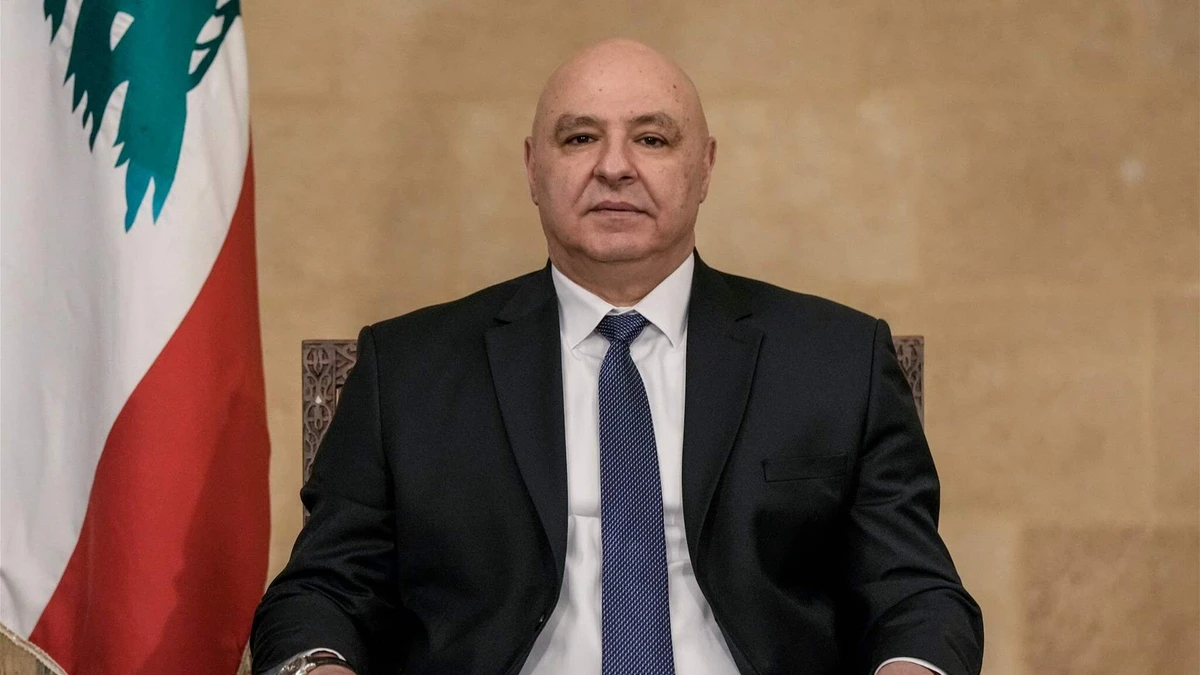
BEIRUT: Lebanese President Joseph Aoun on Thursday welcomed the initial ceasefire agreement between Israel and Hamas aimed at ending the war in Gaza.
Aoun expressed hope that this first step would lead to a permanent ceasefire and end the humanitarian crisis facing Palestinians in Gaza.
He called for sustained international and regional efforts to achieve a comprehensive and just peace in line with the Arab Peace Initiative adopted in Beirut in 2002.
The president also urged Israel to heed calls from Arab and global leaders to cease hostilities in the rest of Palestine, Lebanon, and Syria, fostering an environment conducive to lasting stability in the Middle East.
Meanwhile, Lebanon continues its internal efforts to assert state sovereignty over arms.
In early September, the government approved the army’s confidential plan to monopolize weapons and retrain and redeploy forces throughout Lebanese territory.
Kamal Chehade, Lebanon’s minister of displaced persons and minister of state for technology affairs, on Thursday highlighted the importance of extending army authority nationwide as a foundation for stability.
He said that “the government has adopted the security plan and is closely monitoring its implementation, as it moves forward with its decision to restrict weapons and prevent their transfer across Lebanese territory.”
Speaking to “Beirut Today,” the minister revealed that the army commander’s report to the Cabinet detailed the first phase of transferring weapons under state authority — a process scheduled to last one to three months, of which about a third has already elapsed.
“The report included encouraging figures showing clear progress in the south, where the number of individual missions carried out by the army in the area south of the Litani River exceeded 4,200 – double the previous rate,” he said.
“The army’s response rate to the demands of the ‘mechanism’ (i.e., the committee charged with monitoring the implementation of the Cessation of Hostilities Agreement) reached 85 percent. Seven tunnels have been completely sealed, and the army is working to close four additional tunnels,” he added.
Chehade also noted that the army had found some weapons under the rubble of destroyed buildings, explaining that retrieving them will take time.
The Trump administration recently provided an important boost to the mission, when Washington unlocked $230 million in funding for Lebanon’s security forces, including $195 million to the Lebanese Army, double what it had previously provided.
Chehade credited US diplomacy, particularly the efforts of Morgan Ortagus, for securing the funds in time, just ahead of the US government shutdown, and noted ongoing French, Saudi, and wider Arab initiatives to convene an international conference in support of the Lebanese Army.
Chehade said the army has begun containing armed incidents across Lebanon, including along the Syrian border and near Palestinian camps, noting that the southern phase is expected to be completed within 50 days.
Despite Israeli attacks, he admitted that only Hezbollah knows the location of its weapon stockpiles.
“The party has withheld this information from the army, and there is no cooperation concerning tunnels and booby traps,” he said.
Since the army’s first report was submitted in April, Chehade and other ministers have pushed for greater transparency.
“The army commander has promised to appoint an official spokesperson responsible for communicating with the media and documenting missions for the public,” he said.
He emphasized that the government’s efforts “are rooted in protecting Lebanon and its people,” adding that citizens have the right to be informed about ongoing developments.
“The state has made a sovereign and diplomatic decision: that Lebanon’s protection relies on the self-sustaining capabilities of the army, internal security forces, and political and diplomatic relations,” the minister said.
The government has formally begun to implement UN Security Council Resolution 1701, he added, but warned that the process will take time.
“The government’s decision is not subject to bargaining. Our goal is reconstruction, the liberation of the five regions, the return of prisoners, and putting all weapons, including Hezbollah’s and those of all armed factions, under Lebanese Army control,” the minister said.
Chehade identified the greatest obstacles to disarmament as the army’s limited resources, difficulty accessing weapon caches, and ongoing Israeli attacks. Still, he maintained that “progress is ongoing and there is a will to accomplish the mission,” calling on Hezbollah to accelerate the handover of its arms and cooperate with the army if it truly wants to “protect the south.”
According to Chehade, diplomats revealed that Israeli strikes are likely to continue until Hezbollah relinquishes its weapons south of the Litani River, after which the focus will move to areas north of the river.
“The government’s policy is clear: a complete monopoly on arms,” he said.
He noted that the first part of the initial phase is nearly complete, but that the second part may require 50 more days to finish.
US diplomats have reportedly told Lebanon that no reciprocal Israeli response should be expected before both segments are done, after which the army is committed to advancing to subsequent phases.
“The political decision has been made, and there will be no turning back. No government since 1969 has dared to take such a step,” Chehade said.
Turning to politics, the minister emphasized that Cabinet and Parliament are the appropriate venues for dialogue and challenged opponents to “head to the polls” rather than “circumvent” legitimate institutions.
“We are living in a parliamentary democracy that answers to the ballot box.”
Separately, Prime Minister Nawaf Salam received Dr. Christian Turner, political director and director general for geopolitical affairs at the British Foreign, Commonwealth and Development Office, accompanied by British Ambassador to Lebanon Hamish Cowell to discuss political developments.
Talks covered British support for the Lebanese army and the importance of achieving a full Israeli withdrawal from southern Lebanon.
In a significant diplomatic move, the UK this week floated the idea — first reported by pro-Hezbollah Al-Akhbar newspaper — to appoint a special envoy to negotiate with the party to disarm and fully integrate into the state.
Reports named Jonathan Powell, national security adviser under the government of Keir Starmer and former chief of staff under Tony Blair, who has experience in dealing with rebel forces or those classified as terrorist organizations.
Meanwhile, Minister of Foreign Affairs and Emigrants Youssef Rajji received Charles Fries, deputy secretary-general for peace, security, and defense at the European External Action Service, accompanied by EU Ambassador to Lebanon Sandra De Waele and a delegation from the EU.
Discussions included ways the EU could support Lebanon, particularly by enhancing the capabilities of the army so it can carry out its duties in implementing UN Security Council Resolution 1701.
Rajji expressed gratitude to the EU for its multifaceted support to Lebanon, emphasizing the importance of maintaining assistance for the Lebanese Armed Forces, which will assume increased responsibilities after the conclusion of UNIFIL’s mandate at the end of 2026 — a mission in which several EU member states participate.
He urged the EU to increase pressure on Israel to cease its daily attacks, withdraw from occupied Lebanese territory, and release prisoners.
Rajji also affirmed the government’s commitment to the reform process, underscoring that it answers both public demand and international requirements.
For his part, Fries reaffirmed the EU’s commitment to Lebanon and its armed forces, outlining proposals to assist Lebanon after UNIFIL departs.
He welcomed the progress of Lebanon’s reforms and noted that they will deepen the strategic partnership, attract financial support, and enhance broader EU-Lebanon relations.
Fries reiterated EU backing for Lebanon’s position on the return of Syrian refugees in accordance with international law.
Additionally, Rajji met a delegation from the Economic and Social Council, led by Charles Arbid, who briefed him on preparations for the “Beirut One” Investment Conference scheduled for Nov. 18-19, 2025, organized in partnership with the ESC and under the patronage of President Aoun.
The delegation highlighted the foreign ministry’s role in promoting active participation by the Lebanese diaspora, whose contributions are essential to reviving Lebanon’s economy and ensuring a sustainable recovery.