

Heavy rains lash Punjab as Pakistan warns of renewed flood risk

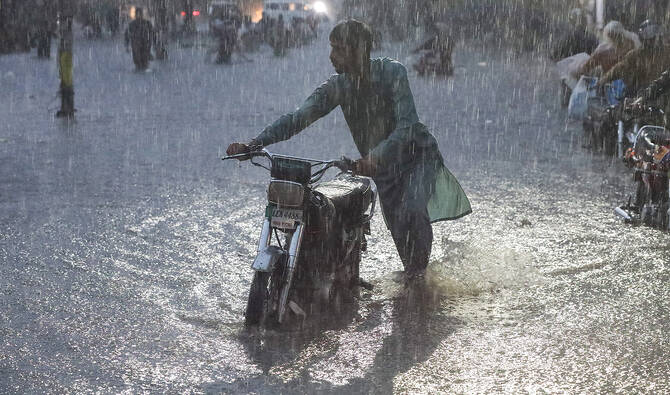
A man pushes his motorbike as he wades through a flooded road amid rain in Lahore, Pakistan, on September 8, 2025. (REUTERS/File)
Short Url
Updated 05 October 2025
Follow

Heavy rains lash Punjab as Pakistan warns of renewed flood risk

  • Over 1,000 people have been killed in this year’s monsoon season, millions of acres of farmland destroyed 
  • Punjab, Pakistan’s most populous and agriculturally vital province, has suffered repeated flooding since August

ISLAMABAD: Heavy overnight rains drenched large parts of Pakistan’s Punjab province on Sunday, prompting fresh flood warnings as authorities reported rising water levels in major rivers following weeks of intense late-monsoon weather.

This year’s monsoon season, stretching from late June through September, has been one of the deadliest in recent years, killing at least 1,006 people nationwide and displacing tens of thousands, according to the National Disaster Management Authority (NDMA). The downpours have damaged hundreds of thousands of homes and large stretches of roads, while washing away livestock and destroying key crops, including cotton, rice and maize, across the country’s agricultural heartland.

Punjab, Pakistan’s most populous and agriculturally vital province, has suffered repeated flooding since August. Relief officials say persistent rains have left soil saturated, embankments weakened and drainage systems clogged, increasing the risk of renewed inundation even from moderate rainfall. 

“Rainfall is forecast in most districts of Punjab over the next 24 hours,” the Provincial Disaster Management Authority (PDMA) said in a Sunday bulletin. 

“Rising water levels are likely in major rivers due to continuing rainfall,” it warned, citing a potential increase in flows in the Indus and Jhelum rivers, and a possible surge in the Chenab between Oct. 5 and 7.

Flows in the Ravi and Sutlej rivers would depend on releases from Indian reservoirs, the agency said. 

“Commissioners, deputy commissioners and other officers are on alert. Citizens are urged to take precautions during bad weather and remain in safe locations,” it said. 

The PDMA added that rain could also swell smaller tributaries connected to the major rivers, warning residents in low-lying districts to stay vigilant. Local authorities have been ordered to monitor embankments and pre-position rescue equipment in vulnerable areas.

Pakistan, among the countries most at risk from climate change, has faced consecutive years of extreme weather. Experts say erratic monsoon patterns — alternating between long dry spells and sudden, intense rainfall — underscore the urgent need for climate-resilient infrastructure and improved early-warning systems across the Indus basin.


T20 World Cup: Pakistan’s India boycott splits fans as politics overshadows cricket

Updated 5 sec ago
Follow

T20 World Cup: Pakistan’s India boycott splits fans as politics overshadows cricket

  • The boycott has dealt a blow to the ICC’s marquee event, with India-Pakistan matches ‌the biggest drivers ‌of global viewership, revenue
  • On the streets, many Pakistani fans back the boycott as a response to what they see as India’s growing influence over cricket governance

KARACHI: Pakistan’s decision to boycott its Twenty20 World Cup match against India has drawn widespread support from fans ​and administrators who hailed the move as a long-overdue stand in a rivalry in which sport and geopolitics have collided.

The government on Sunday cleared Pakistan to take part in the tournament beginning February 7 but barred the team from playing India in a February 15 group match in Colombo, a decision the International Cricket Council (ICC) said was not in the interests of the global game.

The boycott deepened a long freeze in bilateral cricket between the nuclear-armed neighbors — who have not played a full series since 2012–13 and now meet largely at neutral venues — and dealt a blow to the ICC’s marquee event, with India-Pakistan matches ‌the biggest drivers ‌of global viewership and revenue.

’ENOUGH IS ENOUGH’

For many in Pakistan, however, ‌the ⁠boycott ​was less ‌about cricketing issues, with Pakistan forfeiting two points by skipping the match, and more about symbolism.

“Enough is enough,” former Pakistan Cricket Board (PCB) chairman Najam Sethi told Reuters, accusing India’s board of politicizing the ICC. “It’s time to challenge this duplicitous approach by exercising PCB’s options in alliance with Bangladesh.”

The Indian government, the Board of Control for Cricket in India (BCCI) and the International Cricket Council did not respond to requests for comment.

The ICC said it was still awaiting an official communication from the Pakistan Cricket Board (PCB) conveying their “position of selective participation.”

“While the ICC respects the roles ⁠of governments in matters of national policy, this decision is not in the interest of the global game or the welfare of fans ‌worldwide, including millions in Pakistan,” the Dubai-based body said in a ‍statement on Sunday.

The government has not publicly detailed ‍its reasoning, but Mosharraf Zaidi, a spokesperson for Prime Minister Shehbaz Sharif, linked the move to security ‍tensions with India.

“Nothing is more important than the memory of Pakistani citizens and troops murdered by Indian proxy terrorists over the weekend,” Zaidi said. “With funerals taking place today, this was the least that could be done.”

The remarks followed coordinated attacks by Baloch separatist militants across Pakistan’s southwestern Balochistan province over the weekend that killed nearly 50 people.

India’s ​foreign ministry rejected Pakistan’s accusations, calling them “baseless” and accusing Islamabad of deflecting attention from its own internal issues.

Pakistan’s World Cup jersey has been branded the “Markhor Edition,” after the national ⁠animal, a symbol of resilience also used in military iconography, Geo TV reported.

’LET CRICKET JUST BE A GAME’

On the streets of Pakistan’s major cities, many cricket fans backed the boycott as a response to what they see as India’s growing influence over global cricket governance.

“This arrogance of India should be broken a little,” said Mohammad Asghar, a fan in Karachi. “They should realize someone has come forward to challenge them.”

Others drew parallels with Bangladesh’s earlier withdrawal from the tournament over safety concerns, a move that led to Scotland replacing them, and questioned why Pakistan should be held to a different standard.

“If Bangladesh can boycott for one player’s safety, why can’t Pakistan take a stand?” said Ayaz Ahmed.

The decision also sparked heated debate on social media, with users divided between calls for “self-respect” and warnings that skipping the match could further isolate Pakistan in global cricket.

Former Pakistan captain Shahid Afridi agreed.

“Cricket ‌can open doors when politics closes them,” he wrote on X. “It’s regrettable that Pakistan won’t play India, but this is the moment for the ICC to prove it is impartial.”