

Pakistan saw 143% rise in civilian deaths from militant attacks in Jan. — report

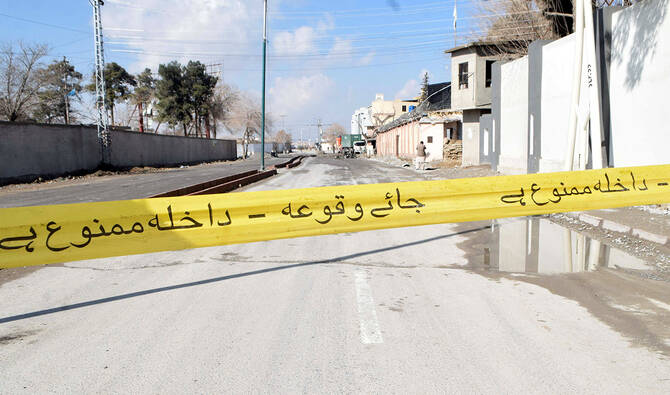
A road leading to a site is cordoned off, after militant attacks, in Quetta, Pakistan, February 1, 2026. (REUTERS)
Short Url
Updated 02 February 2026
Follow

Pakistan saw 143% rise in civilian deaths from militant attacks in Jan. — report

  • Pakistan witnessed 87 militant attacks in Jan., with 38 in Khyber Pakhtunkhwa and 27 in Balochistan
  • The report follows coordinated bomb and gun attacks in Balochistan that killed more than 200 people

KARACHI: Pakistan witnessed a 143 percent increase in civilian casualties in the month of January, compared to the previous month, an Islamabad-based think tank said on Monday, with the country’s restive Khyber Pakhtunkhwa and Balochistan provinces experiencing the highest number of incidents.

The surge in attacks comes amid a resurgence of militant activity in Pakistan’s northwestern and southwestern regions bordering Afghanistan, where security forces have been confronting multiple groups such as the Tehreek-e-Taliban Pakistan (TTP) and the separatist Baloch Liberation Army (BLA). Islamabad has often accused Kabul of allowing militants to operate from Afghan soil and New Delhi of backing these groups, allegations they both deny.

Pakistan saw a 28 percent increase in militant attacks, with 87 incidents across the country in January, the Islamabad-based Pakistan Institute for Conflict and Security Studies (PICSS) said in its report. Of these, 38 attacks took place in Khyber Pakhtunkhwa, 27 in Balochistan and two in the Punjab province.

“A total of 361 people were killed during the month, including 242 militants, 73 civilians, and 46 security force personnel,” PICSS said in its report.

“Compared to the previous month, civilian deaths increased by 143 percent, militant deaths by 35 percent, and security force fatalities by seven percent,” it continued.

“Balochistan emerged as the primary theater of both militant activity and security force operations.”

The report follows coordinated bomb and gun attacks across multiple cities in Balochistan, according to officials. The attacks killed at least 177 militants, 31 civilians and 17 security personnel.

The PICSS report said that 71 civilians, 52 security personnel, and 12 militants were also injured in attacks, while around 60 suspected militants were arrested in Jan. The country witnessed three suicide attacks last month, it added.

“No militant attacks were reported during January from Sindh, Azad Jammu and Kashmir, Islamabad, or Gilgit-Baltistan,” the report added.


Pakistan anti-graft body says in talks with UAE to curb money laundering, illegal assets holding

Updated 7 sec ago
Follow

Pakistan anti-graft body says in talks with UAE to curb money laundering, illegal assets holding

  • Many Pakistanis reportedly own luxury homes and commercial properties in the UAE despite not working or having any businesses in Gulf country
  • A team of Pakistan’s National Accountability Bureau will soon visit Dubai to sign an MoU with Emirati authorities for cooperation against corruption

ISLAMABAD: Pakistan’s National Accountability Bureau (NAB) said on Tuesday it was in talks with its counterparts in the United Arab Emirates (UAE) to curb money laundering and illegal offshore asset holdings through mutual legal assistance.

Pakistan has a large diaspora in the UAE, who are a major source of foreign remittances to the South Asian country, while many Pakistanis reportedly own luxury homes and commercial properties despite not working or having any businesses in the Gulf nation.

In 2018, the Supreme Court of Pakistan was presented a report, compiled by chartered accountancy firm A.F. Ferguson, that stated that Pakistani nationals owned properties and assets worth $150 billion in the UAE, in a case relating to illegal offshore assets.

Speaking at a press conference on Tuesday, senior NAB officials said they have recently signed multiple mutual legal assistance agreements with foreign governments as they announced a record recovery of Rs6.213 trillion ($22 billion) ill-gotten money in 2025.

“A team of NAB officials will travel to Dubai in the coming weeks to sign an MoU with the UAE Accountability Authority (UAEAA) for joint cooperation against corruption,” NAB’s Director General (Operations) Amjad Majeed Aulakh said, adding that both sides have already held several rounds of talks to finalize the agreement.

Asked if Pakistan planned to crack down on individuals who purchased assets in the UAE using illicit funds, Aulakh said the anti-corruption watchdog was already tracing and repatriating assets stashed abroad via INTERPOL, the Global Operational Network of Law Enforcement Agencies (GlobE), and the Asset Recovery Interagency Network – Asia Pacific (ARIN-AP).

The Bureau’s total recoveries reached Rs11.524 trillion ($41 billion) over the past three years, with 2025 alone accounting for more than half of that amount, according to NAB Deputy Chairman Sohail Nasir. These recoveries included around 2.98 million acres of encroached state and forest land.

The watchdog is also strengthening its capacity to handle sophisticated financial crimes, including the use of cryptocurrency to evade monitoring, officials said.

“We are working on enhancing our capacity,” Aulakh said. “However, those using crypto for money laundering or corruption are eventually caught when they attempt to convert it into movable or immovable assets.”

Such investigations are increasingly supported by artificial intelligence-assisted tools, blockchain analysis and digital forensics, he added.