

T20 World Cup: Pakistan’s India boycott splits fans as politics overshadows cricket

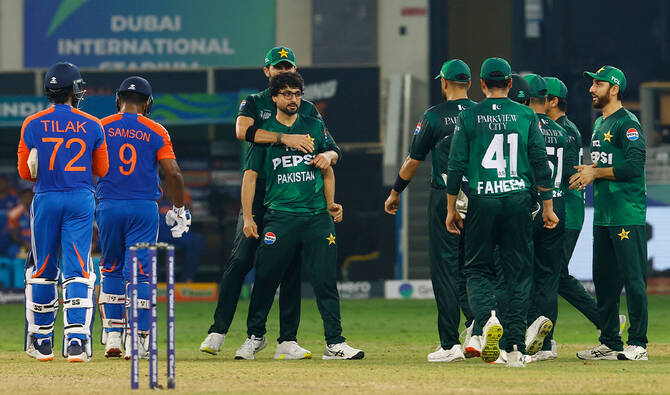
Pakistan's Abrar Ahmed celebrates after taking the wicket of India's Sanju Samson at - Dubai International Cricket Stadium, Dubai, United Arab Emirates on September 28, 2025. (REUTERS)
Short Url
Updated 02 February 2026
Follow

T20 World Cup: Pakistan’s India boycott splits fans as politics overshadows cricket

  • The boycott has dealt a blow to the ICC’s marquee event, with India-Pakistan matches ‌the biggest drivers ‌of global viewership, revenue
  • On the streets, many Pakistani fans back the boycott as a response to what they see as India’s growing influence over cricket governance

KARACHI: Pakistan’s decision to boycott its Twenty20 World Cup match against India has drawn widespread support from fans ​and administrators who hailed the move as a long-overdue stand in a rivalry in which sport and geopolitics have collided.

The government on Sunday cleared Pakistan to take part in the tournament beginning February 7 but barred the team from playing India in a February 15 group match in Colombo, a decision the International Cricket Council (ICC) said was not in the interests of the global game.

The boycott deepened a long freeze in bilateral cricket between the nuclear-armed neighbors — who have not played a full series since 2012–13 and now meet largely at neutral venues — and dealt a blow to the ICC’s marquee event, with India-Pakistan matches ‌the biggest drivers ‌of global viewership and revenue.

’ENOUGH IS ENOUGH’

For many in Pakistan, however, ‌the ⁠boycott ​was less ‌about cricketing issues, with Pakistan forfeiting two points by skipping the match, and more about symbolism.

“Enough is enough,” former Pakistan Cricket Board (PCB) chairman Najam Sethi told Reuters, accusing India’s board of politicizing the ICC. “It’s time to challenge this duplicitous approach by exercising PCB’s options in alliance with Bangladesh.”

The Indian government, the Board of Control for Cricket in India (BCCI) and the International Cricket Council did not respond to requests for comment.

The ICC said it was still awaiting an official communication from the Pakistan Cricket Board (PCB) conveying their “position of selective participation.”

“While the ICC respects the roles ⁠of governments in matters of national policy, this decision is not in the interest of the global game or the welfare of fans ‌worldwide, including millions in Pakistan,” the Dubai-based body said in a ‍statement on Sunday.

The government has not publicly detailed ‍its reasoning, but Mosharraf Zaidi, a spokesperson for Prime Minister Shehbaz Sharif, linked the move to security ‍tensions with India.

“Nothing is more important than the memory of Pakistani citizens and troops murdered by Indian proxy terrorists over the weekend,” Zaidi said. “With funerals taking place today, this was the least that could be done.”

The remarks followed coordinated attacks by Baloch separatist militants across Pakistan’s southwestern Balochistan province over the weekend that killed nearly 50 people.

India’s ​foreign ministry rejected Pakistan’s accusations, calling them “baseless” and accusing Islamabad of deflecting attention from its own internal issues.

Pakistan’s World Cup jersey has been branded the “Markhor Edition,” after the national ⁠animal, a symbol of resilience also used in military iconography, Geo TV reported.

’LET CRICKET JUST BE A GAME’

On the streets of Pakistan’s major cities, many cricket fans backed the boycott as a response to what they see as India’s growing influence over global cricket governance.

“This arrogance of India should be broken a little,” said Mohammad Asghar, a fan in Karachi. “They should realize someone has come forward to challenge them.”

Others drew parallels with Bangladesh’s earlier withdrawal from the tournament over safety concerns, a move that led to Scotland replacing them, and questioned why Pakistan should be held to a different standard.

“If Bangladesh can boycott for one player’s safety, why can’t Pakistan take a stand?” said Ayaz Ahmed.

The decision also sparked heated debate on social media, with users divided between calls for “self-respect” and warnings that skipping the match could further isolate Pakistan in global cricket.

Former Pakistan captain Shahid Afridi agreed.

“Cricket ‌can open doors when politics closes them,” he wrote on X. “It’s regrettable that Pakistan won’t play India, but this is the moment for the ICC to prove it is impartial.”


Pakistan says fuel stocks sufficient to last a month as Iran conflict disrupts Hormuz supplies

Updated 5 sec ago
Follow

Pakistan says fuel stocks sufficient to last a month as Iran conflict disrupts Hormuz supplies

  • Tehran on Saturday closed the vital shipping lane, following US-Israeli attacks on Iran
  • Analysts say prolonged disruption of Hormuz may spike global oil prices, shipping costs

ISLAMABAD: Pakistan's government and industry officials on Sunday said the country has enough fuel stockpiles to last at least a month, amid regional tensions in the Middle East that have disrupted oil supply through the Strait of Hormuz.

Pakistan relies heavily on energy imports, with majority of its crude oil and petroleum imports from the Middle East passing through the Strait of Hormuz. On Saturday, Tehran closed the shipping lane, warning that it was dangerous due to US and Israeli attacks on Iran.

The Strait of Hormuz is a narrow waterway between Iran and Oman, connecting the Gulf to the Arabian Sea. On a typical day, tankers carrying around 20 percent ‌of global oil consumption pass through it with cargoes from Saudi Arabia, ​Iraq, Iran, UAE, Kuwait and Qatar.

Pakistan's Petroleum Division has been directed to submit daily stock reports, while the country's Oil and Gas Regulatory Authority (OGRA) has been tasked with maintaining strict market oversight, according to officials.

“Fuel inventories remain robust, with 28 days’ supply of both petrol and diesel currently available in stock,” OGRA spokesman Imran Ghaznavi told Arab News. "This level is comfortably above the mandatory reserve requirement, indicating a stable and well-managed supply position."

The statement came after three ships were attacked in the Strait of Hormuz, maritime security agencies said on Sunday, as Iran pressed a second day of strikes in response to ongoing US-Israeli air raids.

An official at the Pakistani energy ministry, who spoke on condition of anonymity, said finished petroleum stocks were sufficient to last for “over one month.”

The state-owned Pakistan State Oil (PSO) company said it held “healthy stock of all petroleum products.”

"However, the situation is being monitored and we will act accordingly in line with Ministry of Energy’s directives," it said in a statement.

While energy companies and regulators have taken steps to ensure fuel availability in the event of further regional disruptions, analysts warn that the country’s heavy reliance on imported crude could leave it vulnerable if the instability persisted.

“If the Strait of Hormuz is impacted [for long], this may create a shortage of oil supply in region and world as material amount of oil passes through this track,” said Shankar Terleja, head of research at Topline Securities Ltd.

“This may cause spike in petroleum prices globally.”

Ahsan Mehanti, chief executive officer of Arif Habib Commodities, said the Strait of Hormuz is "highly critical" to Pakistan for its petroleum supplies and its prolonged closure could impact "security and industrial activity."

The alternatives could include Russian and Venezuelan oil, according to Mehanti.

The Federation of Pakistan Chambers of Commerce and Industry (FPCCI) has voiced concern over the potential impact of the Middle East conflict on Pakistan's economy.  “The instability in the region will disrupt trade routes and lead to a massive increase in shipping costs,” FPCCI President Atif Ikram Sheikh said, urging the government to “make full efforts to achieve a ceasefire through mediation and negotiations between the United States and Iran.”

He also requested the government to “immediately formulate a policy to ensure supply chain continuity, particularly for petroleum products.”