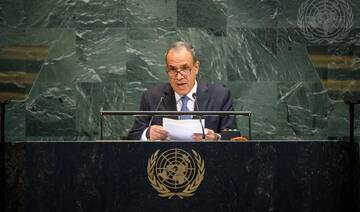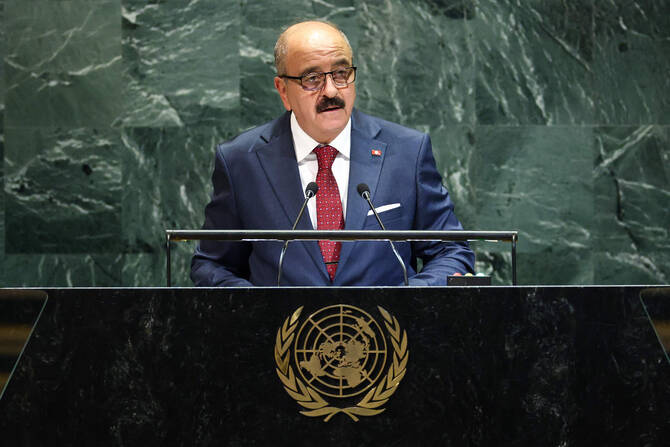

NEW YORK: Tunisia’s foreign minister on Saturday condemned the international community’s failure to prevent Israel from attempting to “liquidate” the Palestinian question.
Mohammed Ali Nafti told the 80th UN General Assembly that only reform of the organization and the wider multilateral system will allow an empowered Security Council to “put an end to the terrible humanitarian tragedy, genocidal war and starvation against the Palestinian people.”
He warned that 2025 represents a “critical time for our world, a time of instability and unprecedented frequency of violations of the rules of international law and the principles of the UN Charter.”
Tunisia is “disappointed today as the Security Council is still unable to put an end” to the suffering in Gaza, he added.
“The brutal occupying entity continues to worsen the suffering of the Palestinian people before the entire world without accountability and with full impunity,” Nafti said.
“We call on the international community to shoulder its responsibility immediately to lift the blockade on the Gaza Strip and all the Palestinian territory, and to put an end to the starvation and to guarantee an effective delivery of assistance.”
Nafti called on the UN Security Council to “immediately” intervene and put an end to Israel’s violations against Syria, Lebanon, Iran and Qatar.
“Tunisia will remain committed with an unshakable will to support the Palestinian people in their struggle to reclaim their legitimate and inalienable rights,” he said.
“We can’t confront the current and emerging global challenges if we don’t rebuild international relations based on solidarity, constructive cooperation, justice, mutual respect, non-interference in the affairs of others and respect for national sovereignty.”
Nafti addressed Tunisia’s status as a critical transit hub for irregular migration. The North African state is a common departure point for sub-Saharan African migrants seeking to cross the Mediterranean Sea for European shores.
Tunisia’s approach to the issue is “based on respecting human rights and rejecting all forms of racial discrimination and hate speech,” Nafti said.
The country’s authorities “continue to make every possible effort to save the lives of irregular migrants on land and at sea, to provide them with care and enable them to voluntarily return to their countries of origin in cooperation with the International Organization for Migration,” he added.
“We renew our call to adopt a comprehensive approach to migration that takes into account the human and historic dimensions, and not just the narrow security dimension.”
Nafti warned that countries in the Global South should not be handed a migration burden “that exceeds their capacity.”
He said: “We refuse to be a country of transit for irregular migrants that are victims of networks of human smuggling and human trafficking. Migration must be a choice and not a necessity.”
Nafti voiced his country’s support for non-interference by foreign actors in the affairs of Libya, Syria, Yemen and Sudan.
Only the UN is entitled to support actors within those countries in bringing about peace and security, he said.
“We remain hopeful that we’ll be able to build together a future that carries opportunities that meet the aspirations and the hopes of our people and future generations,” he added.