

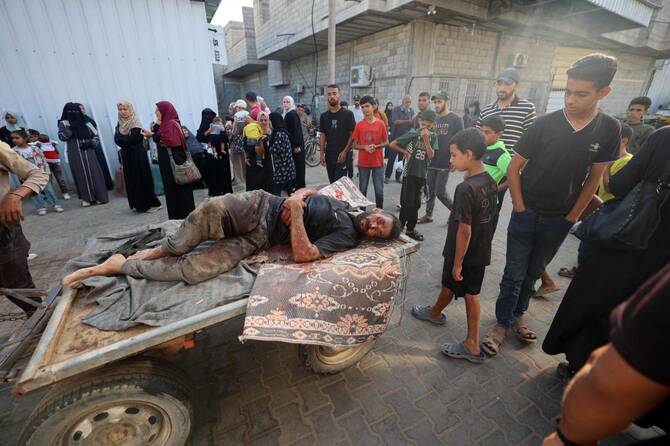

GAZA CITY, Palestinian Territories: Palestinian women wept and wailed Saturday as they mourned a family killed in an Israeli strike on Gaza City, expressing anger at Israel and Hamas for the bloodshed engulfing the city.
Seven members of the Bakr family were killed overnight in the strike on Al-Shati refugee camp in Gaza City, where Israeli forces have stepped up a ground and air assault.
The dead included children and women, according to the Gaza civil defense agency, a rescue force operating under Hamas authority, which said several others were also wounded in the Israeli strike.
“What is happening are massacres, massacres that are condemned internationally,” said Umm Khaleel, who survived when the family home was hit.
AFP footage showed women in black abayas crying out in grief, one clutching the small body of her child tightly to her chest.
“We cannot sleep because of the bombing and shelling on Al-Shati... the children were sleeping when suddenly a missile landed on us,” said Salwa Subhi Bakr.
“What does the world want from us? What does (Israeli Prime Minister Benjamin) Netanyahu want? What does Hamas want?.”
The bodies, wrapped in white shrouds, some stained with blood, were then taken for burial.
Gaza’s main Al-Shifa hospital confirmed receiving six bodies of victims killed in the strike.
The Israeli military did not offer an immediate response.
Bakr, displaced by the nearly two-year-long war, said families had nowhere safe to flee.
“They tell us go there, then come back here. Where do we get the money for trucks?” she said.
“People are in the streets, in the south scattered everywhere. Where should we go? Find us a solution.”
Since launching its air assault on Gaza City late last month, which preceded a ground offensive, the Israeli military has repeatedly ordered Palestinians to head south.
Some 700,000 people have already fled since then, according to the Israeli military.
- ‘Finish the job’ -
At the same time, Israel continued to strike other parts of the Gaza Strip, home to more than two million people, most of whom have been displaced at least once since the war began.
On Saturday, Gaza’s civil defense agency reported that Israeli fire killed at least 70 people across the territory, including 38 in Gaza City according to hospitals in the territory’s largest urban area.
Media restrictions in Gaza and difficulties in accessing many areas mean AFP is unable to independently verify the tolls or details provided by the civil defense or the Israeli military.
AFP footage from a hospital courtyard in central Gaza on Saturday showed several bodies in white shrouds, victims of a strike on Nuseirat refugee camp.
Women wept over the dead, while men stood in prayer beside the bodies.
Piles of concrete blocks and gaping holes marked the site of the strike that hit a building in the camp.
Groups of men and children picked through the debris, salvaging what they could of their belongings.
Iyad Shokr, who survived the strike on Nuseirat, said the attack came before dawn.
“The debris collapsed on our floor. By the will of God some survived while others were martyred,” he told AFP.
On Friday, Netanyahu vowed in his address at the UN General Assembly to “finish the job” against Hamas, despite widespread international condemnation of the intensified offensive.
The war in Gaza broke out after Palestinian militants led by Hamas attacked Israel on October 7, 2023.
That attack resulted in the deaths of 1,219 people on the Israeli side, mostly civilians, according to an AFP tally based on official Israeli figures.
Israel’s retaliatory military offensive has since killed at least 65,926 people, also mostly civilians, according to the health ministry in Hamas-run Gaza, figures the United Nations deems reliable.


