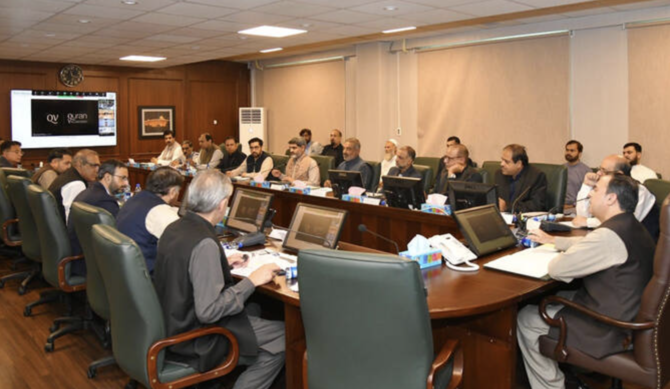

KARACHI: Pakistan is planning Saudi-linked port and shipping projects, including new gateway terminals, direct shipping routes and green ship recycling yards, as part of efforts to become a logistics bridge between the Gulf, Central Asia and China, the maritime ministry said on Friday.
Officials say Pakistan’s location at the mouth of the Arabian Sea gives it a strategic advantage in connecting Gulf energy exporters with China and the landlocked markets of Central Asia.
With Gulf–China trade volumes rising and regional shipping routes expanding, Islamabad is seeking to position its ports as key nodes in emerging transport corridors.
According to a statement from the maritime ministry, Technical Adviser for Maritime Affairs Muhammad Jawad Akhtar proposed several new projects with Saudi Arabia.
These included “Karachi–KSA and Gwadar–KSA Gateway Terminals, expansion of the Pakistan National Shipping Corporation fleet under Saudi partnership, start direct shipping lines from Karachi to Jeddah and Gwadar to Dammam, and establish 20 green ship recycling yards at Gaddani,” the maritime ministry statement said.
Karachi Port and Port Qasim — Pakistan’s two largest and busiest seaports handling most of the country’s container and cargo traffic — along with Gwadar Port, a Chinese-developed deep-sea port near the mouth of the Arabian Gulf, are seen as key to these plans.
Maritime Affairs Minister Muhammad Junaid Anwar Chaudhry said the effort was part of a broader plan to integrate Pakistan’s ports and logistics infrastructure with regional trade routes.
“We are not merely compiling lists of projects; we are shaping a national roadmap for logistics and connectivity,” he said.
“Pakistan performs best under compressed timelines, and this is one such moment.”
Chaudhry said Karachi Port, Port Qasim and Gwadar Port would be central to the plan, which aims to link them to regional transport corridors through rail, road and air networks.
He highlighted the importance of the long-delayed ML-1 railway modernization project — a planned multi-billion-dollar upgrade of Pakistan’s 150-year-old main railway line from Karachi in the south to Peshawar near the Afghan border — expected to boost freight and passenger traffic from the northwest province of Khyber Pakhtunkhwa to southern ports.
He said Pakistan must align its development agenda with the connectivity needs of partner countries.
Chaudhry added that a joint working group bringing together the maritime, communications, railways and defense ministries would hold its first meeting next week to shortlist priority projects for rapid funding and development.
Other ministries outlined their own connectivity priorities. The communications ministry called for laying fiber optic cables along railway lines, expanding submarine cable networks and speeding up completion of the M-6 motorway — a 394-km section of Pakistan’s north–south highway network linking the port city of Karachi to Sukkur in interior Sindh province — described as a missing link in the China–Pakistan Economic Corridor (CPEC), a multibillion-dollar infrastructure and energy program that is part of China’s Belt and Road Initiative.
The communications ministry also highlighted plans for an M-10 motorway extension through the Khirthar mountains in southern Pakistan to complement existing road infrastructure.
A petroleum ministry representative said a $300 million feasibility study was underway for a new merchant oil terminal at Hub, an industrial town near Karachi, as part of Pakistan State Oil’s infrastructure expansion strategy.
Chaudhry urged ministries to deliver a clear, investment-ready roadmap that would attract international financing and cement Pakistan’s role as a “central bridge” connecting the Gulf with Central Asia and China.