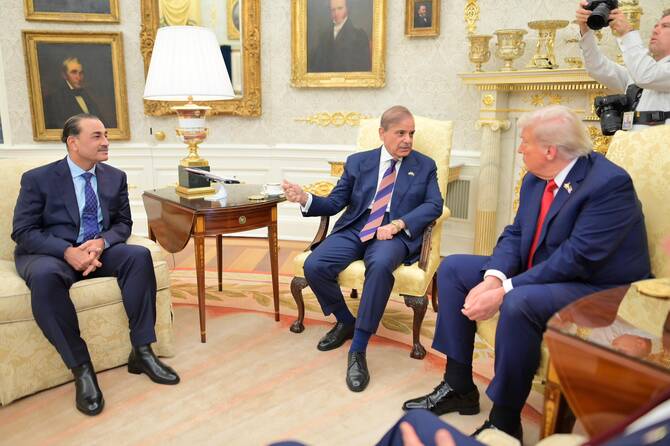
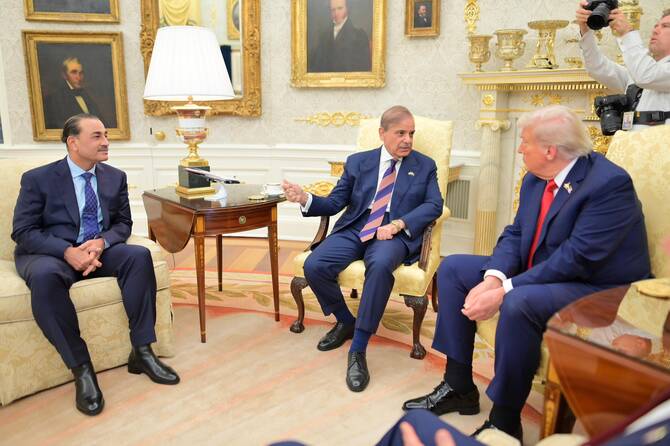
ISLAMABAD: Pakistani Prime Minister Shehbaz Sharif and Field Marshal Syed Asim Munir met US President Donald J. Trump at the White House on Thursday in a high-level engagement aimed at resetting relations between the two countries and expanding cooperation on security, trade and regional peace.
The Oval Office talks marked Sharif’s first meeting with Trump since the latter’s return to power earlier this year and the first joint appearance by Pakistan’s top civilian and military leadership before a US president in years. The meeting followed a precedent-setting White House lunch between Trump and Field Marshal Munir earlier this year — conducted without civilian officials present — and which came amid shifting geopolitical dynamics, including Washington’s increasingly strained ties with New Delhi.
By pairing civilian and military leadership in the same room with the US president, Pakistan is widely seen to be signaling a more coordinated foreign policy posture aimed at strengthening its influence in wider Middle Eastern and Asian security discussions.
During what the Pakistani prime minister’s office described as a “warm and cordial” meeting, Sharif said he was confident the talks would usher in a new phase in bilateral relations.
“Under President Trump’s leadership, the Pakistan-US partnership will be further strengthened to the mutual benefit of both countries,” Sharif was quoted as saying in a statement released by his office after the meeting.
Sharif and Munir arrived at the White House shortly before 5pm on Thursday as Trump was signing executive orders and talking with reporters. The meeting between the two leaders was closed to the media, with Pakistan’s delegation leaving the White House at 618pm.
Ties have improved between the US and Pakistan as Trump’s relationship with Indian Prime Minister Narendra Modi, one of the Republican president’s closest with a world leader during his first term, has become strained over India’s increased purchases of discounted Russian oil after Moscow invaded Ukraine in February 2022. India and Pakistan are neighbors and fierce rivals.
Trump has dramatically raised tariffs on India for those oil purchases in an effort to put indirect economic pressure on Moscow.
Meanwhile, the US and Pakistan reached a landmark trade agreement in July that is expected to allow Washington to help develop Pakistan’s largely untapped oil reserves and lower tariffs for Islamabad.
During Thursday’s meeting, Sharif invited American firms to invest in Pakistan’s agriculture, IT, minerals and energy sectors.
He also praised Trump as a “man of peace” whose “bold, courageous and decisive leadership” helped facilitate a ceasefire between Pakistan and India in May, averting what Islamabad said could have been a “major catastrophe in South Asia.”
The truce, brokered with US involvement, followed a four-day war in which the two nuclear-armed neighbors shared artillery, missile and drone strikes.
Security and counterterrorism cooperation featured prominently in the talks, with Sharif thanking Trump for his public endorsement of Pakistan’s counterterrorism role and calling for expanded intelligence collaboration.
Sharif has gained favor with Trump since publicly endorsing the American leader for a Nobel Peace Prize over his role in brokering the ceasefire with India. Unlike Sharif, Modi has declined to indulge Trump’s attempt to claim credit for arranging the truce.
Pakistan did split with Trump on his decision to carry out US strikes in June on three Iranian nuclear facilities.
Pakistan said the attack “constituted a serious violation of international law” as well as on the stature of the International Atomic Energy Agency.
MIDDLE EAST PEACE DISCUSSED
Discussions also turned to the Middle East, where Pakistan is taking an increasing role. The prime minister’s office said Sharif “lauded President Trump’s efforts to bring about an immediate end to the war in Gaza.”
Sharif was one of the leaders from Muslim-majority nations who met Trump earlier this week on the sidelines of the United Nations General Assembly.
The US President had presented them with a 21-point peace plan for the Middle East and Gaza, US special envoy Steve Witkoff said on Wednesday, adding that he is confident of “some sort of breakthrough.”
Pakistan is the only nuclear-armed Muslim-majority nation and also boasts the largest army among them.
With inputs from AP and Reuters