

Who recognizes the State of Palestine, who doesn’t, and why does it matter?

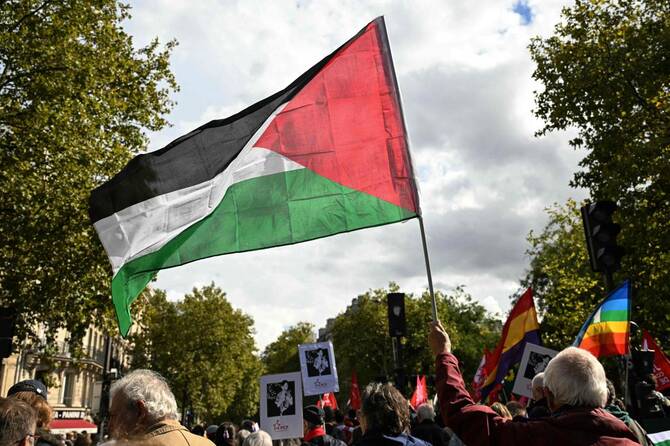
A protester waves a Palestinian flag during a march asking for the “recognition of the State of Palestine and the end of the genocide,” in Paris. (Bertrand Guay/AFP)
Short Url
Updated 21 September 2025
Follow

Who recognizes the State of Palestine, who doesn’t, and why does it matter?

  • At least 144 countries out of 193 UN members already recognize the State of Palestine
  • Algeria became the first country to officially recognize a Palestinian state on November 15, 1988

PARIS: Britain, Australia and Canada on Sunday recognized a Palestinian state after nearly two years of war in the Gaza Strip, with France, Belgium and other countries poised to follow suit at the United Nations General Assembly in New York.
Here is an overview of diplomatic recognition of the state, which was unilaterally proclaimed by the Palestinian leadership in exile in 1988.
Of the territory claimed by the state, Israel currently occupies the West Bank and the Gaza Strip is largely in ruins.

Which countries recognize or will recognize the State of Palestine?

Answer: three-quarters of UN members.
According to an AFP tally, at least 144 countries out of 193 UN members already recognize the State of Palestine.
AFP has not yet obtained recent confirmation from three African countries.
The count includes Britain and Canada — the first G7 countries to do so — and Australia.
Portugal was expected to follow suit soon, and several other countries including France, Belgium, Luxembourg and Malta are expected to do the same during a summit on the future of the two-state solution chaired by France and Saudi Arabia on Monday at UN headquarters.
Russia, alongside all Arab countries, almost all African and Latin American countries, and most Asian countries including India and China are already on the list.
Algeria became the first country to officially recognize a Palestinian state on November 15, 1988, minutes after late Palestine Liberation Organization (PLO) leader Yasser Arafat unilaterally proclaimed an independent Palestinian state.
Dozens of other countries followed suit in the following weeks and months, and another wave of recognitions came in late 2010 and early 2011.
The Israeli offensive in Gaza, which was sparked by the Palestinian Islamist organization Hamas’s attack in Israel on October 7, 2023, has already driven another 12 countries to recognize the state.

Who does not?

Answer: at least 46 countries, including Israel, the United States and their allies.
Israeli Prime Minister Benjamin Netanyahu’s government completely rejects the idea of a Palestinian state.
Japan, South Korea and Singapore are the Asian countries that do not recognize Palestine.
Neither does Cameroon in Africa, Panama in Latin America and most countries in Oceania.
Europe is the most divided continent on the issue, and is split almost 50-50 over Palestinian statehood.
Until the mid-2010s, the only countries recognizing the State of Palestine apart from Turkiye were those of the former Soviet bloc.
Now, some former Eastern-bloc countries such as Hungary and the Czech Republic do not recognize a Palestinian state at a bilateral level.
Western and northern Europe were until now united in non-recognition, with the exception of Sweden, which extended recognition in 2014.
But the war in Gaza has upended things, with Norway, Spain, Ireland and Slovenia following in Sweden’s footsteps to recognize the state in 2024, before the United Kingdom did so on Sunday.
Italy and Germany do not plan on recognizing a Palestinian state.

What does recognition mean?

Romain Le Boeuf, a professor in international law at the University of Aix-Marseille in southern France, described recognition of Palestinian statehood as “one of the most complicated questions” in international law, “a little like a halfway point between the political and juridical.”
He told AFP states were free to choose the timing and form of recognition, with great variations that are either explicit or implicit.
According to Le Boeuf, there is no office to register recognitions.
“The Palestinian Authority in the West Bank puts all they consider to be acts of recognition on its own list, but from a purely subjective point of view. In the same way, other states will say that they have or have not recognized, but without really having to justify themselves,” he said.
However, there is one point on which international law is quite clear: “Recognition does not mean that a state has been created, no more than the lack of recognition prevents the state from existing.”
While recognition carries largely symbolic and political weight, three-quarters of countries say “that Palestine meets all the necessary conditions to be a state,” he said.
“I know for many people this seems only symbolic, but actually in terms of symbolism, it is sort of a game changer,” lawyer and Franco-British law professor Philippe Sands wrote in the New York Times in mid-August 2025.
“Because once you recognize Palestinian statehood... you essentially put Palestine and Israel on level footing in terms of their treatment under international law.”


New Trump strategy vows shift from global role to regional

Updated 8 sec ago
Follow

New Trump strategy vows shift from global role to regional

WASHINGTON: President Donald Trump’s administration said in a long-awaited new strategy document Friday that the United States will shift from its historic global role toward increasing dominance in Latin America and vigorously fighting migration.
The national security paper, meant to flesh out Trump’s norms-shattering “America First” worldview, signals a sharp reorientation from longstanding US calls to refocus on Asia, although it still identifies China as a top competitor.
The strategy also brutally criticized allies in Europe and said that the United States will champion opponents to European Union-led values, including on immigration.
Breaking with decades of attempts to be the sole superpower, the strategy said that the “United States rejects the ill-fated concept of global domination for itself.”
It said that the United States would also prevent other powers from dominating but added: “This does not mean wasting blood and treasure to curtail the influence of all the world’s great and middle powers.”
The strategy called for a “readjustment of our global military presence to address urgent threats in our Hemisphere, and away from theaters whose relative import to American national security has declined in recent decades or years.”
The strategy speaks in bold terms of pressing US dominance in Latin America, where the Trump administration has been striking alleged drug traffickers at sea, intervening to bring down leftist leaders including in Venezuela, and loudly seeking to take charge of key resources such as the Panama Canal.
The strategy cast Trump as modernizing the two-century-old Monroe Doctrine, in which the then young United States declared Latin America off-limits to rival powers, then from Europe.
“We will assert and enforce a ‘Trump Corollary’ to the Monroe Doctrine,” it said.

- Championing Europe ‘resistance’ -

Trump has sharply reversed many longstanding US principles since returning to office in January.
He rose to political prominence demanding sweeping curbs on immigration to the United States, fanning fears that the white majority was losing its status, and since taking office has ordered drastic and high-profile raids to deport undocumented people.
“The era of mass migration must end. Border security is the primary element of national security,” the strategy said.
The strategy made clear that the United States under Trump would aggressively pursue similar objectives in Europe, in line with far-right parties that have made strong gains in much of the continent.
In extraordinary language in speaking of close allies, the strategy said: “Cultivating resistance to Europe’s current trajectory within European nations.”
Germany quickly hit back, saying that it does not need “outside advice.”
The strategy pointed to Europe’s lower share of the global economy — which is the result largely of the rise of China and other emerging powers — and said: “This economic decline is eclipsed by the real and more stark prospect of civilizational erasure.
“Should present trends continue, the continent will be unrecognizable in 20 years or less.”
As Trump seeks an end to the Ukraine war that would likely favor Russia gaining territory, the strategy accused Europeans of weakness and said the United States should focus on “ending the perception, and preventing the reality, of NATO as a perpetually expanding alliance.”

- Less on Middle East and Africa -

The strategy paid comparatively little attention to the Middle East, which has long consumed Washington.
Pointing to US efforts to increase energy supply at home and not in the oil-rich Gulf, the strategy said: “America’s historic reason for focusing on the Middle East will recede.”
The paper said it was a US priority for Israel to be secure, but stopped short of the fulsome language on Israel used even in the first Trump administration.
On China, the strategy repeated calls for a “free and open” Asia-Pacific region but focused more on the nation as an economic competitor.
After much speculation on whether Trump would budge on Taiwan, the self-ruling democracy claimed by Beijing, the strategy made clear that the United States supports the decades-old status quo, but called on allies Japan and South Korea to contribute more to ensure Taiwan’s defense from China.
The strategy predictably puts little focus on Africa, saying the United States should transition away from “liberal ideology” and an “aid-focused relationship” and emphasize goals such as securing critical minerals.