

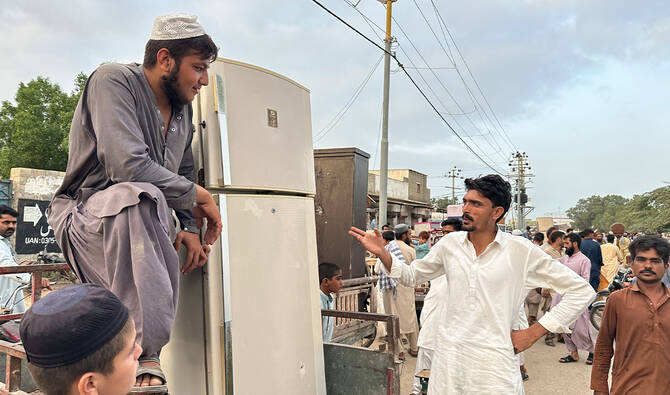

KARACHI: On an ordinary double-carriage road on the outskirts of Karachi, the hum of traffic gives way each afternoon to the bustling chaos of a makeshift market. Refrigerators, washing machines, fans, wardrobes and other household items are offered at throwaway prices.
For their Afghan owners, the sale is a painful necessity — a distress liquidation forced by uncertainty over their future in Pakistan amid an ongoing deportation drive.
“All this household stuff is not just things,” Muhammad Khan, a 32-year-old Afghan refugee, said. “These were ... dreams we worked hard to fulfill. Now, we are being forced to sell them.”

Afghan refugees sell household belongings at a makeshift market on the outskirts of Karachi, Pakistan, on September 19, 2025. (AN)
Born to refugee parents in a neighborhood called Afghan Basti on the outskirts of the city, Khan, 32, is among nearly 30,000 residents set to leave for Afghanistan in the coming week.
Pakistan launched a crackdown against illegal immigrants, mostly Afghans, in 2023, when its administration ordered all foreign nationals without valid documents to leave or face deportation.
The decision followed a string of deadly militant attacks that killed hundreds of people, with officials blaming Afghan citizens for involvement in multiple cases without providing evidence.
The authorities in Kabul denied Afghan nationals were part of the militant attacks and objected to their forced repatriation. However, Pakistan not only continued the deportations but also expanded the drive to include people with officially recognized status as refugees.
According to the International Organization for Migration and UN agencies, more than 860,000 Afghan nationals have left Pakistan since the plan began.
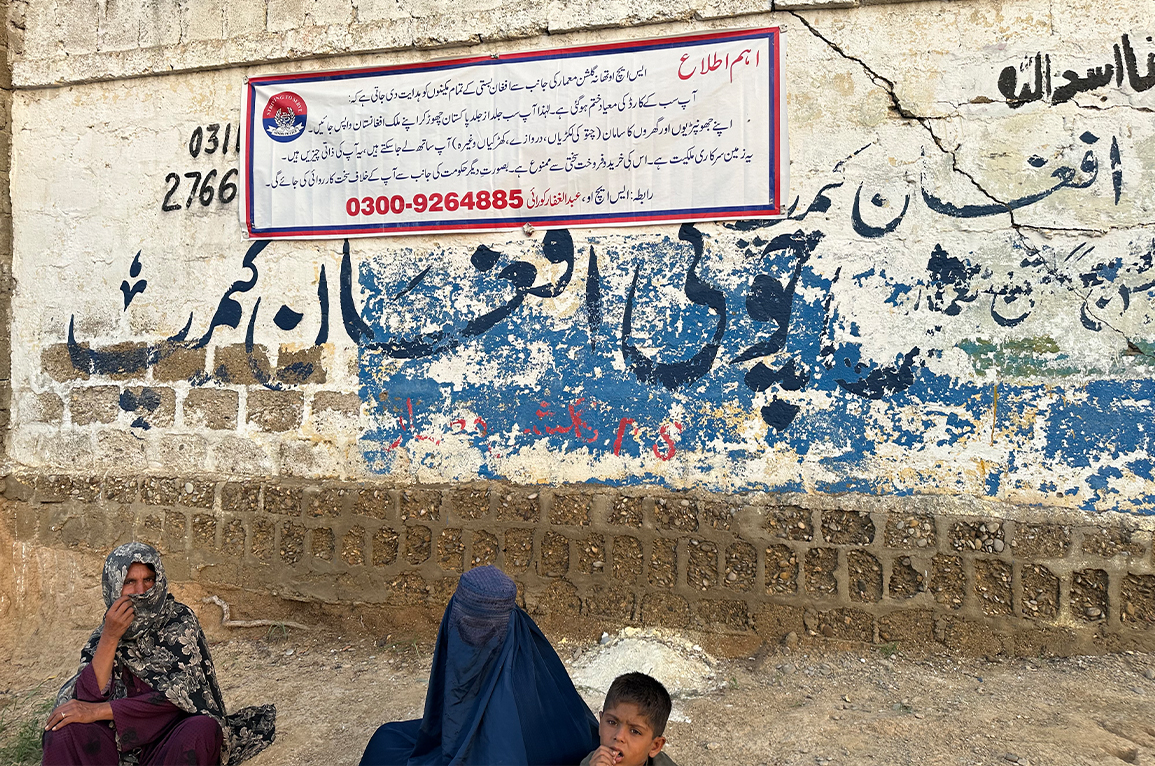
Afghan women sit by a wall bearing a banner warning them to leave Pakistan, at a refugee camp on the outskirts of Karachi, September 19, 2025. (AN)
Khan lamented the frantic, low-cost sale of his family’s possessions.
“We bought this fridge for Rs70,000 [$245], but right now it is only fetching Rs10,000 [$35],” he said. “We ask the government to give us enough time so buyers at least purchase our things for half the value.”
Maulana Rehmanullah, an elder in the Afghan settlement, described the difficulty of liquidating possessions under official restrictions.
“This freezer was bought for Rs105,000 [$368] by this brother, which he is now ready to sell for Rs75,000 [$263],” he said while pointing at an Afghan national. “No one is willing to buy it. It will probably be sold for a maximum of Rs40,000-45,000 [$140-158].”
He added most of the refugees were born in Pakistan and were now being forced to leave for a country they have never seen.
“My wife, my children are all born in Pakistan,” he added. “My sons and daughters are not ready to go. They call Pakistan their country.”

An Afghan refugee (right) sells a split air conditioner at a makeshift market on the outskirts of Karachi, Pakistan, on September 19, 2025. (AN)
Residents like Noor Agha, whose family of 10 relied on a fries cart for daily income, said something his family lived with will be sold very cheaply.
“I bought this fries cart for Rs55,000 [$193],” he said. “The people in our area would purchase chips from me. It’s now lying here in the middle of the road and they are offering Rs17,000-18,000 [$60-63].”
Abdullah, another refugee born and raised in Karachi who goes by a single name, said he had invested heavily in property, vehicles and business ventures.
He spent Rs3.5 million [$12,280] to build a home. Yet, a board outside a nearby police check post prohibits refugees from selling immovable property. The few items they can sell fetch far less than half their value.
“If we go to Afghanistan now, there is no work, no employment,” he said.
For local buyers, the market offers an opportunity to acquire goods at discounted prices.
Zahihullah Khan, a painter from nearby Muslim Goth, purchased fans for Rs2,700 [$9], which would have cost him Rs7,000 [$25] in a retail shop.
“Our Afghan brothers who are leaving are selling their belongings at a low price because they are returning to their country. I came here so that I could buy some things and take them home,” he said.
For the sellers of these items, the economic and emotional toll is profound.
Families who have lived, worked and built communities in Pakistan for decades are now leaving under compulsion, with minimal compensation for years of effort and investment.
“Forty-five years of their hard work has gone to waste,” Rehmanullah said. “They came empty-handed from Afghanistan, and they will leave empty-handed.”


