NEW DELHI/BRASILIA: This is a story about a bird and a family. But this is no ordinary bird, and this is no ordinary family.
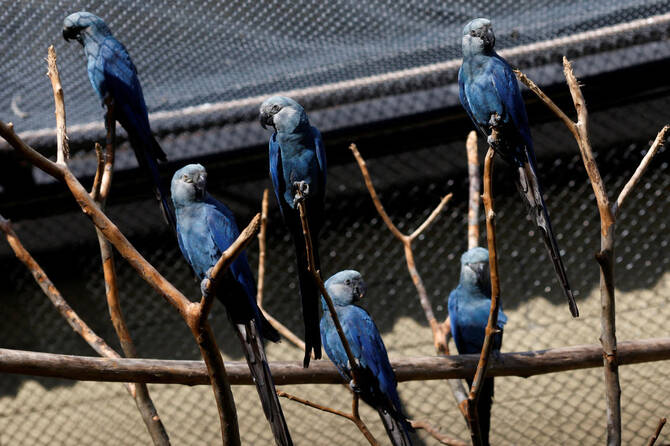
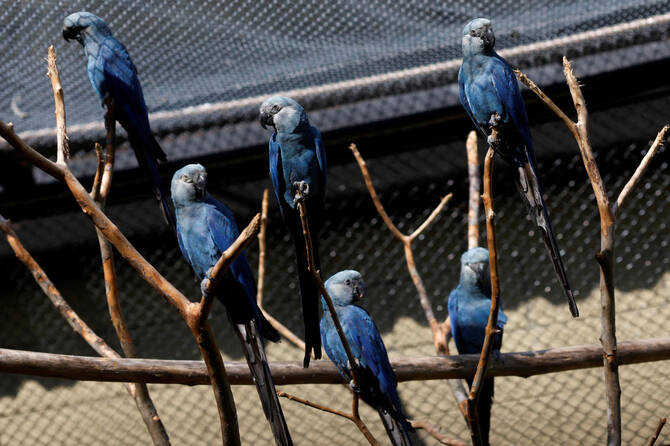
Spix’s macaw, a vivid-blue parrot with elaborate mating rituals, was declared extinct in the wild in 2019. A captive-breeding program has since seen some of the birds reintroduced to their native habitat in Brazil.
For more than two years, officials on three continents have been agitating over why 26 of the creatures ended up at a private zoo in India run by the philanthropic arm of a conglomerate controlled by Asia’s richest family, the Ambanis. Indian investigators cleared the sanctuary of any wrongdoing this week. But European officials say they are keeping a close watch on any exports to Vantara, while Brazil, Germany and India are working toward a possible resolution at a United Nations-administered body that monitors wildlife trade. The 3,500-acre Vantara animal rescue and rehabilitation center in Gujarat state says it is home to some 2,000 species. The venue featured in pre-wedding celebrations last year for the center’s leader Anant Ambani, the youngest son of billionaire Mukesh Ambani, whose guests included Ivanka Trump and Mark Zuckerberg.
The zoo, adjacent to an oil refinery operated by the Ambanis’ Reliance Industries, was inaugurated in March by Indian Prime Minister Narendra Modi.
A Reuters analysis of 2,500 commercially available customs records shows that since 2022, the wildlife center has imported an extraordinary range of exotic species from countries including South Africa, Venezuela, Democratic Republic of Congo and the UAE.
The haul resembles a modern-day Noah’s Ark: 2,896 snakes, 1,431 tortoises, 219 tigers, 149 cheetahs, 105 giraffes, 62 chimpanzees, 20 rhinoceroses and scores of reptiles, including spiny-tailed lizards and veiled chameleons.
The shipments were recorded with a declared value of $9 million, which a Vantara spokesperson said reflected freight and insurance charges, not payments for wildlife.
“They are not commercial transactions in animals,” the spokesperson said. “There has never been any commercial consideration paid for any animal transferred to Vantara.” In August, India’s Supreme Court ordered investigators to examine whether Vantara’s acquisitions and treatment of animals complied with Indian laws and the Convention on International Trade in Endangered Species of Wild Fauna and Flora (CITES). The court this week said investigators found no illegality.
This parrot isn’t dead, it’s in India
The biggest bone of contention has revolved around the Spix’s macaws that the park sourced in 2023 from the Association for the Conservation of Threatened Parrots (ACTP), a Germany-based non-profit that had partnered with Brazilian authorities to breed the birds, according to customs records, Brazilian officials and CITES documents.
The macaws’ journey is detailed in a customs bill of entry seen by Reuters. It shows the birds were flown to Ahmedabad from Berlin on February 4, 2023, with costs, insurance and freight amounting to $969 per macaw, for a total of $25,194. Customs taxes and local duties of $19,000 were waived in line with Indian practice.
Brazil says it didn’t consent to the parrots’ passage to India, and has raised its concerns at CITES meetings.
“The Vantara zoo has not yet joined the Spix’s Macaw Population Management Program, which is a fundamental condition for the official involvement of this institution in the species conservation effort,” the Chico Mendes Institute for Biodiversity Conservation, a Brazilian government agency, said by email on September 8.
“At the moment, no Indian institutions are participating in the program, so there is no reason for Spix’s macaws to be sent to India.”
Brazil ended its agreement with ACTP last year, saying the group had sent Spix’s macaws to other countries in “commercial transactions” without Brazilian consent. The nonprofit has previously denied that the parrots’ transfer was commercial in nature; it didn’t respond to a request for comment.
The Vantara spokesperson said the macaws’ transfer was “entirely lawful, non-commercial, and undertaken as a conservation breeding arrangement with ACTP.”
India’s Central Zoo Authority didn’t respond to queries.
Germany’s federal environment ministry said it had cleared the 2023 transfer of macaws to Vantara in “good faith,” but didn’t consult Brazil at the time.
Last year, after consulting with Brazilian authorities, Germany rejected an application for a further transfer of Spix’s macaws to Vantara on the grounds that the zoo was “not a participant” in the species’ population management program, a ministry spokesperson said.
“This decision is currently subject to legal proceedings,” the spokesperson added, declining to elaborate.
Popcorn for elephants
In the year ended March 2024, only 20 percent of the 6,355 animals that reached Vantara came from India, the center’s annual report shows. Overall, it has imported species from 40 countries.
Vantara developed from barren land in 2020 to an area of manicured lawns and jungle-like greenery, satellite imagery provided by Maxar Technologies shows.
In media tours, Anant Ambani has showcased kitchens stocked with premium products used to prepare fresh juices, sweets, and even popcorn as treats for elephants.
When Modi visited Vantara this year, his office released an eight-minute video of him feeding lion cubs, elephants, rhinos and giraffes. One picture showed a Spix’s macaw perched on a prime ministerial hand.
India’s government defended Vantara at CITES meetings in Geneva in February, saying the facility is a “recognized center for conservation breeding,” according to a summary published by CITES.
CITES documents published ahead of its next meeting in November show progress in resolving the inquisition. The CITES Secretariat said there had been consultations involving Brazil, India and Germany, and that Brazilian officials would provide an update.
Still, European officials recently indicated they are keeping an eagle eye on any applications to ship wildlife to Vantara.
In an August 1 response to a lawmaker’s concerns about wildlife trade, European Environment Commissioner Jessika Roswall said EU states “will pay particular attention to any export requests directed toward India and the facility in question” and assess them with “increased scrutiny.” Roswall’s action hasn’t been previously reported.
Judges in New Delhi this week released a summary of the Indian investigators’ report.
Among the findings: The export-import permits for Spix’s macaws were in order, and Vantara was now holding direct talks with Brazil about “rewilding.”
“Their deliberations are at a preliminary stage,” it said.


![]()
Feathers fly in dispute over Ambani zoo’s pursuit of rare parrot
Short Url
https://arab.news/4w5v5
Feathers fly in dispute over Ambani zoo’s pursuit of rare parrot
- Vantara has imported animals from many nations; denies commercial payments
- Brazil has raised concerns about transfer of Spix’s macaws to India


Latest updates






© 2026 SAUDI RESEARCH & PUBLISHING COMPANY, All Rights Reserved And subject to Terms of Use Agreement.