MIAMI: Less than three years after President Joe Biden pardoned a close ally of Nicolás Maduro, the Justice Department is once again targeting the businessman, The Associated Press has learned, an investigation that could bolster the US prosecution of the deposed Venezuelan leader.
Federal prosecutors for months have been digging into Alex Saab’s role in an alleged bribery conspiracy involving Venezuelan government contracts to import food, according to two former law enforcement officials who spoke to AP about the ongoing probe on the condition of anonymity.
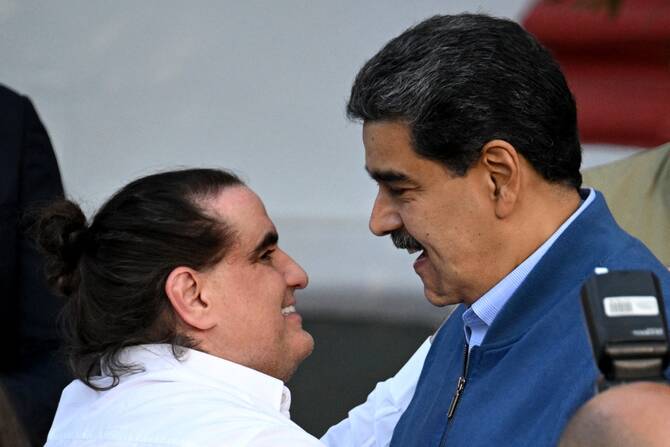
Saab, 54, amassed a fortune through Venezuelan government contracts. But the Colombian-born businessman, long described by US officials as Maduro’s “bag man,” fell out of favor with the country’s new leadership that took power following the US ouster of the Venezuelan president last month.
The Justice Department’s newfound interest in Saab is taking place against the backdrop of the Trump administration’s efforts to stabilize relations with the oil-rich nation. The investigation stems from a 2021 case the Justice Department brought against Saab’s longtime partner, Alvaro Pulido, the former law enforcement officials said. That prosecution, out of Miami, centers around the so-called CLAP program set up by Maduro to provide staples — rice, corn flour, cooking oil — to poor Venezuelans struggling to feed themselves at a time of rampant hyperinflation and a crumbling currency.
The renewed scrutiny marks a reversal of fortunes for Saab, who escaped an earlier US prosecution for an unrelated bribery scheme after Biden pardoned him as part of a prisoner swap for several Americans jailed in Venezuela.
His whereabouts remained unknown Tuesday, days after conflicting news accounts suggested he had been detained or brought in for questioning – at least temporarily – by officials in Venezuela at the request of the Trump administration.
Neither US officials nor acting President Delcy Rodriguez’s government has commented. Luigi Giuliano, an Italian attorney, said he met Saab last week in the Venezuelan capital and denied he was detained but declined further comment. Saab’s US attorney, Neil Schuster, also didn’t comment.
Since taking over from Maduro on Jan. 3, Rodríguez has demoted Saab, firing him from her cabinet and stripping him of his role as the main conduit for foreign companies looking to invest in Venezuela.
Biden pardons Saab over objections by law enforcement
Over the objections of law enforcement, Biden in 2023 agreed to free Saab in exchange for the release of several imprisoned Americans and Venezuela’s return of a fugitive foreign defense contractor known as “Fat Leonard.” The deal came as part of an effort by the Biden White House to roll back sanctions and lure Maduro into holding a free and fair presidential election.
Fresh charges against individuals previously granted clemency are rare and can only be secured for crimes committed outside the defined scope of the pardon, said Frank Bowman, a professor emeritus at the University of Missouri School of Law who is writing a book on pardons.
Saab’s pardon was narrowly tailored to a 2019 indictment — the case number is cited in the pardon itself — related to a contract he and Pulido allegedly won through bribes to build low-income housing units in Venezuela that were never built.
Saab’s pardon came with a number of conditions, Bowman noted, including that he remain outside the United States and not commit any further crimes against it. “This is a voidable pardon,” he said.
Insider connections fuel Saab’s rise
In Venezuela’s graft-ridden patronage system, where loyalty and insider connections are paramount, few insiders prospered like Saab. He first came onto the radar of the US Drug Enforcement Administration more than a decade ago, after amassing a large number of contracts with Maduro’s socialist administration.
In 2016, a pro-Maduro governor allegedly hired a company controlled by Pulido to import from Mexico 10 million food boxes at $34 per box. He allegedly did so knowing that the real cost of purchasing and sending the boxes to Venezuela was far less and demanded kickbacks. One of those who allegedly signed off on the deal and helped set up a web of companies to hide the bribe payments was Saab, who is identified in the indictment as “Co-Conspirator 1.”
Saab was arrested in 2020 after his private jet made a refueling stop in Cape Verde en route to Iran on what the Venezuelan government described as a humanitarian mission to circumvent US sanctions.
Maduro celebrated Saab’s return in 2023 as a “triumph for truth” over what he called a US-led campaign of lies, threats and torture against someone he considered a Venezuelan diplomat. But several Republicans criticized the deal, including Sen. Chuck Grassley, of Iowa, who wrote a letter to then-Attorney General Merrick Garland saying history “should remember as a predator of vulnerable people.”
The White House did not respond to requests for comment on the federal investigation of Saab. The Justice Department and FBI declined to comment.
Witness against Maduro?
Should he be returned to US custody, Saab could become a valuable witness against Maduro, the former law enforcement officials said. Saab secretly met with the DEA before his first arrest and, in a closed-door court hearing in 2022, his lawyers revealed that the businessman, for years, helped the DEA untangle corruption in Maduro’s inner circle. As part of that cooperation, he forfeited more than $12 million in illegal proceeds from dirty business dealings.
David Weinstein, a former federal prosecutor in Miami, said Saab could be a valuable character witness against Maduro even if he himself has not been charged with drug trafficking like the former Venezuelan leader.
“The indictment against Maduro contained a lot of salacious allegations, but there was little in the way of corroboration,” said Weinstein. “Saab, if the reports about his own criminal activity and closeness to Maduro are true, can describe for jurors a range of criminal activity that is alleged to have taken place across Maduro’s government.”
Saab also has ties to Rodríguez, the Trump administration’s preferred partner to succeed Maduro. The AP reported last month that the DEA has examined Rodríguez’s involvement in government contracts awarded to Saab. The US government has never publicly accused Rodríguez of any criminal wrongdoing.


![]()

Close Maduro ally pardoned by Biden once again a target of US criminal investigation
Short Url
https://arab.news/y4v3q
Close Maduro ally pardoned by Biden once again a target of US criminal investigation
Latest updates




© 2026 SAUDI RESEARCH & PUBLISHING COMPANY, All Rights Reserved And subject to Terms of Use Agreement.