

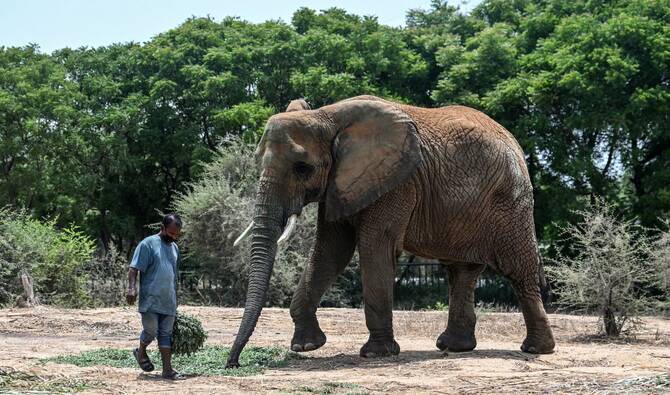
Jumbo journey as Indian elephant set to return home

The story of the 36-year-old elephant called Madhuri reflects both the passion that some communities have for elephants in India -- and the mind-boggling scale of the self-declared "world's biggest wild animal rescue centre". (AFP/File)
Short Url
Updated 06 August 2025
Follow

Jumbo journey as Indian elephant set to return home

  • The elephant spent her adult life at a Jain monastery in Kolhapur in Maharashtra state
  • The often chained animal killed a monk in the temple in 2017

NEW DELHI: An Indian elephant taken on an epic journey to a tycoon’s giant zoo is expected to return home after protests by the religious community she came from, officials said Wednesday, following a court battle over the animal’s welfare at the temple.

The story of the 36-year-old elephant called Madhuri reflects both the passion that some communities have for elephants in India — and the mind-boggling scale of the self-declared “world’s biggest wild animal rescue center.”

The elephant spent her adult life at a Jain monastery in Kolhapur in Maharashtra state — where campaigners from People for the Ethical Treatment of Animals (PETA) India said she experienced “cruel and bleak living conditions.”

The often chained animal killed a monk in the temple in 2017 when she lashed out in frustration, and a court in 2024 ordered she be rehabilitated after a complex legal battle.

Madhuri was taken more than 1,100 kilometers (700 miles) to the Vantara Animal Rescue Center, run by Anant Ambani, son of the billionaire head of Reliance Industries Mukesh Ambani, arriving in July.

Vantara is a vast operation that includes more than 200 elephants, as well as more than 50 bears, 160 tigers, 200 lions, 250 leopards and 900 crocodiles.

It was also among the many venues for Anant Ambani’s lavish multi-day wedding celebrations in 2024, parties that set a new benchmark in matrimonial extravagance — including private performances by R&B star Rihanna, Justin Bieber, Katy Perry and Italian tenor Andrea Bocelli.

Elephants taken to the zoo are usually transported by road in “elephant ambulances” — specially adapted trucks — accompanied by a large team including vets.

Vantara said Madhuri was given veterinary care, and space to roam alongside other elephants.

Activists offered a rubberised “anti-cruelty” mechanical elephant model to the monastery as a replacement.

But thousands marched on Sunday in Kolhapur demanding the real elephant be returned.

Vantara on Wednesday offered a solution, acknowledging the “deep religious and cultural significance” that the elephant holds.

It proposed to house the elephant at a special rehabilitation center near the temple — which would include pools to ease the elephant’s arthritis and open spaces.

Maharashtra Chief Minister Devendra Fadnavis on Wednesday said in a statement that he had “good news” that Vantara would join a court petition “for the smooth passage of the elephant Madhuri back.”

Vantara said that, subject to court approval, it “will provide complete technical and veterinary assistance for her safe and dignified return.”

PETA says the more than 2,700 captive elephants in India often face “severe physical and psychological stress.”

When the herd animals are not chained up, they are used in temple ceremonies, paraded through packed crowds with flashing lights and ear-splitting music.


Egypt reveals restored colossal statues of pharaoh in Luxor

Updated 14 December 2025
Follow

Egypt reveals restored colossal statues of pharaoh in Luxor

  • Amenhotep III, one of the most prominent pharaohs, ruled during the 500 years of the New Kingdom, which was the most prosperous time for ancient Egypt

LUXOR: Egypt on Sunday revealed the revamp of two colossal statues of a prominent pharaoh in the southern city of Luxor, the latest in the government’s archeological events that aim at drawing more tourists to the country.
The giant alabaster statues, known as the Colossi of Memnon, were reassembled in a renovation project that lasted about two decades. They represent Amenhotep III, who ruled ancient Egypt about 3,400 years ago.
“Today we are celebrating, actually, the finishing and the erecting of these two colossal statues,” Mohamed Ismail, secretary-general of the Supreme Council of Antiquities, said ahead of the ceremony.
Ismail said the colossi are of great significance to Luxor, a city known for its ancient temples and other antiquities. They’re also an attempt to “revive how this funerary temple of King Amenhotep III looked like a long time ago,” Ismail said.
Amenhotep III, one of the most prominent pharaohs, ruled during the 500 years of the New Kingdom, which was the most prosperous time for ancient Egypt. The pharaoh, whose mummy is showcased at a Cairo museum, ruled between 1390–1353 BC, a peaceful period known for its prosperity and great construction, including his mortuary temple, where the Colossi of Memnon are located, and another temple, Soleb, in Nubia.
The colossi were toppled by a strong earthquake in about 1200 BC that also destroyed Amenhotep III’s funerary temple, said Ismail.
They were fragmented and partly quarried away, with their pedestals dispersed. Some of their blocks were reused in the Karnak temple, but archeologists brought them back to rebuild the colossi, according to the Antiquities Ministry.
In late 1990s, an Egyptian German mission, chaired by German Egyptologist Hourig Sourouzian, began working in the temple area, including the assembly and renovation of the colossi.
“This project has in mind … to save the last remains of a once-prestigious temple,” she said.
The statues show Amenhotep III seated with hands resting on his thighs, with their faces looking eastward toward the Nile and the rising sun. They wear the nemes headdress surmounted by the double crowns and the pleated royal kilt, which symbolizes the pharaoh’s rule.
Two other small statues on the pharaoh’s feet depict his wife, Tiye.
The colossi — 14.5 meters and 13.6 meters respectively — preside over the entrance of the king’s temple on the western bank of the Nile. The 35-hectare complex is believed to be the largest and richest temple in Egypt and is usually compared to the temple of Karnak, also in Luxor.
The colossi were hewn in Egyptian alabaster from the quarries of Hatnub, in Middle Egypt. They were fixed on large pedestals with inscriptions showing the name of the temple, as well as the quarry.
Unlike other monumental sculptures of ancient Egypt, the colossi were partly compiled with pieces sculpted separately, which were fixed into each statue’s main monolithic alabaster core, the ministry said.
Sunday’s unveiling in Luxor came just six weeks after the inauguration of the long-delayed Grand Egyptian Museum, the centerpiece of the government’s bid to boost the country’s tourism industry. The mega project is located near the famed Giza Pyramids and the Sphinx.
In recent years, the sector has started to recover after the coronavirus pandemic and amid Russia’s war on Ukraine — both countries are major sources of tourists visiting Egypt.
“This site is going to be a point of interest for years to come,” said Tourism and Antiquities Minister Sherif Fathy, who attended the unveiling ceremony. “There are always new things happening in Luxor.”
A record number of about 15.7 million tourists visited Egypt in 2024, contributing about 8 percent of the country’s GDP, according to official figures.
Fathy, the minister, has said about 18 million tourists are expected to visit the country this year, with authorities hoping for 30 million visitors annually by 2032.
