

Pakistan Air Force conducts ‘Exercise Golden Eagle’ to test combat readiness, agility

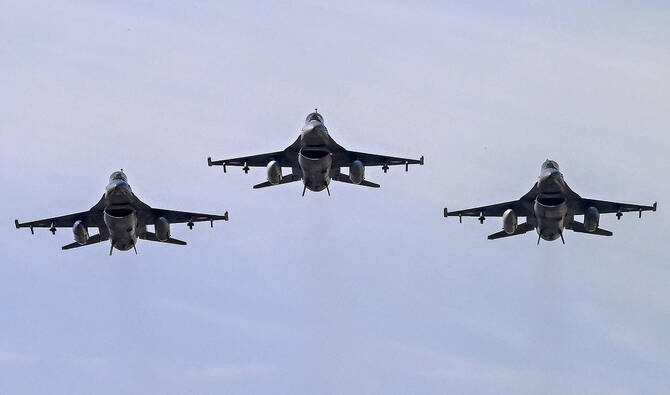
Pakistan Air Force F-16 fighter jets fly past over the President's House during the national day parade in Islamabad on March 23, 2025. (AFP/ file)
Short Url
Updated 10 February 2026
Follow

Pakistan Air Force conducts ‘Exercise Golden Eagle’ to test combat readiness, agility

  • The exercise follows an intense, four-day Pakistan-India military conflict in May 2025
  • It focused on AI-enabled operations integrating disruptive technologies, military says

ISLAMABAD: The Pakistan Air Force (PAF) has conducted “Exercise Golden Eagle” that successfully validated its combat readiness and operational agility through synchronized employment of the PAF’s complete combat potential, the Pakistani military said on Tuesday.

It comes months after Pakistan’s four-day military conflict with India in May, with Islamabad claiming victory in the standoff after the PAF claimed to have shot down at least six Indian fighter aircraft, including the French-made Rafale. New Delhi acknowledged some losses but did not specify a number.

The exercise was conducted on a Two-Force construct, focusing on AI-enabled, net-centric operations while integrating indigenous niche, disruptive and smart technologies in line with evolving regional security dynamics, according to the Inter-Services Public Relations (ISPR), the Pakistani military’s media wing.

Operating within a robust Integrated Air Defense System, friendly forces shaped the battlespace through seamless fusion of kinetic operations with cyber, space and electro-magnetic spectrum operations.

“The kinetic phase featured First-Shoot, First-Kill swing-role combat aircraft equipped with long-range BVR air-to-air missiles, extended-range stand-off weapons and precision strike capabilities, supported by Airborne Early Warning & Control platforms and Air-to-Air Refuelers,” the ISPR said in a statement.

“A key highlight of the exercise was Manned–Unmanned Teaming, with deep-reach killer drones and loitering munitions operating in a highly contested, congested and degraded environment, validating PAF’s capability to conduct high-tempo operations in modern warfare.”

In recent months, many countries have stepped up defense engagement with Pakistan, while delegations from multiple nations have proposed learning from the PAF’s multi-domain air warfare capabilities that officials say were successfully employed during the May conflict.

“The successful conduct of Exercise Golden Eagle reaffirms Pakistan Air Force’s unwavering commitment to maintaining a high state of operational preparedness, leveraging indigenous innovation and effectively countering emerging and future security challenges,” the ISPR added.


Pakistan raises fuel prices by Rs55 per liter as Middle East conflict drives oil surge

Updated 06 March 2026
Follow

Pakistan raises fuel prices by Rs55 per liter as Middle East conflict drives oil surge

  • Government says adequate fuel stocks in place despite global energy shock
  • Oil prices jump from about $78 to over $106 per barrel amid regional conflict

ISLAMABAD: Pakistan on Friday increased petrol and diesel prices by Rs55 ($0.20) per liter each as escalating conflict in the Middle East sent global oil prices sharply higher and disrupted energy supply routes, officials said.

Global oil markets have been rattled since coordinated strikes by the United States and Israel against Iran began last week, triggering retaliatory attacks across the region, raising fears of disruption to key energy shipping routes and pushing petroleum prices sharply upward.

The price adjustment in Pakistan was announced after a joint press conference by Finance Minister Muhammad Aurangzeb, Deputy Prime Minister and Foreign Minister Ishaq Dar and Petroleum Minister Ali Pervaiz Malik, who said the government was monitoring international energy markets and domestic supply conditions amid the crisis.

“So, the decision we have made by changing the levy a little bit is that we are going ahead with increasing the price of both fuels, petrol and diesel, by Rs55 ($0.20),” Malik told reporters. 

“And as soon as this matter settles, we will revise the prices downward with the same speed and take steps on how to increase people’s income and purchasing power.”

He said Pakistan entered the crisis with “comfortable energy reserves” due to earlier planning but rising global prices had forced the government to adjust domestic fuel rates to maintain supply continuity.

He said international petrol prices had climbed from roughly $78 per barrel on March 1 to around $106.8 per barrel, while diesel prices had risen to about $150 per barrel.

Malik added that the government had taken steps to minimize the burden on consumers, noting diesel plays a critical role in agriculture, transportation and public mobility.

Malik also warned that authorities would take strict action against anyone attempting to hoard fuel or manipulate supply for profiteering.

The minister said Pakistan was working with international partners to secure additional energy supplies, including arrangements with Saudi Aramco and the use of Pakistan National Shipping Corporation vessels to transport crude oil imports.

Finance Minister Aurangzeb said a high-level government committee formed by Prime Minister Shehbaz Sharif had been meeting daily to review developments in global petroleum markets and their potential impact on Pakistan’s economy.

“Pakistan currently maintains adequate energy stocks and macroeconomic stability,” Aurangzeb said, adding that the government’s response was based on preparedness rather than panic.

He said the committee, which includes senior ministers, the governor of the State Bank of Pakistan and other officials, was assessing short-, medium- and long-term implications of the crisis for inflation, foreign exchange reserves and broader economic indicators.

Deputy PM Dar said the regional conflict had significantly disrupted global energy markets, with international petroleum prices rising by as much as 50–70 percent in recent days.

The deputy prime minister added that Pakistan was also engaged in diplomatic efforts aimed at de-escalating tensions and restoring stability in the region.

Petroleum prices will now be reviewed more frequently, potentially on a weekly basis, and any reduction in global oil prices would be passed on to consumers.

Pakistan, which relies heavily on imported fuel to meet its energy needs, is particularly vulnerable to global oil price shocks that can quickly feed into inflation and pressure the country’s external accounts.