

Nepal returns to calm as first woman PM takes charge

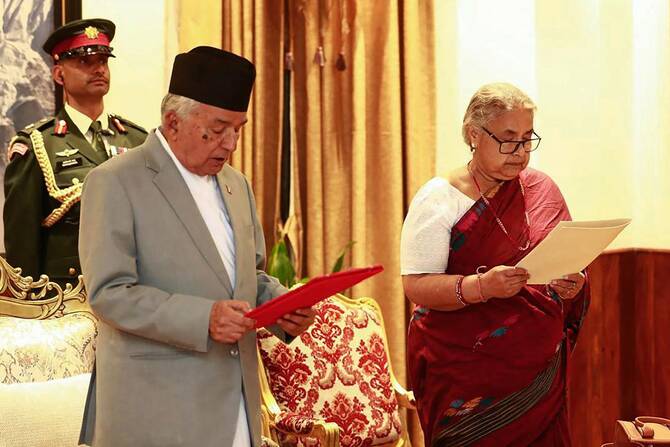
Nepal's President Ram Chandra Paudel (L) administers the oath to the country's newly appointed Prime Minister Sushila Karki during her swearing-in-ceremony at the President House in Kathmandu on September 12, 2025. (AFP)
Short Url
Updated 13 September 2025
Follow

Nepal returns to calm as first woman PM takes charge

KATMANDU: Nepal’s capital on Saturday took a step back toward normality after deadly anti-corruption protests, as daily life returned with a curfew eased and an interim prime minister sworn into office.
Soldiers scaled back their presence on the streets, where they had been deployed in large numbers since Wednesday after violent demonstrations toppled the government and left parliament in flames.
At least 51 people were killed in the worst unrest since the end of a decade-long civil war and the abolition of the monarchy in 2008.
On Friday evening, 73-year-old former chief justice Sushila Karki was sworn in as interim leader, tasked with restoring order and addressing protesters’ demands for a corruption-free future.
Parliament was later dissolved, elections set for March 5, 2026, and work to restore the government began.
By Saturday morning, the mood on the streets was calmer, with markets opening, traffic returning and families visiting temples.

’Satisfied today’

For many Nepalis, Karki’s appointment carried both symbolic weight and the promise of change.
“Nepal has got its first woman prime minister,” said Suraj Bhattarai, 51, a social worker.
“We think that the prime minister — our former chief justice — will address Nepal’s fight against corruption and take good governance forward.”
The appointment of Karki, known for her independence, came after intense negotiations by army chief General Ashok Raj Sigdel and President Ram Chandra Paudel, including with “Gen Z” representatives, the loose umbrella title of the youth protest movement.
Thousands of young activists had used the app Discord to debate the next steps — and name Karki as their choice of next leader.
The new prime minster appeared to be widely welcomed as people sought to put the unrest behind them.
“The interim government decision is good for now,” said Durga Magar, 23, who works in a Katmandu shop.
“The main issue for the people, especially young people, at this time is corruption,” she said.
“It doesn’t matter whether it is Gen Z, or anyone older in politics who tackles it — it just needs to stop,” she added.
Protests, which began Monday and escalated on Tuesday, fed into long-standing economic woes in Nepal.
A fifth of people aged 15-24 are unemployed, according to the World Bank, with GDP per capita standing at just $1,447.
“We don’t know what will happen in the future now but we are satisfied today and hope it will not remain as tense ahead,” Magar added.

’Musical chairs’

Indian Prime Minister Narendra Modi on Saturday offered his “best wishes” to Karki, adding that New Delhi was “firmly committed to the peace, progress and prosperity of the people of Nepal.”
Huge challenges remain.
The protesters’ hope of rooting out endemic corruption is no easy task, while in terms of security, more than 12,500 prisoners who escaped from jails during the chaos are on the run.
But for many, Karki’s swearing-in marks a break from the revolving door of aging prime ministers who fueled public anger with endless political horse-trading.
KP Sharma Oli, the 73-year-old leader of the Communist Party, quit as prime minister on Tuesday, ending his fourth term in the post. His whereabouts are not known.
“They were playing a game of musical chairs,” said Katmandu businessman Shikhar Bajracharya, 32.
“There was no possibility for younger people to come into power.”


What Bangladesh’s election means for India, China and Pakistan ties

Bangladesh Nationalist Party supporters gather for a rally ahead of the upcoming national election, in Sylhet on Jan. 22, 2026.
Updated 08 February 2026
Follow

What Bangladesh’s election means for India, China and Pakistan ties

  • Bangladeshis will vote on Feb. 12, almost two years after the 2024 student-led uprising
  • After nearly 2 years of tensions, experts expect a thaw with India under elected government

DHAKA: As Bangladesh prepares to hold its first elections since the 2024 ouster of Sheikh Hasina, its longest-serving prime minister, the outcome will define Dhaka’s relations with the most important regional powers — China, India, and Pakistan.

Nearly 128 million Bangladeshis will head to the polls on Feb. 12 to bring in new leadership after an 18-month rule of the current caretaker administration.

The interim government, led by Nobel laureate Muhammad Yunus, took control following a student-led uprising that ended 15 years in power of Hasina and her Awami League party.

The two main parties out of the 51 competing for power are the Bangladesh Nationalist Party and Jamaat-e-Islami. The Awami League, which for decades has had close ties with India, was excluded from the election ballot over its role in the deadly crackdown on the 2024 student-led protests, in which 1,400 people were killed.

While Bangladesh’s relationship India has deteriorated since the fall of Hasina, who has been in self-exile in New Delhi, the period of diplomatic strain is expected to ease when the new government takes office.

“Whoever comes to power in Bangladesh, due to domestic pressure in the country, relationships with India need a resetting,” Humayun Kabir, former ambassador to the US, told Arab News.

“It’s anticipated that India will also engage with the new government, but they will protect their interests, and we also have to do the same. It’s most likely that the India-Bangladesh relationship will be normalized under the new, elected, government.”

Since 2024, India has suspended key transshipment access that allowed Bangladeshi exports to go via Indian ports and airports. It also put on hold most normal visa services for Bangladeshis, who were among its largest groups of medical tourists.

From Hasina’s heavy pro-India orientation, the interim government has tried to rebalance Bangladesh’s foreign policy toward the two other key regional players — China and Pakistan — who at the same time are India’s main rivals. 

If New Delhi regains its importance, it should not deal a blow to the newly expanded relations with Pakistan, with whom Bangladesh has recently increased exchanges, especially economic, and last month resumed direct flights — after a 14-year gap.

Since the relations have been expanded under the caretaker government, Prof. Delwar Hossain from the International Relations Department at Dhaka University forecast that they would only further improve, no matter who comes to power, and there is no likelihood of a sudden change.

“For Pakistan, any political coalition — whether BNP or Jamaat — will be positive. The BNP has a long history of having good relations with Pakistan during their rule ... Jamaat also has a strong and very positive influence in Pakistan,” he said.

“For Pakistan, the new regime or new government is not the issue. The issue is what the (India) policy of the new government would be and to what extent it would actually support Pakistan’s view.”

Both the BNP and Jamaat have repeatedly said they wanted friendly relations with India, and Hossain expected that they would, at the same time, continue the balanced approach introduced by the caretaker administration.

“India is a reality as a neighbor. At the same time, India is also showing interest in mending relations or adopting a more cooperative approach after the vote, with the government that will be elected ... I think there will be pragmatism from both sides,” he said.

“I don’t see there is a long-term threat to Bangladesh-India relations ... When China and Pakistan were trying to create a trilateral cooperative system or some kind of coalition — China, Bangladesh and Pakistan — we have seen that Bangladesh opted out. It seems that Bangladesh is going to continue its policy of maintaining a balance among these great powers.”

Bangladesh’s relations with China have not changed since the ouster of Hasina, whose government signed several economic agreements with Beijing. Yunus’s administration has continued this cooperation, and China was among the very few countries he officially visited during his term.

During the visit, he secured about $2.1 billion in Chinese investments, loans and grants, including funding for infrastructure like Mongla Port and a special economic zone in Chattogram — Bangladesh’s largest port. China has also eased visa rules for Bangladeshi businesspeople, medical travelers and tourists.

According to Munshi Faiz Ahmed, Bangladesh’s former ambassador to Beijing, China’s importance for Bangladesh cannot be substituted by any other country, especially as over the past few years it has emerged not only as its key investor, but also the largest trade partner.

In the fiscal year 2024-25, Bangladesh’s trade with China was over $21.3 billion, according to National Board of Revenue data. With India, it was about $11.5 billion.

The trade — especially import — dependence on Beijing started long before the regime change. In terms of trade volume, China overtook India already in 2018.

“Even when people thought that we had very close relations with India, our relations with China continued to grow in terms of trade and commerce ... Our trade with China has surpassed India’s, and China is a much bigger investor in Bangladesh’s development projects,” Ahmed said.

“Bangladesh will continue to cooperate with China for a long time to come because what China can provide, no other country can.”