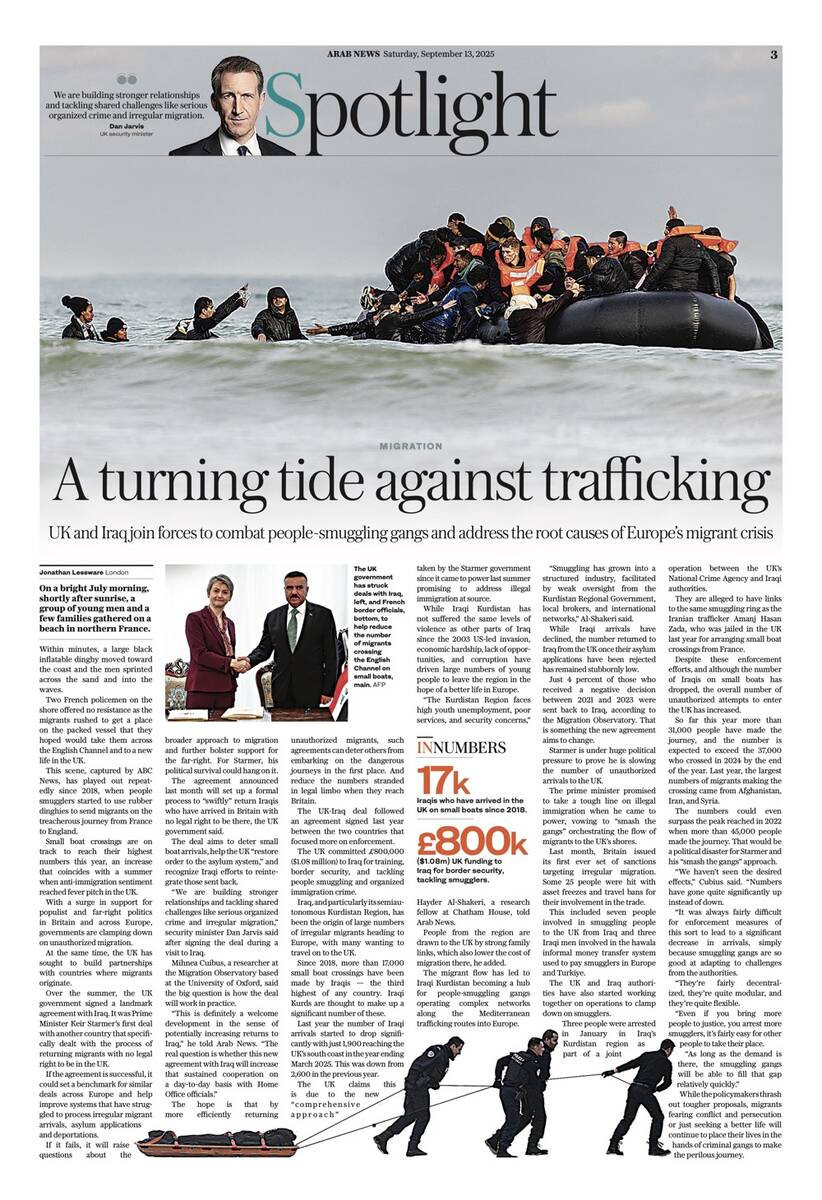
LONDON: On a bright July morning, shortly after sunrise, a group of young men and a few families gathered on a beach in northern France.
Within minutes, a large black inflatable dinghy moved toward the coast and the men sprinted across the sand and into the waves.
Two French policemen on the shore offered no resistance as the migrants rushed to get a place on the packed vessel that they hoped would take them across the English Channel and to a new life in the UK.
This scene, captured by ABC News, has played out repeatedly since 2018, when people smugglers started to use rubber dinghies to send migrants on the treacherous journey from France to England.
Small boat crossings are on track to reach their highest numbers this year, an increase that coincides with a summer when anti-immigration sentiment reached fever pitch in the UK.
With a surge in support for populist and far-right politics in Britain and across Europe, governments are clamping down on unauthorized migration.

The UK government has struck deals with Iraq and French border officials to help reduce the number of migrants crossing the English Channel on small boats. (AFP/File)
At the same time, the UK has sought to build partnerships with countries where migrants originate from as part of a multi-pronged approach to reduce the number of irregular arrivals.
Over the summer, the UK government signed a landmark agreement with Iraq. It was Prime Minister Keir Starmer’s first deal with another country that specifically dealt with the process of returning migrants with no legal right to be in the UK.
If the agreement is successful, it could set a benchmark for similar deals across Europe and help improve systems that have struggled to process irregular migrant arrivals, asylum applications and deportations.
If it fails, it will raise questions about the broader approach to migration and further bolster support for the far-right. For Starmer, his political survival could hang on it.
The agreement announced last month will set up a formal process to “swiftly” return Iraqis who have arrived in Britain with no legal right to be there, the UK government said.
The deal aims to deter small boat arrivals, help the UK “restore order to the asylum system,” and recognize Iraqi efforts to help reintegrate those sent back.
“We are building stronger relationships and tackling shared challenges like serious organized crime and irregular migration,” security minister Dan Jarvis said after signing the deal during a visit to Iraq.
Mihnea Cuibus, a researcher at the Migration Observatory based at the University of Oxford, said the big question is how the deal will work in practice.
“This is definitely a welcome development in the sense of potentially increasing returns to Iraq,” he told Arab News. “The real question is whether this new agreement with Iraq will increase that sustained cooperation on a day-to-day basis with Home Office officials.”

The EU has established agreements with countries including Tunisia and Libya that incentivizes them to strengthen border security and stop migrant boats leaving their shores. (AFP/File)
Previous agreements on returning irregular migrants have had mixed results. A deal between the last government and Albania in 2022 led to a large increase in the number of people sent back. But a similar deal with Pakistan in the same year failed to have an impact.
Cuibus said success hinges on how cooperation works on the ground, especially with operational processes such as obtaining the necessary travel documents in collaboration with embassies and consulates in the UK.
The hope is that by more efficiently returning unauthorized migrants, such agreements can deter others from embarking on the dangerous land and sea journeys in the first place. And reduce the numbers stranded in legal limbo when they reach Britain.
The UK-Iraq deal followed an agreement signed last year between the two countries that focused more on enforcement.
The UK committed £800,000 ($1.08 million) to Iraq for training, border security, and tackling people smuggling and organized immigration crime.
Iraq, and particularly its semiautonomous Kurdistan Region to the north, has been the origin of large numbers of irregular migrants heading to Europe, with many wanting to travel on to the UK.
Since 2018, more than 17,000 small boat crossings have been made by Iraqis — the third highest of any country. Iraqi Kurds are thought to make up a significant number of these.
Last year the number of Iraqi arrivals started to drop significantly with just 1,900 reaching the UK’s south coast in the year ending March 2025. This was down from 2,600 in the previous year.
The UK claims this is due to the new “comprehensive approach” taken by the Starmer government since it came to power last summer promising to address illegal immigration at source.
While Iraqi Kurdistan has not suffered the same levels of violence as other parts of Iraq since the 2003 US-led invasion, economic hardship, lack of opportunities, and corruption have driven large numbers of young people to leave the region in the hope of a better life in Europe.
“The Kurdistan Region faces high youth unemployment, poor services, and security concerns,” Hayder Al-Shakeri, a research fellow at Chatham House, told Arab News.
People from the region are drawn to the UK by strong family links, which also lower the cost of migration there, he added.

The UK committed £800,000 ($1.08 million) to Iraq for training, border security, and tackling people smuggling and organized immigration crime. (AFP/File)
The migrant flow has led to Iraqi Kurdistan becoming a hub for people-smuggling gangs operating complex networks along the Mediterranean trafficking routes into Europe.
“Smuggling has grown into a structured industry, facilitated by weak oversight from the Kurdistan Regional Government, local brokers, and international networks,” Al-Shakeri said.
While Iraqi arrivals have declined, the number returned to Iraq from the UK once their asylum applications have been rejected has remained stubbornly low.
Just 4 percent of those who received a negative decision between 2021 and 2023 were sent back to Iraq, according to the Migration Observatory. That is something the new agreement aims to change.
Starmer is under huge political pressure to prove he is slowing the number of unauthorized arrivals to the UK.
The prime minister promised to take a tough line on illegal immigration when he came to power, vowing to “smash the gangs” orchestrating the flow of migrants to the UK’s shores.
Last month, Britain issued its first ever set of sanctions targeting irregular migration. Some 25 people were hit with asset freezes and travel bans for their involvement in the trade.
This included seven people involved in smuggling people to the UK from Iraq and three Iraqi men involved in the hawala informal money transfer system used to pay smugglers in Europe and Turkiye.
The UK and Iraq authorities have also started working together on operations to clamp down on smugglers.

The UK-Iraq deal followed an agreement signed last year between the two countries that focused more on enforcement. (AFP/File)
Three people were arrested in January in Iraq’s Kurdistan region as part of a joint operation between the UK’s National Crime Agency and Iraqi authorities.
They are alleged to have links to the same smuggling ring as the Iranian trafficker Amanj Hasan Zada, who was jailed in the UK last year for arranging small boat crossings from France.
Despite these enforcement efforts, and although the number of Iraqis on small boats has dropped, the overall number of unauthorized attempts to enter the UK has increased.
So far this year more than 31,000 people have made the journey, and the number is expected to exceed the 37,000 who crossed in 2024 by the end of the year. Last year, the largest numbers of migrants making the crossing came from Afghanistan, Iran, and Syria.
The numbers could even surpass the peak reached in 2022 when more than 45,000 people made the journey. That would be a political disaster for Starmer and his “smash the gangs” approach.
“We haven’t seen the desired effects,” Cubius said. “Numbers have gone quite significantly up instead of down.
“It was always fairly difficult for enforcement measures of this sort to lead to a significant decrease in arrivals, simply because smuggling gangs are so good at adapting to challenges from the authorities.
“They’re fairly decentralized, they’re quite modular, and they’re quite flexible.
“Even if you bring more people to justice, you arrest more smugglers, it’s fairly easy for other people to take their place.

The agreement announced last month will set up a formal process to “swiftly” return Iraqis who have arrived in Britain with no legal right to be there, the UK government said. (AFP)
“As long as the demand is there, the smuggling gangs will be able to fill that gap relatively quickly.”
The small boats issue has become a lightning rod for anti-immigration sentiment in the UK, even though the numbers are just a fraction of overall annual migration into the country.
Legal and illegal migration to the UK has surged since the country left the EU, despite the issue being a key factor in the success of the Brexit campaign.
This summer has seen a wave of protests, often whipped up by far-right groups, outside hotels used to house migrants as they await decisions on their asylum applications.
The Bell Hotel in Epping in southeast England became a focal point after an Ethiopian man staying there was arrested and later convicted of sexually assaulting a 14-year-old girl.
The government has pledged to stop using hotels to house asylum seekers and speed up the process that decides which migrants are allowed to remain or granted refugee status and those who will be sent back.
It is focusing on trying to return more migrants whose applications are refused more quickly, hence the recent Iraq agreement.
INNUMBERS
• 17k Iraqis who have arrived in the UK on small boats since 2018.
• £800k ($1.08m) UK funding to Iraq for border security, tackling smugglers.
Starmer also secured a “one in, one out” agreement with France in July that allows the UK to return some small boat arrivals to France in exchange for an equal number of asylum seekers with ties to the UK.
The government claims it is making progress with 35,000 failed asylum seekers, foreign criminals, and immigration offenders returned to their countries in its first year — a 14 percent increase on the previous 12 months.
All the while, the anti-immigration Reform UK party led by Nigel Farage has surged ahead of Starmer’s Labour and the opposition Conservatives in polling. About 30 percent of voters say they back the party.
This raises the very real prospect that Farage could become the UK’s next prime minister, joining other countries in Europe run by right-wing populist administrations.

Despite these enforcement efforts, and although the number of Iraqis on small boats has dropped, the overall number of unauthorized attempts to enter the UK has increased. (AFP/File)
Across Europe, governments have been trying to implement tougher immigration policies, including proposed schemes similar to the previous UK government’s failed plan to send migrants to Rwanda for processing.
The EU has established agreements with countries including Tunisia and Libya that incentivizes them to strengthen border security and stop migrant boats leaving their shores.
While this has helped reduce the number of arrivals, the policies have been criticized by human rights groups who say it has led to increased abuses against migrants.
“The rise of far-right parties has certainly increased the attention on and polarization around migration,” Helena Hahn, migration analyst at the European Policy Centre, told Arab News.
“However, ‘quick fixes’ like border controls or suspension of family reunification are oftentimes shortsighted and unlikely to reestablish the ‘sense of control’ many voters and politicians are calling for.
“Rather than stealing ideas from the far right’s playbook, policymakers should focus on implementing the regulatory framework in place and address long-standing challenges related to migrant integration.”

This summer has seen a wave of protests, often whipped up by far-right groups, outside hotels used to house migrants as they await decisions on their asylum applications. (AFP/File)
While the policymakers thrash out tougher proposals, migrants fearing conflict and persecution or just seeking a better life will continue to place their lives in the hands of criminal gangs to make the perilous journey to Europe.
This week, three more people, including two children, died in an overcrowded dinghy off the coast of northern France as they attempted to make the crossing.
For places like Iraq’s Kurdistan Region, Al-Shakeri says that unless authorities there act to “create opportunities for its youth and dismantle these smuggling networks,” the trafficking routes will simply adapt to any new enforcement measures and people will continue to leave.