

Gaza antiquities rescued ahead of Israeli strike

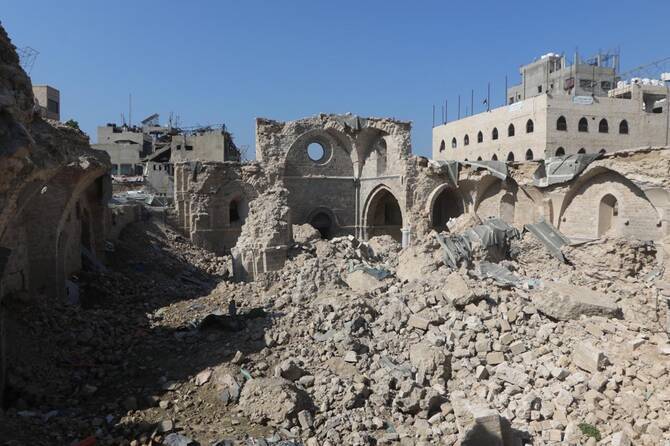
Nearly three decades of archaeological finds in Gaza were hurriedly evacuated Thursday from a Gaza City building threatened by an Israeli strike, an official in charge of the antiquities told AFP. (RIWAQ/File)
Short Url
Updated 12 September 2025
Follow

Gaza antiquities rescued ahead of Israeli strike

  • “A real last-minute rescue,” said Poquillon, director of EBAF whose storehouse housed the relics
  • “We had to improvise transport, labor and logistics,” said Poquillon

JERUSALEM: Nearly three decades of archaeological finds in Gaza were hurriedly evacuated Thursday from a Gaza City building threatened by an Israeli strike, an official in charge of the antiquities told AFP.
“This was a high-risk operation, carried out in an extremely dangerous context for everyone involved — a real last-minute rescue,” said Olivier Poquillon, director of the French Biblical and Archaeological School of Jerusalem (EBAF), whose storehouse housed the relics.
On Wednesday morning, Israeli authorities ordered EBAF — one of the oldest academic institutions in the region — to evacuate its archaeological storehouse located on the ground floor of a residential tower in Gaza City that was due to be targeted.
The Israeli army did not confirm the warning when asked by AFP, but several sources said France, UNESCO and the Latin Patriarchate of Jerusalem played a key role in securing a brief reprieve that allowed most of the artefacts to be removed.
“With almost no international actors left on the ground, no infrastructure, nothing functioning, we had to improvise transport, labor and logistics,” said Poquillon.
The evacuation, he added, was carried out in strict secrecy, with “the overriding concern, as a religious organization, of not endangering human lives,” as Israeli military pressed operations in the territory’s largest urban hub.
The depot contained around 180 cubic meters of finds from Gaza’s five main archaeological sites, including the fourth-century Saint Hilarion Monastery, listed as a UNESCO World Heritage site.
All of these sites have been damaged, EBAF said, expressing concern for “unique” mosaics left exposed despite their fragility.

‘Only trace’

Poquillon said Gaza has “an extremely ancient heritage, very precious for the region, showing the succession and coexistence of peoples, cultures and religions.”
Of Gaza’s two museums, one has been destroyed and the other heavily damaged since the war erupted nearly two years ago.
Researchers told AFP that aside from scattered ruins highly vulnerable to bombardment, the EBAF storehouse was the only significant repository of artefacts left in the Palestinian territory.
The rediscovery of Gaza’s past began in the wake of the 1993 Oslo accords.
Two years later, the newly created Gaza antiquities service opened its first archaeological dig in cooperation with EBAF, unearthing remnants of the ancient Greek port of Anthedon and a Roman necropolis.
Excavations stalled after Hamas seized power in 2007 and Israel imposed a blockade, resuming years later with support from the British Council and French NGO Premiere Urgence Internationale (PUI).
Now, with Israel contemplating a full takeover of Gaza and ceasefire talks stalled, archaeologists say prospects for renewed excavations are remote.
UNESCO, which has already identified damage to 94 heritage sites in Gaza using satellite images, including the 13th-century Pasha’s Palace, has not yet been able to take a full inventory.
“We saved a large part, but in a rescue you always lose things, and you always face painful choices,” said Rene Elter, an archaeologist affiliated with EBAF and scientific coordinator for PUI.
The depot, he said, was especially valuable because collections had been classified systematically.
“Many items have been broken or lost, but they had been photographed or drawn, so the scientific information is preserved,” Elter explained.
“Perhaps that will be the only trace that remains of Gaza’s archaeology — in books, publications, libraries.”


Halt to MSF work will be ‘catastrophic’ for people of Gaza: MSF chief

Dena Abu Youssef and Mahmoud Abu Youssef, a Palestinian boy who is receiving treatment at Al-Aqsa Martyrs Hospital.
Updated 43 min 30 sec ago
Follow

Halt to MSF work will be ‘catastrophic’ for people of Gaza: MSF chief

  • MSF slammed the move, which takes effect on March 1, as a “pretext” to obstruct aid
  • “Ceasing MSF activities is going to be catastrophic for the people of the Gaza Strip and the West Bank,” he said

GENEVA: Israel’s ban on Doctors Without Borders’ humanitarian operation in Gaza spells deeper catastrophe for the Palestinian territory’s people, the head of the medical charity told AFP on Monday.
Israel announced on Sunday that it was terminating all the activities in Gaza and the West Bank by the organization, known by its French acronym MSF, after it failed to provide a list of its Palestinian staff.
MSF slammed the move, which takes effect on March 1, as a “pretext” to obstruct aid.
“This is a decision that was made by the Israeli government to restrict humanitarian assistance into Gaza and the West Bank at the most critical time for Palestinians,” MSF secretary-general Christopher Lockyear warned in an interview with AFP at the charity’s Geneva headquarters.
“We are at a moment where Palestinian people need more humanitarian assistance, not less,” he said. “Ceasing MSF activities is going to be catastrophic for the people of the Gaza Strip and the West Bank.”
MSF has been a key provider of medical and humanitarian aid in Gaza, particularly since war broke out after Hamas’s October 7, 2023 attack on Israel.
The charity says it currently provides at least 20 percent of hospital beds in the territory and operates around 20 health centers.
In 2025 alone, it carried out more than 800,000 medical consultations, treated more than 100,000 trauma cases and assisted more than 10,000 infant deliveries.
It also provided more than 700 million liters of water, Lockyear pointed out.
‘Impossible choice’
Israel announced in December that it planned to prevent 37 aid organizations, including MSF, from working in Gaza for failing to submit detailed information about their Palestinian employees. The move drew widespread condemnation from NGOs and the United Nations.
It had alleged that two MSF employees had links with Palestinian militant groups Hamas and Islamic Jihad, which the medical charity vehemently denies.
“If Israel has any evidence of such things, then they should share that evidence,” Lockyear said, insisting that “there’s been no proof given to us.”
He decried “an orchestrated campaign to delegitimize us,” calling on other countries to defend efforts to bring desperately-needed humanitarian aid into Gaza.
“They should be speaking to Israel, pressuring Israel to ensure that there is a reverse of any banning of humanitarian organizations.”
Lockyear said MSF, which counts around 1,100 staff inside Gaza, had been trying to engage with Israeli authorities for nearly a year over the requested lists.
But it had been left with “an impossible choice,” he said.
“We’ve been forced to choose between the safety and security of our staff and being able to reach patients.”
‘Can only get worse’
The organization said it decided not to hand over staff names “because Israeli authorities failed to provide the concrete assurances required to guarantee our staff’s safety, protect their personal data, and uphold the independence of our medical operation.”
Lockyear insisted that was a “very rational” decision, pointing out that 15 MSF staff had been killed in Gaza during the war, out of more than 500 humanitarian workers and more than 1,700 medical workers killed in the Strip.
Lockyear highlighted that without independent humanitarian organizations in Gaza, an already “catastrophic” situation “can only get worse.”
“We need to increase massively the humanitarian assistance that’s going into Gaza,” he said, “not restrict it, not block it.”