

Pakistani state-owned firm announces major oil, gas discovery in Attock district

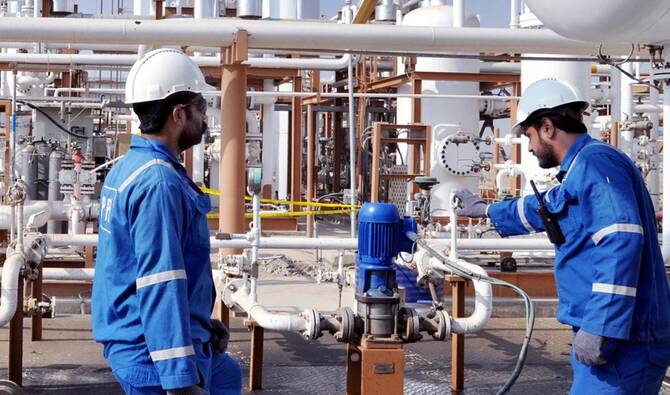
the undated file photo shows employees working at a Pakistan Petroleum Limited plant. (Photo courtesy: Pakistan Petroleum Limited/ website)
Short Url
Updated 05 September 2025
Follow

Pakistani state-owned firm announces major oil, gas discovery in Attock district

  • The well flows 1,469 barrels per day of oil and 2.56 MMscfd of gas at Wellhead Flowing Pressure of 1,147 psig on a 32/64” choke
  • The discovery will make a meaningful contribution to Pakistan’s energy mix by adding additional reserves, exploration firm says

KARACHI: The Pakistan Petroleum Limited (PPL), one of the country’s leading oil and gas exploration and production companies, has discovered “significant” oil and gas reserves in the Attock district of the eastern Punjab province, it said on Friday.

This landmark discovery at Dhok Sultan-03 well is not only a major milestone for PPL and its partner, the Government Holdings Private Limited (GHPL), but also marks the second deepest oil discovery in naturally fractured carbonate in the Pothohar region, according to PPL.

The exploration firm, as operator of the Dhok Sultan block with a 75 percent working interest (WI) alongside GHPL’s 25 percent WI, spudded the well on January 18. Drilled to a depth of 5,815 meters, the well tested the hydrocarbon potential of the Patala and Lockhart formations.

The well flowed 1,469 barrels per day of oil and 2.56 Million Standard Cubic Feet per Day (MMscfd) of gas at Wellhead Flowing Pressure (WHFP) of 1,147 Pounds per Square Inch Gauge (psig) on a 32/64” choke, and 2,113 barrels per day of oil and 4.13 MMscfd of gas at WHFP of 813psig on a 48/64” choke.

“This discovery is a result of rigorous geological, geophysical and reservoir engineering data analyzes and integration that helped in overcoming the drilling challenges by optimizing the well design that resulted in saving drilling days and cost optimization,” PPL said.

The South Asian country, which imports most of its energy needs and is currently looking for ways to lessen the costs, is currently pursuing a multi-pronged strategy to advance the energy sector, focusing on indigenization, electrification and liberalization.

The Dhok Sultan-03 discovery is expected to make a meaningful contribution to Pakistan’s energy mix by adding additional hydrocarbon reserves and will save significant foreign exchange for the country through indigenous hydrocarbon production.

“This discovery is a testament to PPL’s in-house expertise, perseverance, and commitment to energy security,” PPL Managing Director Imran Abbasy. “It demonstrates our ability to deliver impactful results that not only strengthen our reserves base but also contribute to reducing the country’s reliance on imported energy and conserving valuable foreign exchange.”

Earlier in Feb., Mari Energies, a Pakistani hydrocarbon exploration firm, discovered new oil and gas reserves in the northwestern Khyber Pakhtunkhwa (KP) province, with initial tests suggesting a flow of 12.96 million standard cubic feet per day (MMSCFD) of gas and around 20 barrel per day (bbl/d) of condensate.

The discovery was made in KP’s Waziristan district at the Spinwam-1 exploratory well, which was drilled on May 28 last year, according to Mari Energies. The company holds a 55 percent stake in the Waziristan block together with the state-owned Oil and Gas Development Company Limited (OGDCL) and Orient Petroleum Inc. (OPI).

It followed Islamabad’s announcement offering foreign investors 40 offshore and 31 onshore blocks for oil and gas exploration.


Pakistan’s finance chief says country shifting from aid to trade, investment with Gulf nations

Updated 15 December 2025
Follow

Pakistan’s finance chief says country shifting from aid to trade, investment with Gulf nations

  • Aurangzeb says remittances from the GCC topped $38 billion last fiscal year, projected at $42 billion this time
  • He tells an international media outlet discussions on a free trade agreement with the GCC are at an advanced stage

ISLAMABAD: Pakistan is no longer seeking aid-based support and is instead pivoting toward trade- and investment-led partnerships, Finance Minister Muhammad Aurangzeb said in an interview with an international media outlet circulated by the finance division on Monday, acknowledging longstanding economic backing from Gulf countries.

Aurangzeb spoke to CNN Business Arabia at a time when Pakistan seeks to consolidate macroeconomic stability after a prolonged crisis marked by soaring inflation, currency pressure and external financing gaps.

Aurangzeb said the government’s economic direction, articulated by Prime Minister Shehbaz Sharif, aims to replace reliance on external assistance with sustainable growth driven by investment and exports, particularly from partners in the Gulf Cooperation Council (GCC), which includes Saudi Arabia, the United Arab Emirates, Qatar, Kuwait, Oman and Bahrain.

“We are not looking for aid flows anymore,” he said. “For us, we are very clear ... that going forward is really trade and investment, which is going to bring sustainability and be win-win for our longstanding bilateral partners in GCC and for Pakistan.”

“This FDI [foreign direct investment] is going to help us in terms of GDP growth [and] more employment opportunities as we go forward,” he continued. “So, you know, all hands are on deck at this point in time to make this materialize.”

Aurangzeb said Pakistan’s shift was underpinned by improving macroeconomic indicators following an 18-month stabilization program.

He noted that inflation, which peaked at 38 percent in 2023, has fallen to single-digit levels, while the country has posted primary fiscal surpluses and kept the current account deficit within targeted limits, adding that foreign exchange reserves now cover about 2.5 months of imports.

The finance chief described recent international assessments as external validation of the government’s reform path.

“All three international credit rating agencies are now aligned in terms of their upgrades and outlook for Pakistan this year,” he said, adding that the successful completion of the second review under the International Monetary Fund’s loan program, approved by the lending agency’s executive board, reinforced confidence in Pakistan’s economic management.

The finance minister said reforms across taxation, energy, state-owned enterprises, public finance and privatization were central to consolidating stability and supporting growth.

He pointed out Pakistan’s tax-to-GDP ratio had risen to about 10.3 percent from 8.8 percent at the start of the reform program and is on track to reach 11 percent, driven by efforts to widen the tax base to include under-taxed sectors such as real estate, agriculture and wholesale and retail trade, while tightening compliance through technology-based monitoring.

Aurangzeb also highlighted the role of the GCC in supporting Pakistan’s external position, particularly through remittances.

He said inflows reached about $38 billion last fiscal year and are projected to rise to nearly $42 billion this time, with more than half originating from GCC states, reflecting the contribution of Pakistani nationals working in the region.

The finance chief said Pakistan was actively engaging Gulf partners to attract investment in sectors including energy, oil and gas, mining, artificial intelligence, digital infrastructure, pharmaceuticals and agriculture, while discussions on a free trade agreement with the GCC were at an advanced stage.