

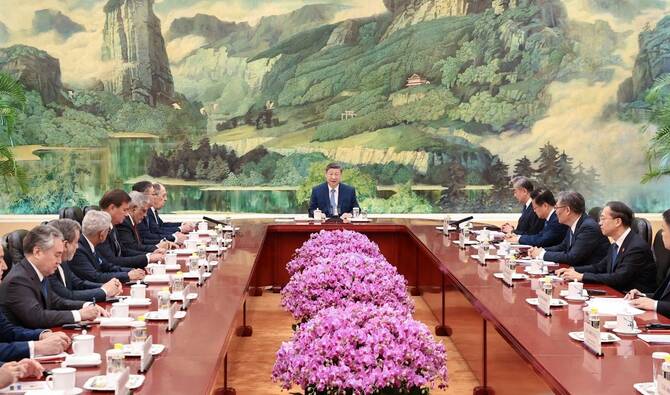

BEIJING: China’s President Xi Jinping will host world leaders including Russia’s Vladimir Putin and India’s Narendra Modi from Sunday for a summit before a huge military parade as he seeks to showcase a non-Western style of regional collaboration.
The Shanghai Cooperation Organization summit will be held Sunday and Monday, days before the military parade in nearby Beijing to mark 80 years since the end of World War II, which North Korea’s Kim Jong Un will attend.
The SCO comprises China, India, Russia, Pakistan, Iran, Kazakhstan, Kyrgyzstan, Tajikistan, Uzbekistan and Belarus — with 16 more countries affiliated as observers or “dialogue partners.”
China and Russia have used the organization — sometimes touted as a counter to the Western-dominated NATO military alliance — to deepen ties with Central Asian states.
As China’s claim over Taiwan and Russia’s invasion of Ukraine have seen them clash with the United States and Europe, analysts say the SCO is one forum where they are trying to win influence.
More than 20 leaders including Iranian and Turkish presidents Masoud Pezeshkian and Recep Tayyip Erdogan will attend the bloc’s largest meeting since its founding in 2001.
Hosting this many leaders gives Beijing a chance to “demonstrate convening power,” said Lizzi Lee from the Asia Society Policy Institute.
But substantial outcomes, she added, are not expected as the summit would be more about optics and agenda-setting.
“The SCO runs by consensus, and when you have countries deeply divided on core issues like India and Pakistan, or China and India, in the same room, that naturally limits ambition,” Lee told AFP.
Beijing wants to show it can bring diverse leaders together and reinforce the idea that global governance is “not Western-dominated,” she added.
Assistant Foreign Minister Liu Bin said Friday that the summit will bring stability in the face of “hegemonism and power politics,” a veiled reference to the United States.
Putin’s attendance comes as Ukraine’s President Volodymyr Zelensky insists that a meeting with him would be “the most effective way forward.”
While US President Donald Trump has pushed to broker a Ukraine-Russia summit, Moscow has ruled out any immediate Putin-Zelensky talks.
Putin at the SCO summit will likely seek to demonstrate Russia’s continued support from non-Western partners to promote its narratives of the cause of war and “how the ‘just’ end of the war will look like,” said Dylan Loh, an assistant professor at Singapore’s Nanyang Technological University.
“With Putin in the room, the war will hang over the proceedings,” Asia Society’s Lee said, but added that the topic of Ukraine would not be “front and center” of the summit.
“The SCO avoids topics that divide members, and this one obviously does,” she told AFP.
But Putin will want to show that he “is not isolated, reaffirming the partnership with Xi, and keeping Russia visible in Eurasia,” Lee added.
Modi’s visit is his first to China since 2018.
The world’s two most populous nations are intense rivals competing for influence across South Asia and fought a deadly border clash in 2020.
A thaw began last October when Modi met with Xi for the first time in five years at a summit in Russia.
Caught in geopolitical turbulence triggered by Trump’s tariff war, they have moved to mend ties.
“China will try its very best to pull out all stops to woo India, particularly capitalizing on India’s trade issues with the US,” said Lim Tai Wei, a professor and East Asia expert at Japan’s Soka University.
But fundamental differences between the countries cannot be resolved easily, he cautioned.
“Temporary respite or temperature-cooling, however, may be possible,” Lim told AFP.
Modi was not present at China’s 2015 parade and it remains unclear if he will attend this year’s.
His attendance would be “a barometer of where the geopolitical wind blows in the global contestation between the West and China,” Lim said.
China and India announced in August that they would restart direct flights, advance talks on their disputed border and boost trade.


