

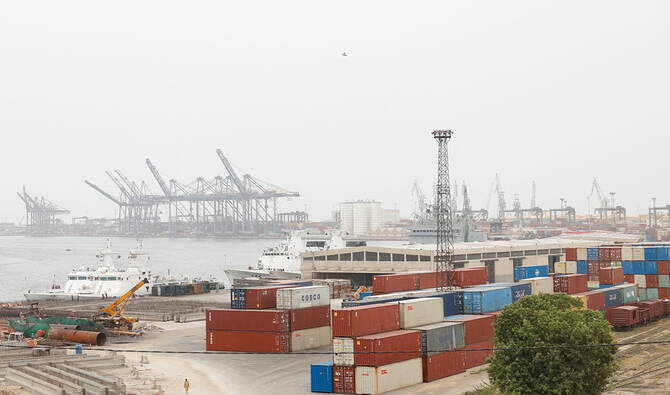

KARACHI: Pakistan has relaxed export rules to allow shipments of food, pharmaceuticals and tents to Iran and onward to Central Asia via Iranian territory, the commerce ministry said on Saturday, as Islamabad seeks to boost declining exports and reroute trade disrupted by regional tensions.
The temporary concession, effective from March 24 to June 21, waives requirements for bank guarantees and letters of credit (LCs) for selected exports to Iran by land, while also enabling Pakistani goods, particularly rice, to reach Central Asian Republics (CARs) and Azerbaijan through Iranian transit routes.
“Federal Minister for Commerce has been pleased to provide exemption from Para 3 of Export Policy Order 2022 which requires all exports from Pakistan to be made in compliance of foreign exchange rules, regulations and procedures,” reads a March 24 notification the commerce ministry shared with Arab News.
The provision refers to requirements governing how export payments are processed, documented and repatriated through formal banking channels.
The exemption covers exports of milled rice, seafood, potato, meat, onions, maize, citrus, banana, tomato, frozen chicken, pharmaceuticals and tents, with exporters required to submit an undertaking that proceeds will be repatriated within the prescribed period.
The commerce ministry described the move as a “historic initiative” in a separate statement on Saturday, saying it aimed at boosting exports and easing constraints faced by exporters operating in regional markets.
“Trade through Iran will significantly reduce exporters’ costs and time,” the ministry said, citing Commerce Minister Jam Kamal Khan.
“By increasing exports, we will steer the country toward economic stability,” he added.
Pakistan’s exports declined seven percent in July-February FY26 to $20.5 billion from $22.1 billion a year earlier, according to Pakistan Bureau of Statistics data.
Last fiscal year, the country posted a trade deficit of more than $26 billion, with exports rising five percent to $32.1 billion against imports of $58.4 billion.
TRANSIT ROUTE
The decision also positions Iran as an alternative trade corridor for Pakistani exports to Central Asia, at a time when traditional overland routes through Afghanistan have faced repeated disruptions.
Pakistan has in recent months closed key border crossings with Afghanistan amid escalating frontier tensions and clashes, constraining bilateral trade and limiting access to landlocked Central Asian markets.
Allowing exports through Iran provides exporters with a parallel route, reducing reliance on the Afghan corridor and potentially stabilizing regional trade flows.
“Pakistan will now be able to export rice to Central Asia and Azerbaijan via Iran while removing obstacles in pharmaceutical exports is our top priority,” said minister Khan.
Samiullah Tariq, head of research at Pakistan Kuwait Investment Company Ltd, said the move “would help increase Pakistan’s exports.”
Industry stakeholders also welcomed the decision.
“It is definitely a very bold and promising move. War times allow food and medicine supplies regardless of sanctions,” Malik Faisal Jahangir, chairman of the Rice Exporters Association of Pakistan (REAP), told Arab News, adding that Iran was the world’s largest importer of rice.
Pakistan is one of the world’s largest rice producers and exported $1.5 billion of the grain in the current fiscal year during July-Feb.
SANCTIONS RISK
Analysts say the move may also carry broader geopolitical implications, as Pakistan maintains contact with multiple parties involved in the ongoing Middle East conflict.
“This trade and export permissions by the ministry could be a step for a broader deal to resolve Middle East conflict,” said Ahsan Mehanti, chief executive officer at Karachi-based Arif Habib Commodities Limited.
He said Pakistan was expected to play a role in easing regional tensions and that expanded trade could help improve ties with Iran.
“Pakistan is a close US ally and steps to trade without bank guarantee and Iran transit trade could help reaching milestone for mediating peace talks,” Mehanti said.
He added that any easing of sanctions enforcement by Washington could serve as a confidence-building measure in support of diplomatic efforts, but cautioned that Pakistan would need to remain mindful of its exposure to potential penalties.
“The exporters expect the [Iran] trade is approved, else sanctions could impact Pakistan standing in US relations,” he said.
The policy shift comes as Pakistan seeks to stabilize its economy under a $7 billion International Monetary Fund (IMF) program.
The IMF said on Saturday it had reached a Staff Level Agreement with Pakistan, which, if approved by its executive board, would unlock about $1.2 billion as a fresh tranche under the Extended Fund Facility and Resilience and Sustainability Facility.
The government has in recent months pushed to expand trade ties and ease export bottlenecks as part of broader efforts to support growth and external balances.




