

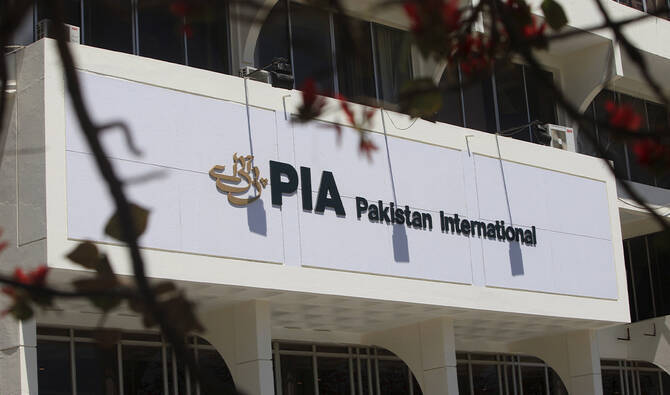

ISLAMABAD: The new majority owner of Pakistan International Airlines (PIA) warned on Saturday that flight operations may no longer be “viable” following a 150 percent surge in jet fuel prices, a development that threatens to derail the country’s most high-profile privatization in decades.
Arif Habib, chairman of the eponymous Arif Habib Group, which led the consortium acquiring a 75 percent stake in the airline last year in December, said the price hike has placed PIA at a major disadvantage against international rivals.
The warning comes as the group prepares to take full operational control of the airline next month.
“It won’t be viable to run the airline with current jet fuel prices,” Habib told Arab News, noting that the domestic price increase has been disproportionately sharp compared to global trends.
The crisis in Pakistan’s aviation sector follows a dramatic escalation in global energy markets. Oil prices spiked after the Feb. 28 joint US and Israeli air strikes in Iran, and subsequent Iranian attacks in Israel and other regional countries, which severely disrupted global supply chains.
In Pakistan, jet fuel prices, Habib said, have climbed from 180 rupees ($0.65) per liter to over 400 rupees ($1.43) in less than a month.
The price surge has already drawn the attention of the Pakistan government. A Cabinet Committee meeting, chaired by Finance Minister Muhammad Aurangzeb earlier this month, cautioned that the current pricing structure was weakening the competitiveness of the domestic aviation sector and shifting market share toward foreign carriers.
Habib urged the government to intervene by rationalizing refining margins to bring fuel costs in line with regional benchmarks.
“No business can remain healthy while operating at a consistent loss,” he said, describing the current price levels as an existential challenge to the airline’s turnaround strategy.
He added that he plans to write to Prime Minister Shehbaz Sharif to seek an immediate resolution to the issue.
PIA’s privatization was a central pillar of Pakistan’s economic reform agenda under a $7 billion International Monetary Fund (IMF) program.
Founded in 1955, PIA was once a pioneer in Asian aviation, famously assisting in the launch of Emirates in the 1980s.
However, the air carrier was crippled by decades of political interference, mismanagement and overstaffing.
A 2020 safety scandal involving “dubious” pilot licenses also led to its four-year ban from European and British airspace.
The Arif Habib-led consortium purchased a majority stake in PIA for Rs135 billion ($485 million) in December.
The deal was hailed as a milestone intended to modernize a depleted fleet of just 18 active aircraft and restore lucrative direct routes to London and Paris.
Despite the fuel crisis, Habib said the airline has not yet grounded any aircraft in its fleet.
He emphasized that the consortium remains committed to its contractual obligations and international deals but stressed that long-term sustainability depends on a “rationalized” domestic fuel pricing mechanism.


