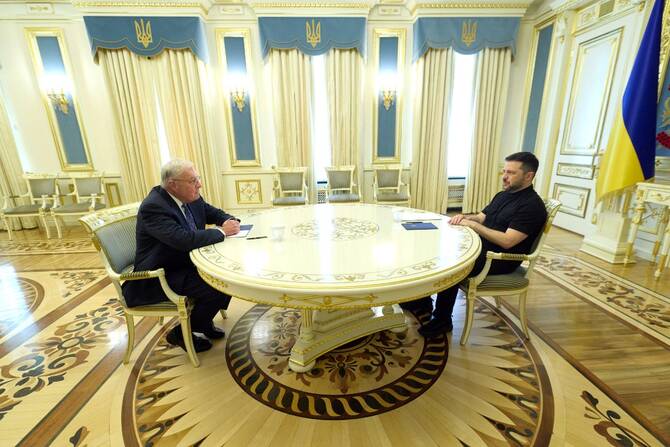
KYIV: US President Donald Trump’s special envoy Keith Kellogg said in Kyiv on Monday that officials are “working very, very hard” on efforts to end the three-year war between Russia and Ukraine, as a lack of progress fuels doubts about whether a peace settlement could be on the horizon.
Officials are “hoping to get to a position where, in the near term, we have, with a lack of a better term, security guarantees” that address Ukraine’s fears of another invasion by Russia in the future, Kellogg said.
“That’s a work in progress,” Kellogg said of the potential security guarantees after attending Ukraine’s annual National Prayer Breakfast along with politicians, business leaders and diplomats.
A week ago, Trump said he had set in motion arrangements for direct peace talks between Russian President Vladimir Putin and Zelensky. But Russian officials have signaled that such a summit won’t happen any time soon.
Trump said Friday he expects to decide on next steps in two weeks if direct talks aren’t scheduled.
A stream of high-ranking visitors to Kyiv in recent days reflects concerns around the US-led peace drive.
Canadian Prime Minister Mark Carney visited Kyiv on Sunday for meetings with Zelensky, pledging 2 billion Canadian dollars in aid, and NATO Secretary General Mark Rutte was in the Ukrainian capital on Friday. Germany’s vice chancellor and finance minister, Lars Klingbeil, arrived in Kyiv on Monday to discuss “how Germany can best support Ukraine in a possible peace process.”
Putin spoke on the phone with Iranian President Masoud Pezeshkian on Monday, the Kremlin said. Russia and Iran have close relations, and Putin has also deepened ties with China, India and North Korea as Western countries have sided with Ukraine in the war.
Putin and Pezeshkian are expected to meet next week when China hosts the Shanghai Cooperation Organization’s annual summit, in Tianjin.
Germany, Norway vow more help for Ukraine
Klingbeil, the German vice chancellor, told Zelensky that Ukraine’s allies have to “talk about what happens if President Putin does not relent, if he wants to continue the war.”
Germany will continue to stand by Ukraine, he said, echoing sentiments by Norwegian Prime Minister Jonas Gahr Store earlier in the day.
Norway’s multibillion-dollar military and civilian support for Ukraine’s fight to defeat Russia’s invasion will stretch into next year, Store said in Kyiv. He said he will propose to the Norwegian Parliament spending $8.45 billion on Ukraine next year.
Store, whose country borders Russia, told a news conference with Zelensky that Ukraine is “defending a critical principle on the European level” by refusing to accept Russia’s seizure of territory.
Analysts say Putin thinks he can outlast Western governments’ commitment to Ukraine and use his bigger army to capture more Ukrainian land while peace efforts are under discussion.
Norway on Sunday pledged about 7 billion kroner ($695 million) toward air defense systems for Ukraine. Norway and Germany are jointly funding two US-made Patriot anti-missile systems, including missiles, with Norway also helping procure air defense radar, Store said.
Drone strikes continue
Ukraine’s Air Force said Russia launched 104 strike and decoy drones overnight, targeting the country’s north and east. There were no immediate reports of damage or casualties.
Ukraine has continued long-range drone attacks on Russia, hitting oil refineries, armories and transport hubs and causing commercial flight disruption during the summer vacation period.
On Sunday, an Egyptian plane carrying Russian tourists from Sharm El Sheikh to St. Petersburg diverted to Tallinn because the Russian city’s international airport had temporarily closed due to a drone attack, the Estonian daily Postimees reported.
Meanwhile, the Russian Defense Ministry reported intercepting 23 Ukrainian drones overnight and Monday morning over seven Russian regions, both on or near the border with Ukraine and deeper inside Russia.

Trump envoy says officials working ‘very, very hard’ on ending Russia-Ukraine war
https://arab.news/bs3wy
Trump envoy says officials working ‘very, very hard’ on ending Russia-Ukraine war
- A week ago, President Trump said he had set in motion arrangements for direct peace talks between Russian President Vladimir Putin and Zelensky
- But Russian officials have signaled that such a summit won’t happen any time soon
Australia to toughen gun laws as it mourns deadly Bondi attack
- Footage showed one man, identified by local media as fruit seller Ahmed al Ahmed, grabbing one of the gunmen as he fired
- Prime Minister Anthony Albanese convened a meeting of leaders of Australia’s states and territories in response on Monday, agreeing with them “to strengthen gun laws across the nation”
SYDNEY: Australia’s leaders have agreed to toughen gun laws after attackers killed 15 people at a Jewish festival on Bondi Beach, the worst mass shooting in decades decried as antisemitic “terrorism” by authorities.
Dozens fled in panic as a father and son fired into crowds packing the Sydney beach for the start of Hanukkah on Sunday evening.
A 10-year-old girl, a Holocaust survivor and a local rabbi were among those killed, while 42 others were rushed to hospital with gunshot wounds and other injuries.
Prime Minister Anthony Albanese convened a meeting of leaders of Australia’s states and territories in response on Monday, agreeing with them “to strengthen gun laws across the nation.”
Albanese’s office said they agreed to explore ways to improve background checks for firearm owners, bar non-nationals from obtaining gun licenses and limit the types of weapons that are legal.
Mass shootings have been rare in Australia since a lone gunman killed 35 people in the town of Port Arthur in 1996, which led to sweeping reforms long seen as a gold standard worldwide.
Those included a gun buyback scheme, a national firearms register and a crackdown on ownership of semi-automatic weapons.
But Sunday’s shooting has raised fresh questions about how the two suspects — who public broadcaster ABC reported had possible links to the Daesh group — obtained the guns.
- ‘An act of pure evil’ -
Police are still unraveling what drove Sunday’s attack, although authorities have said it targeted Jews.
Albanese called it “an act of pure evil, an act of antisemitism, an act of terrorism on our shores.”
A string of antisemitic attacks has spread fear among Australia’s Jewish communities after the October 7, 2023, Hamas assault on Israel and the ensuing war in Gaza.
The Australian government this year accused Iran of orchestrating a recent wave of antisemitic attacks and expelled Tehran’s ambassador nearly four months ago.
But Israeli Prime Minister Benjamin Netanyahu accused Australia’s government of “pouring oil on the fire of antisemitism” in the months before the shooting, referring to Canberra’s announcement that it would recognize Palestinian statehood in August.
Other world leaders expressed revulsion, with US President Donald Trump condemning the “antisemitic attack.”
The gunmen opened fire on an annual celebration that drew more than 1,000 people to the beach to mark Hanukkah.
They took aim from a raised boardwalk at a beach packed with swimmers cooling off on the steamy summer evening.
Witness Beatrice was celebrating her birthday and had just blown out the candles when the shooting started.
“We thought it was fireworks,” she told AFP. “We’re just feeling lucky we’re all safe.”
Carrying long-barrelled guns, they peppered the beach with bullets for 10 minutes before police shot and killed the 50-year-old father.
The 24-year-old son was arrested and remains under guard in hospital with serious injuries.
Australian media named the suspects as Sajid Akram and his son Naveed Akram.
Tony Burke, the home affairs minister, said the father arrived in Australia on a student visa in 1998 and had become a permanent resident. The son was an Australia-born citizen.
Hours after the shooting, police found a homemade bomb in a car parked close to the beach, saying the “improvised explosive device” had likely been planted by the pair.
Rabbi Mendel Kastel said his brother-in-law was among the dead.
“We need to hold strong. This is not the Australia that we know. This is not the Australia that we want.”
Wary of reprisals, police have so far avoided questions about the attackers’ religion or ideological motivations.
Misinformation spread quickly online after the attacks, some of it targeting immigrants and the Muslim community.
Police said they responded to reports on Monday of several pig heads left at a Muslim cemetery in southwestern Sydney.
- Panic and bravery -
A brave few dashed toward the beach as the shooting unfolded, wading through fleeing crowds to rescue children, treat the injured and confront the gunmen.
Footage showed one man, identified by local media as fruit seller Ahmed al Ahmed, grabbing one of the gunmen as he fired.
The 43-year-old wrestled the gun out of the attacker’s hands, before pointing the weapon at him as he backed away.
A team of off-duty lifeguards sprinted across the sand to drag children to safety.
“The team ran out under fire to try and clear children from the playground while the gunmen were firing,” said Steven Pearce from Surf Life Saving New South Wales.
Bleeding victims were carried across the beach atop surfboards turned into makeshift stretchers.
On Monday evening, a flower memorial next to Bondi Beach swelled in size as mourners gathered.
Hundreds, including members of the Jewish community, sang songs, clapped and held each other.
Leading a ceremony to light a menorah candle, a rabbi told the crowd: “The only strength we have is if we bring light into the world.”