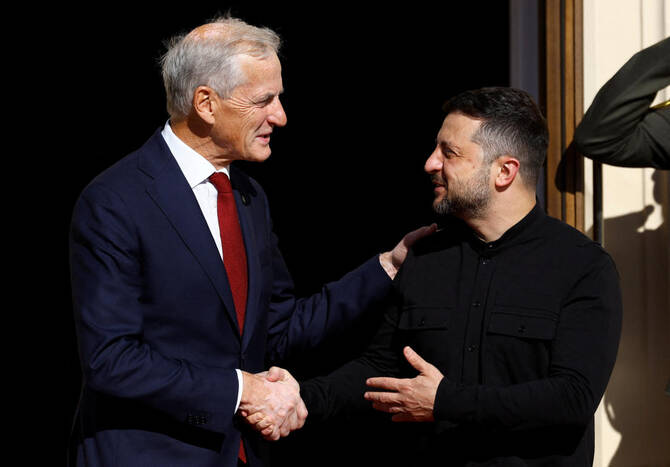
OSLO: The Norwegian government aims to maintain its aid to Ukraine at 85 billion kroner ($8.4 billion) in 2026, the same level as this year, the office of Prime Minister Jonas Gahr Store said Monday.
The proposal, made as Store visited Kyiv, must be ratified by parliament and if passed would take to 275 billion kroner ($27.1 billion) the total civilian and military aid which Norway will send the country for the 2023-2030 period.
“The government intends to maintain Norway’s extraordinary support to Ukraine next year and is proposing an allocation of a total of 85 billion kroner in military and civilian support,” said Store in a statement.
“This is a critical time in Ukraine’s fight to defend itself. As talks on a ceasefire and peace take place, the war rages on in Ukraine.
“It is important in the current situation to reaffirm our continued strong support for Ukraine: political, financial and military,” said Store, who was to meet with Ukrainian President Volodymyr Zelensky on Monday.
The aid package proposed by the minority Labor government must be included in 2026 budget proposals due for presentation in October.
Norway is to hold parliamentary elections – expected to see a close battle between left and right – on September 8.
Oslo’s support for Ukraine is almost universal among the Norwegian public, with the country sharing a border with Russia.
According to German research institute Kiel Institute, Norway was the second largest European provider of military aid to Ukraine in May and June, behind Germany.
On Sunday, Oslo announced it would allocate some seven billion kroner to strengthening Ukraine’s air defenses, including the joint purchase with Germany of two Patriot air and missile defense systems.


![]()

Norway proposes maintaining Ukraine aid at $8.4bn in 2026
Short Url
https://arab.news/wssw5
Norway proposes maintaining Ukraine aid at $8.4bn in 2026
- The proposal must be ratified by the Norwegian parliament
- Norway was the second largest European provider of military aid to Ukraine in May and June


Latest updates




© 2026 SAUDI RESEARCH & PUBLISHING COMPANY, All Rights Reserved And subject to Terms of Use Agreement.