

Pakistan’s deputy PM seeks ‘forward-looking’ ties with Bangladesh, urges revival of SAARC forum

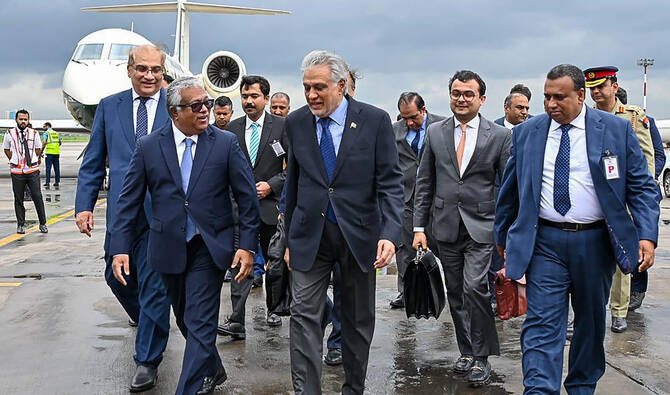
This handout photograph taken and released by Bangladesh's Ministry of Foreign Affairs on August 23, 2025 shows Bangladesh's Foreign Secretary Asad Alam Siam (L) receiving Ishaq Dar (2L), Pakistan's Foreign Minister, at the Hazrat Shahjalal International Airport in Dhaka. (AFP)
Short Url
Updated 24 August 2025
Follow

Pakistan’s deputy PM seeks ‘forward-looking’ ties with Bangladesh, urges revival of SAARC forum

  • Ishaq Dar’s visit marks the highest-level trip by any Pakistani official to Bangladesh in many years
  • It comes amid thaw after Sheikh Hasina’s ouster, widely seen as pro-India and critical of Pakistan

ISLAMABAD: Pakistan’s Deputy Prime Minister and Foreign Minister Ishaq Dar said on Saturday his country wanted a “forward-looking” relationship with Bangladesh based on what unites the two nations, while calling for the revival of the South Asian Association for Regional Cooperation to help deliver peace and prosperity across the neighborhood.

Dar’s visit follows months of increased official contacts after ties began to ease in the wake of Bangladesh’s former prime minister Sheikh Hasina’s ouster last year in a popular uprising. Hasina, widely viewed as close to India and critical of Pakistan, fled to New Delhi soon after her downfall, straining relations between Dhaka and New Delhi.

The shift also created space for Bangladesh and Pakistan – once a single nation until the bloody 1971 war of independence – to reset relations.

Dar, who arrived in Dhaka earlier today, is on the highest-level trip by a Pakistani official to Bangladesh since Hasina’s ouster.

“Notwithstanding the twists and the turns of history, the people of Pakistan have fraternal sentiments toward the people of Bangladesh and hold them in the highest esteem,” he said, as he addressed a gathering at the Pakistan High Commission. “We recognize and respect the sovereign choices of the Bangladeshi nation, and believe in a future where our relations are defined not by what divides us, but what unites us.”


Pakistan’s Deputy Prime Minister and Foreign Minister Ishaq Dar arrives in Dhaka on August 23, 2025, on a two-day official visit to Bangladesh. (Handout/MoFA)

“I wish to underscore the strong desire of the government of Pakistan to forge a cooperative and forward-looking relationship with Bangladesh,” he added.

Dar noted the Pakistan-Bangladesh relations had seen “a number of positive developments” over the past year, citing significant progress across multiple streams of cooperation.

He pointed out that the frequency of high-level exchanges had increased, institutional mechanisms were being revived, economic and commercial ties were gaining momentum and educational and academic collaborations were being explored alongside cultural exchanges, describing the current phase as marked by “new energy and fresh enthusiasm.”

The Pakistani deputy prime minister added both countries shared common ground on several regional and international issues and reiterated support for reviving SAARC, a forum that has largely been dysfunctional since 2016, when India boycotted a planned Islamabad summit amid tensions with Pakistan.

No leaders’ summit has been held since. Pakistan’s push to revive the bloc comes as ties with India are at a low for both Islamabad and Dhaka.


Pakistan’s Deputy Prime Minister and Foreign Minister Ishaq Dar arrives in Dhaka on August 23, 2025, on a two-day official visit to Bangladesh. (Handout/MoFA)

“South Asia, home to nearly a quarter of humanity, cannot afford to lag behind in regional cooperation and integration,” the deputy PM said. “We are hopeful that SAARC will be reinvigorated, and our distances will shorten.”

Earlier, Dar met leaders of Bangladesh’s newly formed National Citizen Party (NCP), a student-led movement that spearheaded the protests which unseated Hasina.

The party, formally launched earlier this year, has called for a “second republic” with a new constitution aimed at strengthening democracy and social justice.

Its emergence has reshaped Bangladesh’s political landscape, challenging decades of dominance by traditional parties and giving voice to younger generations.

Dar emphasized the need for greater interaction between the youth of the two countries.

As part of his outreach to political stakeholders, he also met a delegation of the Bangladesh Jamaat-e-Islami party and discussed ways to strengthen bilateral relations between the two nations.

Additionally, he interacted with the Bangladesh Nationalist Party leadership and affirmed his country’s commitment to stronger ties on the basis of mutual respect and benefit.

The Pakistan deputy PM is scheduled to meet Chief Adviser Muhammad Yunus and senior officials including Adviser for Foreign Affairs Md. Touhid Hossain and Adviser for Commerce SK Bashir Uddin during his two-day stay in Dhaka.


Pakistan PM orders accelerated privatization of power sector to tackle losses

Updated 15 December 2025
Follow

Pakistan PM orders accelerated privatization of power sector to tackle losses

  • Tenders to be issued for privatization of three major electricity distribution firms, PMO says
  • Sharif says Pakistan to develop battery energy storage through public-private partnerships

ISLAMABAD: Pakistan’s prime minister on Monday directed the government to speed up privatization of state-owned power companies and improve electricity infrastructure nationwide, as authorities try to address deep-rooted losses and inefficiencies in the energy sector that have weighed on the economy and public finances.

Pakistan’s electricity system has long struggled with financial distress caused by a combination of factors including theft of power, inefficient collection of bills, high costs of generating electricity and a large burden of unpaid obligations known as “circular debt.” In the first quarter of the current financial year, government-owned distribution companies recorded losses of about Rs171 billion ($611 million) due to poor bill recovery and operational inefficiencies, official documents show. Circular debt in the broader power sector stood at around Rs1.66 trillion ($5.9 billion) in mid-2025, a sharp decline from past peaks but still a major fiscal drain. 

Efforts to contain these losses have been a focus of Pakistan’s economic reform program with the International Monetary Fund, which has urged structural changes in the energy sector as part of financing conditions. Previous government initiatives have included signing a $4.5 billion financing facility with local banks to ease power sector debt and reducing retail electricity tariffs to support economic recovery. 

“Electricity sector privatization and market-based competition is the sustainable solution to the country’s energy problems,” Prime Minister Shehbaz Sharif said at a meeting reviewing the roadmap for power sector reforms, according to a statement from the prime minister’s office.

The meeting reviewed progress on privatization and infrastructure projects. Officials said tenders for modernizing one of Pakistan’s oldest operational hubs, Rohri Railway Station, will be issued soon and that the Ghazi Barotha to Faisalabad transmission line, designed to improve long-distance transmission of electricity, is in the initial approval stages. While not all power-sector decisions were detailed publicly, the government emphasized expanding private sector participation and completing priority projects to strengthen the electricity grid.

In another key development, the prime minister endorsed plans to begin work on a battery energy storage system with participation from private investors to help manage fluctuations in supply and demand, particularly as renewable energy sources such as solar and wind take a growing role in generation. Officials said the concept clearance for the storage system has been approved and feasibility studies are underway.

Government briefing documents also outlined steps toward shifting some electricity plants from imported coal to locally mined Thar coal, where a railway line expansion is underway to support transport of fuel, potentially lowering costs and import dependence in the long term.

State authorities also pledged to address safety by converting unmanned railway crossings to staffed ones and to strengthen food safety inspections at stations, underscoring broader infrastructure and service improvements connected to energy and transport priorities.