

Echoes of the lion’s roar found in Saudi Arabia’s ancient art

1 / 2
World Lion Day, held on Aug. 10, serves as a reminder of the lion’s cultural heritage and renews the call for global conservation efforts to ensure their survival. (File/AFP)
2 / 2
Eight locations across Saudi Arabia show carvings of lions on rocks and mountains in AlUla and Hail province, including in Shwaimes in Hail region. (Supplied)
Short Url
Updated 10 August 2025
Follow

Echoes of the lion’s roar found in Saudi Arabia’s ancient art

RIYADH: On World Lion Day, a global awareness event for the species’ decline, rock engravings in northern Saudi Arabia offer rare evidence of a time when these majestic big cats might have lived in the region.

Although lions do not roam wild in the Kingdom, their presence and interactions with ancient societies were notable.

According to the Royal Commission of AlUla, numerous lion depictions in AlUla symbolize strength, royalty, nobility, and bravery. These include carved guardians of a tomb at Dadan, dating back about 2,500 years.

During the early to middle Holocene (8,000 to 4,000 years ago), the region was wetter and greener, and lions may have been widespread. Archaeological finds of early human activity in AlUla from this time period include lion engravings.

As the region dried, the lion habitat may have shrunk to mountainous zones in Yemen and along the western Arabian edge into Jordan, Syria and Iraq.
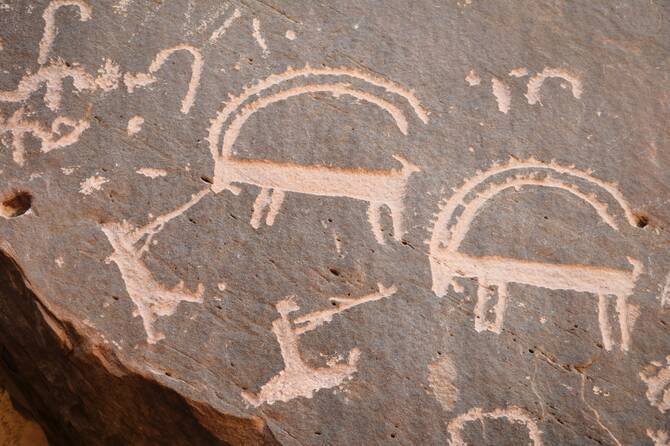


Eight locations across Saudi Arabia show carvings of lions on rocks and mountains in AlUla and Hail province, including in Shwaimes in Hail region. (Supplied)

The commission cautions that, while compelling, the lion iconography in AlUla does not conclusively prove that the predators lived there, since such images were also common in places like Classical Europe and Imperial China.

According to the RCU, the last confirmed sighting of lions in Saudi Arabia is currently unknown, but historical records allegedly support that lions persisted in Yemen into the early 20th century, and that the last known lions in Iraq were shot in 1918, with sightings in Iran in the 1940s.

While the RCU is engaged in reintroducing Arabian leopards to Saudi Arabia, there are no plans to bring back lions to the region.

Globally, lion populations have suffered severe declines: African lion numbers dropped by about 75 percent, with 43 percent of that loss occurring between 1990 and 2005.

World Lion Day, held on Aug. 10, serves as a reminder of the lion’s cultural heritage and renews the call for global conservation efforts to ensure their survival.


Young photographer highlights Qatif’s natural springs

Updated 8 sec ago
Follow

Young photographer highlights Qatif’s natural springs

RIYADH: Young photographer Redha Al-Hammad is documenting the fading natural springs of Qatif, a landscape shaped by water for thousands of years, before their stories disappear.

His new project, “O Breaker of the Louz,” captures the cultural memory surrounding the springs that once sustained one of the oldest settlements in the Arabian Peninsula.

Alhammad, a 20-year-old visual artist from Qatif and student at the American University of Sharjah, developed the project to preserve his hometown’s identity and share its untold narratives.

Qatif’s springs once fueled its agricultural prosperity, nourished date-palm droves, supported early communities, and served as fathering spaces for trade, social life and storytelling. Today, only one spring — Ayn Al-Labbani — still flows.

With limited written research available, Al-Hammad relied on oral histories from relatives and community elders.

“The good thing about being from a small city is that everyone knows everyone,” he told Arab News. “The stories that we hear … that our parents and our older family members tell us … a lot of the time they can kind of … get drowned out.”

One of his key sources was Abdulrasul Al-Gheryafi, an English teacher and local historian who grew up swimming in the springs and has long studied their disappearance. His firsthand accounts shaped the project and provided the folktale that inspired its title.

Al-Hammad began photographing at Ayn Al-Labbani, where locals still gather. He initially “had no idea” what the work would become until Al-Gheryafi shared the tale of a knight who encountered a mysterious voice while at a spring. The project became centered on the idea that springs are more than water sources; they are magical spaces embedded with communal memory and identity.

Al-Hammad wrote a poem based on the story to accompany the images and express what photography alone could not.

What started out as field notes for his research naturally formed as poetic lines, which luckily earned the seal of approval from poet, friend and collaborator Dalia Mustafa.

“Seeing her develop as a writer as well, that helped me come to terms with what poetry could be within the context of photographic work,” he said.

The project blends documentary photography with lyrical elements, a technique Al-Hammad first explored in “Mahanet” (“Did you not yearn for me?”), created with Mustafa during the Jameel Arts Centre Youth Assembly.

Told through low-contrast, dreamlike images, “Mahanet” maps memories, grief and changing landscapes in Qatif.

“I kind of recreated this experience that I had with my dad whenever I would go back home and he would drive me around,” Al-Hammad said, recounting how his father would explain how a sea once existed where there is now a residential area, or which streets were once fields of palm trees.

His second project, “L3eeb” (“Player”), developed under the Kingdom Photography Award, examines the role of football in transforming overlooked spaces into communal “third spaces” for Saudi youth.

Al-Hammad was mentored by photographer, visual artist and photo book publisher Roi Saade, whose guidance he describes as invaluable: “It fit perfectly, the pairing, because he works in kind of the same realm of narrative-based work. And he was with me every step of the way.

“The Kingdom Photography Award program is very important for people like me who are at the early stages of their artistic journey and have something to say, would definitely benefit from having a platform and … the kind of guidance and mentorship that the professionals around me provided.”

All Al-Hammad’s work centers on his hometown, Qatif. Initially, his photography was personal, helping him reconnect with home after years abroad. Over time, he expanded his focus to share Qatif’s culture and heritage with wider audiences, emphasizing the region has as rich and vibrant a voice as other parts of the Kingdom. 

Al-Hammad and Mustafa plan to turn “Mahanet” into a book next year, continuing their collaboration. 

Citing Saudi Arabia’s rich cultural diversity, Al-Hammad hopes similar opportunities expand to other artistic mediums. Through his work, he seeks to inspire others to document their communities, preserve local heritage and contribute to a broader understanding of the Kingdom’s identity.