

Pakistan grants first-ever ferry service license for routes to Iran, GCC countries

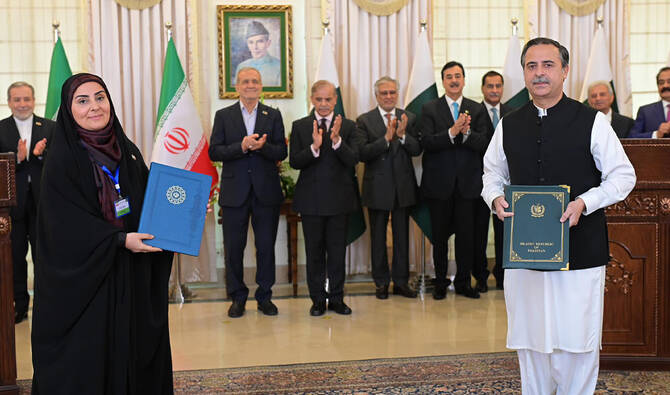
Pakistan's Minister for Maritime Affairs, Junaid Anwar Chaudhry (right) and Iran's Minister for Roads and Urban Development, Farzana Sadiq pose for pictures after signing bilateral agreement in Islamabad, Pakistan, on August 3, 2025. (Government of Pakistan)
Short Url
Updated 04 August 2025
Follow

Pakistan grants first-ever ferry service license for routes to Iran, GCC countries

  • The new ferry service is expected to serve hundreds of thousands annually, including Pakistani workers, tourists and pilgrims
  • It will alleviate pressure on land routes and reduce travel costs as compared to air transport, maritime affairs ministry says

KARACHI: Pakistan has granted its first-ever ferry service license to an international operator, Sea Keepers, for routes connecting Pakistan with Iran and Gulf Cooperation Council (GCC) countries, the Pakistani maritime affairs ministry said on Monday.

Sea Keepers Private Limited is a leading provider of innovative, sustainable, and efficient marine engineering, design and supply chain solutions, with a global footprint that includes offices in Pakistan, United Arab Emirates, United Kingdom and China. 

The approval followed a high-level meeting of the licensing committee, comprising officials from maritime affairs, defense, foreign affairs and interior ministries, along with representatives from the Pakistan National Shipping Corporation (PNSC) and Ports and Shipping authorities.

Maritime Affairs Minister Junaid Anwar Chaudhry hailed the move as a "historic step," aligned with Pakistan’s National Maritime Policy, and emphasized the opportunity this license creates for boosting regional connectivity, religious tourism and economic activity via sea routes.

"Initial operations will commence from the ports of Karachi and Gwadar using modern ferry vessels equipped with essential amenities to ensure safe, affordable travel," Chaudhry was quoted as saying by his ministry.

"Expansion of routes and port calls is planned based on demand and bilateral agreements."

The new ferry service is expected to serve hundreds of thousands annually, including workers and tourists bound for GCC states as well as pilgrims traveling to Iran and Iraq, alleviate pressure on land routes and reduce travel costs as compared to air transport for Pakistani diaspora and religious travelers, according to the Pakistani maritime affairs ministry. 

It did not specify a date for the start of operations.

The development comes amid Pakistan’s efforts to capitalize on its geostrategic location to boost trade and investment alongside tourism as it slowly recovers from a macroeconomic crisis under a $7 billion International Monetary Fund (IMF) program.

The country also plans to cut container dwell time at its seaports by up to 70 percent to improve trade competitiveness and ease congestion, while Islamabad last month reduced port charges for exporters by 50 percent at the second largest Port Qasim.

"This ferry service launch forms part of Pakistan’s broader strategy to develop its blue economy, improve trade logistics, and promote maritime tourism, reflecting a renewed commitment to sustainable regional sea transport infrastructure," Chaudhry added.


Pakistan minister calls for integrating ocean awareness into education to preserve ecosystems

Updated 31 January 2026
Follow

Pakistan minister calls for integrating ocean awareness into education to preserve ecosystems

  • Pakistan’s maritime sector posted a record $360 million profit in 2025 following a year of sweeping reforms
  • Junaid Anwar Chaudhry says education equips youth to make informed decisions, contribute to blue economy

KARACHI: Pakistan’s Maritime Affairs Minister Junaid Anwar Chaudhry has urged integrating ocean awareness into formal education systems and empowering youth as active partners in order to preserve marine ecosystems, his ministry said on Saturday.

Chaudhry said this at a meeting with Minister of State for Education and Professional Training, Wajiha Qamar, who called on him and discussed strategies for enhancing marine education, literacy, and youth engagement in sustainable ocean management.

Pakistan’s maritime sector posted a record Rs100 billion ($360 million) profit in 2025 following a year of sweeping reforms aimed at improving port efficiency, cost-cutting, and safeguarding marine ecosystems to boost the blue economy.

“Understanding our oceans is no longer optional, it is essential for climate resilience, sustainable development, and the long-term health of our maritime resources,” Chaudhry said, highlighting the critical role of marine literacy.

The minister said education equips youth to make informed decisions and actively contribute to marine conservation and the blue economy, urging inclusion of marine ecosystems, conservation and human-ocean interactions into curricula, teacher training and global citizenship programs.

“Initiatives like ‘Ocean Literacy for All’ can mainstream these elements in national policies, school programs, and community workshops to build proactive citizenship on marine challenges,” he added.

Ocean Literacy for All is a UNESCO Intergovernmental Oceanographic Commission–coordinated global initiative under the UN Ocean Decade (2021–2030) that promotes ocean awareness, education, and conservation.

Chaudhry announced reforms in maritime education, including granting degree-awarding status to the Pakistan Marine Academy, and the establishment of the Maritime Educational Endowment Fund (MEEF) to provide scholarships for deserving children from coastal communities.

“The scholarship program promotes inclusive development by enabling access to quality education for youth from over 70 coastal and fishing communities, particularly in Sindh and Balochistan,” he said.

The discussions underscored raising awareness about oceans, coastal ecosystems and marine resources, according to the Pakistani maritime affairs ministry. Both ministers stressed the need to integrate climate and marine education from classrooms

to community programs, addressing risks like rising sea temperatures, coastal erosion, biodiversity loss and pollution.

“Incorporating marine science and ocean literacy into curricula can help students connect local challenges with global trends,” Qamar said, underscoring education’s transformative power in building social resilience.

The meeting explored translating complex marine science into accessible public knowledge through sustained, solution-oriented awareness campaigns, according to the maritime affairs ministry.

With coastline facing pressures from climate change, pollution, and overexploitation, the ministers called for a coordinated approach blending formal education, informal learning and youth-led advocacy.

“A joint effort by the Ministries of Maritime Affairs and Education can cultivate an ocean-literate generation, transforming vulnerability into resilience and ensuring the long-term sustainability of coastal and marine ecosystems,” Chaudhry said.