




PUERTO AYORA, Ecuador: Tsunami warnings were lifted across the Pacific rim Wednesday, allowing millions of temporary evacuees to return home.
After one of the strongest earthquakes ever recorded rattled Russia’s sparsely populated Far East, more than a dozen nations — from Japan to the United States to Ecuador — warned citizens to stay away from coastal regions.
Storm surges of up to four meters (12 feet) were predicted for some parts of the Pacific, after the 8.8 quake struck off Russia’s Kamchatka peninsula.
The tsunamis caused widespread disruption. Peru closed 65 of its 121 Pacific ports and authorities on Maui canceled flights to and from the Hawaiian island.
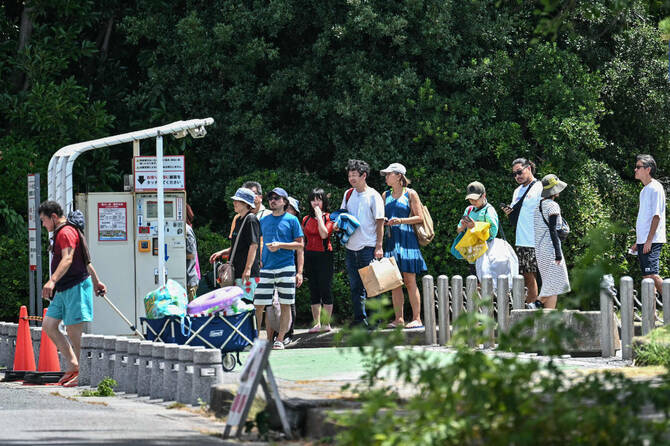
But fears of a catastrophe were not realized, with country after country lifting or downgrading warnings and telling coastal residents they could return.
In Japan, almost two million people had been ordered to higher ground, before the warnings were downgraded or rescinded.
The Fukushima nuclear plant in northeast Japan — destroyed by a huge quake and tsunami in 2011 — was temporarily evacuated.
The only reported fatality was a woman killed while driving her car off a cliff in Japan as she tried to escape, local media reported.
In Chile, authorities conducted what the Interior Ministry said was “perhaps the most massive evacuation ever carried out in our country” — with 1.4 million people ordered to high ground.
Chilean authorities reported no damage or victims and registered waves of just 60 centimeters (two feet) on the country’s north coast.
In the Galapagos Islands, where waves of up to three meters were expected, there was relief as the Ecuadoran navy’s oceanographic institute said the danger had passed.
Locals reported the sea level falling and then rising suddenly, a phenomenon which is commonly seen with the arrival of a tsunami.
But only a surge of just over a meter was reported, causing no damage.
“Everything is calm, I’m going back to work. The restaurants are reopening and the places tourists visit are also open again,” said 38-year-old Santa Cruz resident Isabel Grijalva.
Earlier national parks were closed, schools were shuttered, loudspeakers blared warnings and tourists were spirited off sightseeing boats and onto the safety of land.
The worst damage was seen in Russia, where a tsunami crashed through the port of Severo-Kurilsk and submerged the local fishing plant, officials said.

Russian state television footage showed buildings and debris swept into the sea.
The surge of water reached as far as the town’s World War II monument about 400 meters from the shoreline, said Mayor Alexander Ovsyannikov.
The initial quake also caused limited damage and only light injuries, despite being the strongest since 2011, when 15,000 people were killed in Japan.
Russian scientists reported that the Klyuchevskoy volcano erupted shortly after the earthquake.
“Red-hot lava is observed flowing down the western slope. There is a powerful glow above the volcano and explosions,” said Russia’s Geophysical Survey.
Wednesday’s quake was the strongest in the Kamchatka region since 1952, the regional seismic monitoring service said, warning of aftershocks of up to 7.5 magnitude.
The US Geological Survey said the quake was one of the 10 strongest tremors recorded since 1900.
It was followed by dozens of aftershocks that further shook the Russian Far East, including one of 6.9 magnitude.
The USGS said there was a 59 percent chance of an aftershock of more than 7.0 magnitude in the next week.


