

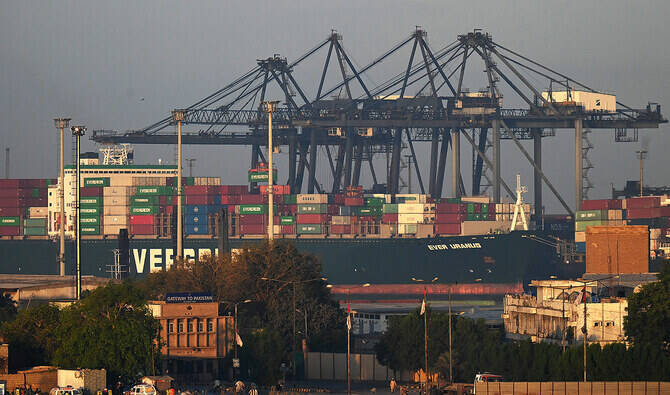

KARACHI: Pakistan is seeing a “modest” increase in transshipment activity as shipping disruptions across the Arab Gulf force global carriers to reroute cargo, with analysts and industry stakeholders saying the uptick offers limited but notable gains.
Pakistan last week revised its international transshipment rules, which shipping line representatives say now permit the handling of transshipment cargo both within and outside Pakistan’s sea and air ports.
The move came as global shipping lines grappled with mounting disruptions across key Middle Eastern routes, particularly through the Strait of Hormuz, a critical artery for global trade that has been blocked by Tehran.
The war, which began with US-Israeli strikes on Feb. 28, has already pushed up oil and gas prices and heightened risks for shipping across Gulf waters, prompting logistics companies to reassess routes and rely more on ports outside the conflict zones.
“We told the government that all, Dubai, Salalah and the Middle Eastern ports, are closed. Shipping lines are all worried,” Pakistan Ship’s Agents Association (PSAA) Secretary-General Syed Tahir Hussain said, adding the Pakistani government changed rules to allow storage of transshipment goods, including containers, bulk, break bulk or liquid cargo, in bonded areas, off-dock terminals and other places to avoid congestion.
“Ships that were supposed to go to Dubai and Salalah have already unloaded transshipment cargo here.”
The Karachi Port Trust (KPT) data showed that three private terminals, including Karachi Gateway Terminal Limited (KGTL), Karachi International Container Terminal (KICT) and South Asia Pakistan Terminal Limited (SAPTL), have handled more than 8,300 Twenty-foot Equivalent Units (TEUs) so far this month. A TEU is a standardized, non-physical unit of measurement used in maritime logistics to quantify cargo capacity of container ships, terminals and trade volume.
Since March 1, KGTL has handled 1,200 TEUs while KICT and SAPTL have handled 1,827 and 5,286 TEUs, respectively. UAE-based AD Ports operates KGTL while China’s Hutchinson Ports operates KICT and SAPTL in Pakistan’s southern port city of Karachi.
The shifting trade patterns have created an opportunity for alternative hubs, with ports in South Asia positioned to absorb diverted cargo and offer transshipment services.
Unzilla Shaikh, an investment analyst at Karachi-based brokerage firm Arif Habib Limited, says Pakistan is experiencing a temporary uptick in transshipment activity as regional shipping patterns were adjusting to ongoing disruptions, with port authorities and operators quickly responding to facilitate diverted cargo flows.
“From an economic standpoint, while this activity does generate some incremental port-related income through standard handling and dues, there are no additional windfall gains,” she told Arab News.
“The overall benefit remains modest.”
According to officials, private terminals were paying as much as $36 per container royalty to port operators at KPT and the Port Qasim Authority (PQA) in Karachi for every two vessel moves (discharge and load back).
SAPT pays $17.72 per container royalty to KPT, KICT pays $32, while KGTL pays $36, said an official at one of the terminals who requested anonymity as he was not authorized to discuss these rates publicly.
Another official at another terminal said Qasim International Container Terminal (QICT) was paying as much as $15 per container to PQA.
“This 8,000 TEUs local terminals have handled this month is still a very little volume,” he said.
However, Hussain, whose association represents foreign shipping lines such as Maersk, China Ocean Shipping Company and around 50 others, said the diversion of transshipment cargo has created port congestion.
“Two or three ships have filled storage,” he told Arab News. “There is no more space left.”
KPT spokesperson Shariq Amin Farooqui did not respond to a question about port congestion as he was awaiting approval from higher authorities at the country’s largest Karachi port.
Hussain said the ongoing war in the Middle East had created an opportunity for Pakistan which could make itself a permanent choice for transshipment traders by making port tariffs more competitive than peers like Dubai, Salalah and Colombo as well as competitors such as India and Hong Kong.
“Previously, we were not even in the race,” he said. “Now, due to the Middle East disruption, Pakistan has a unique opportunity as ships are looking for nearby alternatives and Pakistan is the closest. They can unload here and move later when conditions improve.”


