



TOKYO: One of the strongest earthquakes ever recorded struck off Russia’s sparsely populated Far East early Wednesday, sending tsunami waves into Japan, Hawaii and the US West Coast. Several people were injured, but none gravely, and no major damage has been reported so far.
Authorities warned the risk from the 8.8 magnitude quake could last for hours, and millions of people potentially in the path of the waves were initially told to move away from the shore or seek high ground.
The worst appeared to have passed for many areas, including the US, Japan and Russia. But along South America’s Pacific Coast, new warnings were forcing evacuations in Chile and Colombia.
In the immediate aftermath of the quake off Russia’s Kamchatka peninsula, residents fled inland as ports flooded, and several were injured while rushing to leave buildings.
In Japan, people flocked to evacuation centers, hilltop parks and rooftops in towns on the Pacific coast with fresh memories of the 2011 earthquake and tsunami that caused a nuclear disaster.
Cars jammed streets and highways in Honolulu, with standstill traffic even in areas away from the sea.
“We’ve got water, we got some snacks ... we’re going to stay elevated,” said Jimmy Markowski, whose family from Hot Springs, Arkansas, fled their Waikiki beach resort before evacuation orders were lifted. “This is our first tsunami warning ever. So this is all new to us.”
While tsunami advisories remain in place along much of the US West Coast, US Secretary of Homeland Security Kristi Noem said the worst was over.
“We were fully deployed and ready to respond if necessary but grateful that we didn’t have to deal with the situation that this could have been,” she told reporters in Chile, where she is meeting officials.
Unusually strong currents and unpredictable surges were expected in places as far away as New Zealand, and the National Weather Service warned the San Francisco Bay Area could see “some seriously dangerous currents along beaches and harbors.”
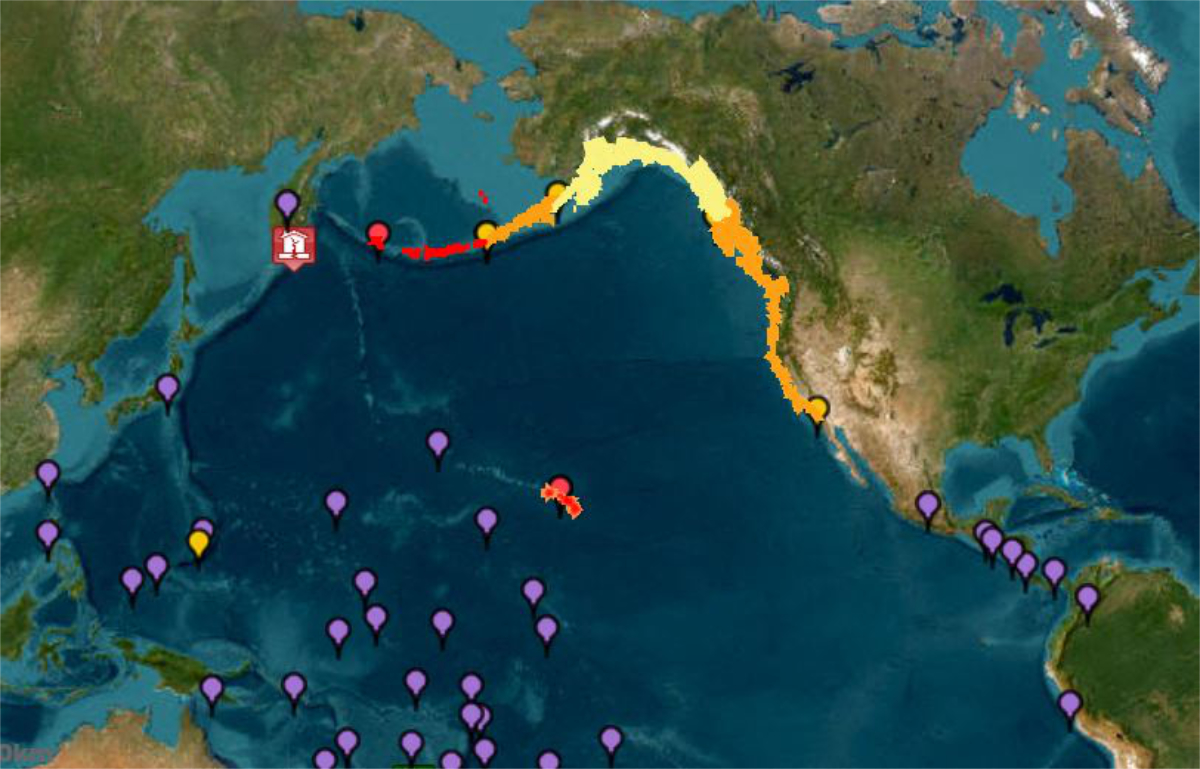
This image courtesy of the National Oceanic and Atmospheric Administration's (NOAA) Tsunami Warning System shows tsunami warnings (red), advisories (orange) watches (yellow) and threats (purple) after an 8.7 earthquake hit off of Russia's far east on July 30, 2025. (AFP)
Among the world’s strongest recorded quakes
The earthquake appeared to be the strongest recorded since the 9.0 magnitude earthquake off northeastern Japan in March 2011 that caused a massive tsunami and set off meltdowns at a nuclear power plant. The International Atomic Energy Agency said initial reports showed Japan’s nuclear plants were not affected Wednesday.
Only a few stronger earthquakes have ever been measured around the world. Wednesday’s occurred along the Pacific “Ring of Fire,” a series of seismic faults around the Pacific Ocean where most of the world’s earthquakes take place.
The quake struck at 11:24 a.m. in Kamchatka with a magnitude of 8.8 and a depth of about 21 kilometers (13 miles), according to the US Geological Survey. It was centered offshore, about 120 kilometers (75 miles) from Petropavlovsk-Kamchatsky, Kamchatka’s regional capital.
Multiple aftershocks as strong as 6.9 magnitude followed.
Russia’s Oceanology Institute said tsunami waves might have been as high as 10 to 15 meters (30 to 50 feet) in some sections of the Kamchatka coast — but the highest were less than 6 meters (20 feet) near the populated areas of the peninsula and the nearby Kuril Islands.
Meanwhile, lava began to flow Wednesday from Kamchatka’s Klyuchevskaya Sopka volcano, the largest active one in the Northern Hemisphere. Observers also heard explosions, the Russian Academy of Sciences’ geophysical service said.
Evacuations ordered in South America
Chile, a place highly vulnerable to earthquakes and subsequent tsunamis, raised its warning early Wednesday to the highest level for most of its lengthy Pacific coast and said it was evacuating hundreds of people.
“Remember that the first wave is usually not the strongest,” Chilean President Gabriel Boric warned on social media. “Let’s act calmly and follow official instructions.”
Colombian officials ordered the complete closure and evacuation of beaches and low-tide areas while maritime traffic was being restricted.
Education officials in Ecuador canceled classes at schools in the Galapagos Islands as well communities along the coast.
Russian regions report limited damage
In Petropavlovsk-Kamchatsky, Kamchatka’s regional capital, the quake damaged a local kindergarten, which was not in operation at the time because it was being renovated.
Oleg Melnikov, head of the regional health department, said several people hurt themselves while rushing to leave buildings and a hospital patient was injured while jumping out of a window. Melnikov said all injured people were stable.
A video released by a Russian media outlet showed a team of doctors at a cancer clinic on Kamchatka holding a patient and clutching medical equipment as the quake rocked an operating room, before continuing with surgery after the shaking stopped.
Authorities introduced a state of emergency on the sparsely populated nearby Kurils after the tsunami. They earlier reported that several waves flooded the fishing port of Severo-Kurilsk, the main city on the islands, and cut power supplies to the area. The port’s mayor said no major damage was recorded.
Authorities on Kamchatka peninsula and in the Kurils canceled their tsunami warnings but said some risk of waves remains.
Hawaii downgrades to tsunami advisory
Authorities in Hawaii downgraded the state to a tsunami advisory early Wednesday, and evacuation orders on the Big Island and Oahu, the most populated island, were lifted.
An advisory means there is the potential for strong currents and dangerous waves, as well as flooding on beaches or in harbors.
“As you return home, still stay off the beach and stay out of the water,” said James Barros, administrator of the Hawaii Emergency Management Agency.
In northern California, tsunami activity continued to build Wednesday morning with maximum confirmed heights along the coast of 3.6 feet (1.1 meters) in Crescent City.
The Oregon Department of Emergency Management said small tsunami waves were expected.
“This is not a major tsunami, but dangerous currents and strong waves may pose a risk to those near the water,” the department said.
A tsunami of less than 1 foot (30 centimeters) was forecast to hit parts of Vancouver Island, British Columbia, and waves of up to 1.4 feet (under 30 centimeters) above tide levels were observed in Alaska’s Aleutian Islands.
Dozens in Japan find refuge on hilltops and on rooftops
A tsunami of 2 feet (60 centimeters) was recorded in Hamanaka town in Hokkaido and Kuji port in Iwate, according to the Japan Meteorological Agency. Several areas reported smaller waves, and at least one person was injured.
In Iwaki city in Fukushima, which was the epicenter of the 2011 tsunami and quake, dozens of residents gathered at a hilltop park after a community siren sounded and breakwater gates were closed.
Workers at the Fukushima Daiichi nuclear plant, severely damaged in 2011, took shelter on higher ground while remotely monitoring operations, the operator said.
By late Wednesday, Japan had downgraded its tsunami alert but left an advisory in place along the Pacific coast.
Authorities in the Philippines, Mexico and New Zealand warned residents to watch for waves and strong currents. People were also urged to stay away from coastlines until any wave surges passed in Fiji, Samoa, Tonga, Federated States of Micronesia and Solomon Islands.


