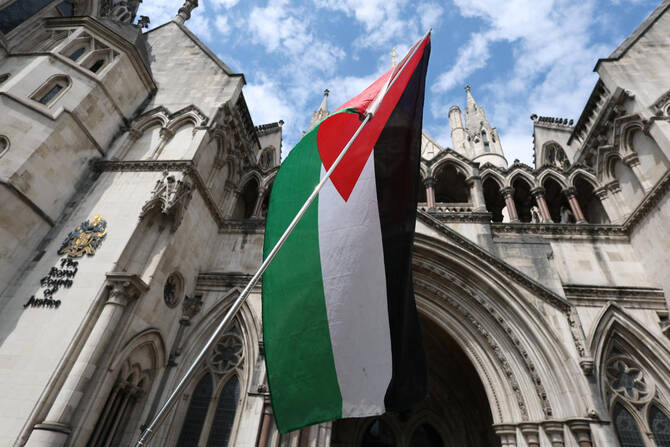
LONDON: The co-founder of a pro-Palestinian campaign group on Wednesday won her bid to bring a legal challenge against the British government’s decision to ban the group under anti-terrorism laws.
Huda Ammori, who helped found Palestine Action in 2020, asked London’s High Court to give the go-ahead for a full challenge to the group’s proscription, which was made on the grounds it committed or participated in acts of terrorism.
Palestine Action has increasingly targeted Israel-linked companies in Britain, often spraying red paint, blocking entrances or damaging equipment. It accuses Britain’s government of complicity in what it says are Israeli war crimes in
Gaza.
Earlier this month, the High Court refused Ammori’s application to pause the ban and, following an unsuccessful last-ditch appeal, Palestine Action’s proscription came into effect just after midnight on July 5.
Proscription makes it a crime to be a member of the group, carrying a maximum sentence of 14 years in prison.
Judge Martin Chamberlain granted permission for Ammori to bring a judicial review, saying her case that proscription amounted to a disproportionate interference with her and others’ right to freedom of expression was “reasonably arguable.”
Dozens of people
have been arrested
for holding placards purportedly supporting the group since the ban, and Ammori’s lawyers say people expressing support for the Palestinian cause have also been subject to increased scrutiny from police.
However, Britain’s interior minister Yvette Cooper has said violence and criminal damage have no place in legitimate protest and that Palestine Action’s activities – including breaking into a military base and
damaging two planes – justify proscription.
Israel has repeatedly denied committing abuses in its war in Gaza, which began after Palestinian militant group Hamas attacked Israel from Gaza on October 7, 2023.


Palestine Action wins bid to challenge UK ban under anti-terrorism laws
https://arab.news/v8ja2
Palestine Action wins bid to challenge UK ban under anti-terrorism laws

- Co-founder Huda Ammori asked London’s High Court to give the go-ahead for a full challenge to the group's proscription


Fourth Palestine Action activist ends hunger strike in UK prison
- Amy Gardiner-Gibson began eating again after 49 days of protest
- Govt rejects claims it ignored prison safety protocols
LONDON: A fourth Palestine Action activist imprisoned in the UK has ended her hunger strike.
Amy Gardiner-Gibson, who also uses the name Amu Gib, began eating again after 49 days of fasting, the campaign group Prisoners for Palestine said.
Qesser Zuhrah, another activist, ended her hunger strike last week after 48 days but said she might resume it next year, Sky News reported.
Four Palestine Action activists have now ended their hunger strikes while in prison, while four others are continuing to fast.
All of them are in prison on remand, awaiting trial for a series of high-profile alleged break-ins and criminal damage.
Palestine Action was proscribed as a terrorist organization and banned earlier this year.
On Tuesday, Swedish climate activist Greta Thunberg was arrested in central London at a rally in support of the hunger strikers.
The protesters are demanding that weapons factories in Britain with ties to Israel be shut down, as well as the removal of Palestine Action’s proscription.
They are also calling for immediate bail to be given to imprisoned pro-Palestine activists and an end to the alleged mistreatment of prisoners in custody.
Seven imprisoned members of Palestine Action have been transferred to hospital over the course of the hunger strike campaign. Doctors have highlighted concerns about the long-term impact of fasting on the activists.
Lawyers representing the group on Monday initiated legal action against the government over its alleged failure to follow prison safety regulations.
The government, however, has rejected this accusation, Sky News reported.
A Ministry of Justice spokesperson said: “Ministers do not intervene in individual cases. Where individuals are on remand, doing so would risk prejudicing ongoing legal proceedings and undermine the independence of the justice system.
“Concerns about welfare and process can be raised through established legal and administrative channels, including prison governors and ultimately the prison and probation ombudsman.
“Healthcare decisions are taken independently by qualified NHS professionals and appropriate care and oversight frameworks remain in place.”
The activists still on hunger strike include Heba Muraisi and Teuta Hoxha. Hoxha has been on remand for 13 months and her family told Sky News they feared she would die in prison.
Another of the activists, Kamran Ahmad, is believed to have been on hunger strike for 45 days and hospitalized three times.
Lewie Chiaramello, who has Type 1 diabetes, is on day 31 of his strike and taking part by fasting every other day.


