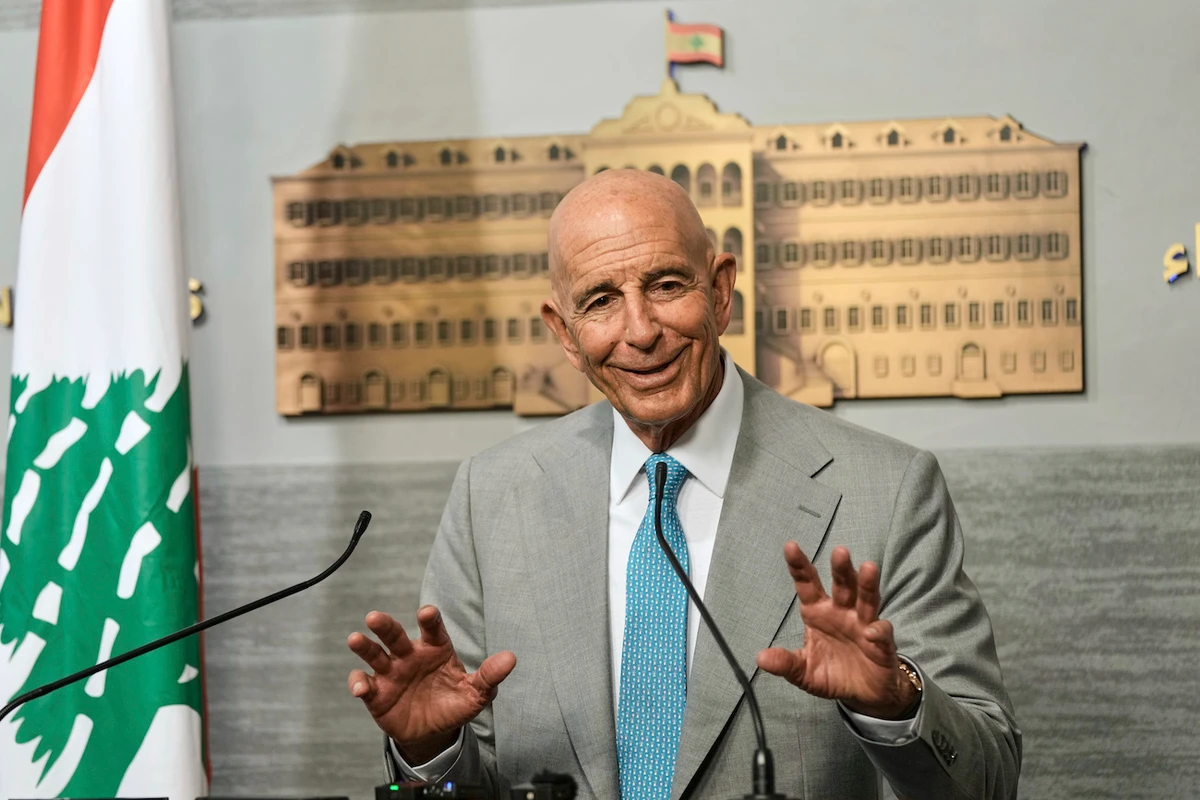
BEIRUT: A US envoy doubled down on Washington’s support for the new government in Syria, saying Monday there is “no Plan B” to working with the current authorities to unite the country still reeling from a nearly 14-year civil war and now wracked by a new outbreak of sectarian violence.
He took a critical tone toward Israel’s recent intervention in Syria, calling it poorly timed and saying that it complicated efforts to stabilize the region.
Tom Barrack, who is ambassador to Turkiye and special envoy to Syria and also has a short-term mandate in Lebanon, made the comments in an exclusive interview with The Associated Press during a visit to Beirut. He spoke following more than a week of clashes in the southern province of Sweida between militias of the Druze religious minority and local Sunni Muslim Bedouin tribes.
Syrian government forces intervened before withdrawing under a ceasefire agreement with Druze factions. Hundreds have been killed in the fighting.
In the meantime, Israel intervened last week on behalf of the Druze, who are seen as a loyal minority within Israel and often serve in its military. Israel launched dozens of strikes on convoys of government forces in Sweida and also struck the Syrian Ministry of Defense headquarters in central Damascus.
Over the weekend, Barrack announced a ceasefire between Syria and Israel, without giving details. Syrian government forces have redeployed in Sweida to halt renewed clashes between the Druze and Bedouins, and civilians from both sides were set to be evacuated Monday.
US envoy says Israeli intervention ‘came at a very bad time’
Barrack told the AP that “the killing, the revenge, the massacres on both sides” are “intolerable,” but that “the current government of Syria, in my opinion, has conducted themselves as best they can as a nascent government with very few resources to address the multiplicity of issues that arise in trying to bring a diverse society together.”
Regarding Israel’s strikes on Syria, Barrack said: “The United States was not asked, nor did they participate in that decision, nor was it the United States responsibility in matters that Israel feels is for its own self-defense.”
However, he said that Israel’s intervention “creates another very confusing chapter” and “came at a very bad time.”
Prior to the conflict in Sweida, Israel and Syria had been engaging in talks over security matters, while the Trump administration had been pushing them to move toward a full normalization of diplomatic relations.
When the latest fighting erupted, “Israel’s view was that south of Damascus was this questionable zone, so that whatever happened militarily in that zone needed to be agreed upon and discussed with them,” Barrack said. “The new government (in Syria) coming in was not exactly of that belief.”
The ceasefire announced Saturday between Syria and Israel is a limited agreement addressing only the conflict in Sweida, he said. It does not address the broader issues between the two countries, including Israel’s contention that the area south of Damascus should be a demilitarized zone.
In the discussions leading up to the ceasefire, Barrack said “both sides did the best they can” to came to an agreement on specific questions related to the movement of Syrian forces and equipment from Damascus to Sweida.
“Whether you accept that Israel can intervene in a sovereign state is a different question,” he said.
He suggested that Israel would prefer to see Syria fragmented and divided rather than a strong central state in control of the country.
“Strong nation states are a threat — especially Arab states are viewed as a threat to Israel,” he said. But in Syria, he said, “I think all of the the minority communities are smart enough to say, we’re better off together, centralized.”
US envoy doubles down on support for Syria’s government, criticizes Israel’s intervention
https://arab.news/vfzq7
US envoy doubles down on support for Syria’s government, criticizes Israel’s intervention
- Israel’s intervention “creates another very confusing chapter” and “came at a very bad time,” Barrack said
As tensions flare on Israel-Lebanon border, war-torn communities struggle to rebuild
- The Lebanon strikes have killed at least 127 civilians, including children, since the ceasefire took hold, according to a November UN report
- The Israeli strikes into southern Lebanon continue, with several a week
METULA, Israel: Ilan Rosenfeld walks through the burnt-out shell of his former business, stepping over crackling pieces of clay plates that used to line his cafe and past metal scraps of Hezbollah rockets littering the rubble.
It’s all that’s left for him in this small, war-ravaged town — the northernmost in Israel, surrounded on three sides by Lebanon.
“Everything I had, everything I saved, everything I built – it’s all burned,” he said as he scanned the damage of the business he’d run for 40 years in Metula, which has long been at the crosshairs of flare-ups along the volatile border. “Every day I wake up, and all I have left are tears.”
Rosenfeld was among tens of thousands of people forced from their homes when war broke out between Israel and the militant group Hezbollah in October 2023, following Hamas’ attack in southern Israel.
One year into a shaky ceasefire on this heavily fortified border, Israel’s government says most of those displaced have returned to their homes in the north, where they struggle to pick up the pieces of their lives. Others are reluctant to come back, as Israel has stepped up attacks in Lebanon. Communities like Metula that were in the center of the conflict remain little more than ghost towns, most still half empty, with many people skeptical of their government’s promise to keep them safe.
The Israeli strikes into southern Lebanon continue, with several a week. Hezbollah has refused to completely disarm until Israel fully withdraws.
“The security situation is starting to deteriorate again,” Rosenfeld said, looking at the bomb shelters on a list recently distributed by the local government. “And where am I in all this? I can barely survive the day-to-day.”
In some towns on the Israel-Lebanon border, the return has been a trickle
Metula residents were among the 64,000 forced to evacuate and relocate to hotels and temporary homes farther south when Hezbollah began firing rockets over the border into Israel in fall 2023. Months of fighting escalated into a full-fledged war. In September 2024, Israel killed 12 and wounded over 3,000 in a coordinated pager attack and killed Hezbollah’s leader in a strike. A month later, the ceasefire deal was reached.
Today, residents have trickled back to the sprawling apple orchards and mountains as Israel’s government encourages them to go home. Officials say about 55,000 people have returned.
In Metula, just over half of the 1,700 residents are back. Yet the streets remain largely empty.
Many hoped to rebuild their lives, but they returned to find 60 percent of the town’s homes damaged from rocket fire, according to the local government. Others were infested and destroyed by rats. The economy — largely based on tourism and agriculture — has been devastated.
With many people, especially young families, reluctant to return, some business owners have turned to workers from Thailand to fill labor shortages.
“Most of the people who worked with us before the war didn’t come back,” said Jacob Katz, who runs a produce business. “We’ve lost a lot … and we can’t read the future.”
Rosenfeld’s modest cafe and farm were perched on a hill overlooking the border fence. Tourists would come to eat, camp in buses converted to rooms and enjoy the view. But now, the towns on the Lebanese side of the border have been reduced to rubble by Israel’s attacks.
Without a home, Rosenfeld sleeps in a small shelter next to the scraps that remain of his business. He has little more than a tent, a refrigerator and a few chairs. Just a stone’s throw away sit a military watch tower and two armored vehicles.
Israel’s government says it has invested hundreds of millions of dollars in border recovery efforts, that it plans to invest more in economic revival, and that residents can apply for support funds.
But Rosenfeld said that despite his requests for government assistance, he hasn’t received any aid.
He’s among residents and business leaders who say they feel forgotten. Most say they need more resources to rebuild.
“The Israeli government needs to do much more for us,” Metula deputy mayor Avi Nadiv said. “The residents who live on Israel’s northern border, we are Israel’s human shield.”
A spokesman for Zeev Elkin, a Cabinet minister overseeing reconstruction in the north, said the local government has not used funds allocated to reconstruction “due to narrow political and oppositional considerations.”
Hezbollah-Israel tensions are flaring
As Hezbollah refuses to disarm, Israel has accused Lebanon’s government of not doing enough to neutralize the militant group. The Lebanese army says it has boosted its presence over the border area to strengthen the ceasefire.
Israel continues to bombard what it says are Hezbollah sites. Much of southern Lebanon has been left in ruins.
The strikes are among a number of offensives Israel has launched – including those in Gaza, the West Bank and Syria – in what it calls an effort to crack down on militant groups.
The Lebanon strikes have killed at least 127 civilians, including children, since the ceasefire took hold, according to a November UN report. UN special rapporteur Morris Tidball-Binz said the strikes amount to “war crimes.” Israel has maintained that it has the right to continue strikes to protect itself from Hezbollah rearming and accuses the group of using civilians as human shields.
Last week, Israel struck the southern suburbs of the Lebanese capital of Beirut, killing Hezbollah’s top military commander. The group, still weakened by last year’s fighting, has not responded.
‘The army cannot protect me’
In Metula, signs of the tensions are everywhere. The local government’s list of public shelters reads: “Metula is prepared for an emergency.”
Explosions and gunfire periodically echo from military drills while farmer Levav Weinberg plays with his 10-, 8- and 6-year-old children. Weinberg, a military reservist, said his kids are too scared to ride their bikes on the street.
Weinberg, 44, and his family returned in July, skeptical of the government’s promise that everything was returning to normal but eager to keep their business alive.
Metula’s government continues to encourage people to come back, telling residents the region is safe and the economy will bounce back.
“Today we feel the winds of, let’s call it, the winds of war – but it doesn’t deter us,” Nadiv said. “Coming back to Metula – there’s nothing to be afraid of. ... The army is here. The houses are fortified. Metula is prepared for anything.”
Weinberg isn’t so sure. In recent weeks, he and his wife have considered leaving once again.
“The army cannot protect me and my family,” Weinberg said. “You sacrifice your family to live in Metula these days. It’s not a perfect life, it’s not that easy, and at some point your kids pay the price.”