

Pakistan stock market sheds over 5,400 points amid US-Iran tensions, lack of risk appetite

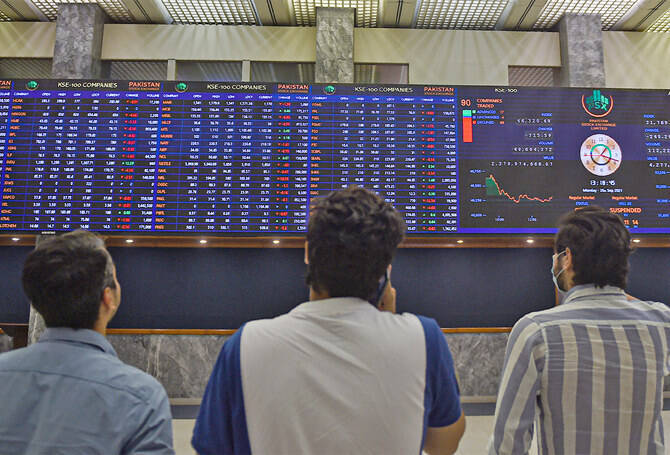
Stockbrokers watch an index board showing the latest share prices during a trading session at the Pakistan Stock Exchange (PSX) in Karachi, Pakistan, on September 20, 2021. (AFP/File)
Short Url
Updated 23 February 2026
Follow

Pakistan stock market sheds over 5,400 points amid US-Iran tensions, lack of risk appetite

  • Trump said on Thursday he would decide in ‘10 or 15 days’ whether to order strikes on Iran if no nuclear deal is reached
  • Despite the decline, the market witnessed trading activity, with 461 million shares traded and a turnover of $89 million

KARACHI: The Pakistan Stock Exchange (PSX) tumbled sharply and lost more than 5,400 points on Monday, the market data showed, amid escalating geopolitical tensions between the United States and Iran and a marked lack of investor risk appetite.

The benchmark KSE-100 index 5,478 points, or 3.16 percent, to close at 167,691 points on Monday as compared to Friday’s close of 173,169 points, according to the PSX website.

The development comes a day after US President Donald Trump said he would decide in “10 or 15 days” whether to order strikes on Iran if no nuclear deal is reached. Iran has said any US attack would be an “act of aggression” that would precipitate a response.

“Risk appetite remains fragile. Markets are still pricing uncertainty,” Muhammad Waqas Ghani, head of research at JS Global Capital, told Arab News.

“Investors don’t wait for inflation prints, trade disruptions, or macro data to confirm the damage, they sell first on heightened geopolitical risk.”

During the intra-day trade, the index fluctuated within the range of 174,336 to 166,886 points, largely influenced by rollover-week dynamics, according to a market review by Topline Securities.

Index-heavy constituents, including Fauji Fertilizer Company (FFC), Lucky Cement (LUCK), Engro Holdings (ENGROH), National Bank of Pakistan (NBP) and Habib Bank Limited (HBL), emerged as the principal laggards, collectively dragging the benchmark down by 1,797 points during the session.

Despite the decline, the market witnessed trading activity, with total volume of 461 million shares and turnover amounting to Rs24.9 billion ($89 million). K-Electric led the volumes chart, recording over 35.9 million shares traded.


Pakistan stocks plunge 9 percent, trading halted as Middle East tensions rattle markets

Updated 4 sec ago
Follow

Pakistan stocks plunge 9 percent, trading halted as Middle East tensions rattle markets

  • Benchmark index triggers automatic halt minutes after opening
  • Rising oil prices raise concerns over inflation, import bill and currency pressure

ISLAMABAD: Pakistan’s stock market fell nearly 9 percent within the first few minutes of trading on Monday, triggering an automatic one-hour halt under risk management rules, following intensifying hostilities in the Middle East.

Trading on the Pakistan Stock Exchange (PSX) was temporarily suspended after the sharp early selloff, reflecting panic across regional markets. The market reaction came after the United States and Israel conducted strikes in Iran over the weekend that killed Supreme Leader Ayatollah Ali Khamenei and other senior officials. Iran retaliated by bombing US bases in Gulf states and direct attacks on Israel. Concerns over potential disruption to energy supplies, particularly through the Strait of Hormuz l, which handles roughly one-fifth of global oil shipments, pushed crude prices sharply higher.

Although Pakistan, which borders Iran, is not directly involved in the conflict, the country remains vulnerable to external shocks due to its heavy reliance on imported energy and remittances from the Gulf region, analysts said.

“Due to the evolving nature of the conflict and involvement of various countries, the volatility may continue till the resolution or de-escalation of this conflict,” Topline Securities said in a note to clients.

The brokerage said Pakistan’s benchmark index has already fallen about 19 percent from its January high of 189,000 points and warned that further instability could weigh on investor sentiment.

Oil prices rose 6–7 percent in the latest session and are up about 15 percent over the past seven trading sessions amid mounting regional uncertainty, according to the brokerage note.

Pakistan imports an estimated $15–16 billion worth of petroleum products annually, including crude oil, refined fuel, LNG and LPG. Every 10 percent increase in oil prices could raise the country’s import bill by approximately $1.5–1.6 billion, Topline said. Other imports linked to energy prices include edible oil, coal and rubber-based products.

Higher oil prices could also feed into inflation. 

“Every 10 percent increase in crude oil prices may elevate inflation estimates by 40–50 basis points,” the brokerage said, noting both direct fuel price impacts and secondary effects across supply chains.

Analysts also flagged potential currency pressure, as rising import costs and concerns over Middle East instability, a region that accounts for more than half of Pakistan’s remittance inflows, could weigh on the rupee.

However, Topline said Pakistan’s foreign exchange reserves remain at relatively comfortable levels due to recent credit rating improvements and proactive central bank interventions.

With Monday’s decline, the market is now trading below 6.5 times projected 2027 earnings, compared with a historical average of 6.9 times, the brokerage added.

The conflict’s trajectory remains uncertain, and investors are closely watching developments in the Gulf, particularly around energy routes and further retaliatory actions.