

Egypt grand museum delay puts tourism hopes on hold

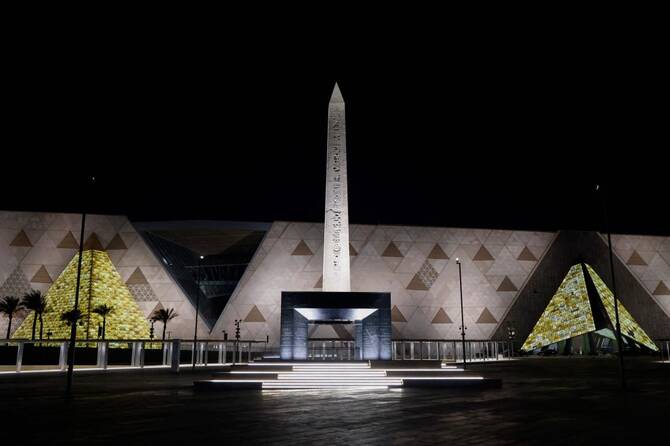
The Obelisk of Ramses II is pictured before the facade and entrance of the new Grand Egyptian Museum in Giza near Cairo late on April 6, 2025. (AFP)
Short Url
Updated 15 July 2025
Follow

Egypt grand museum delay puts tourism hopes on hold

  • The vast museum, two decades in the making, has faced repeated delays
  • Tourism accounts for about 10 percent of Egypt’s workforce, but the sector has struggled

CAIRO: In the shadow of the Grand Egyptian Museum, souvenir shop owner Mona has been readying for the tourist boom she hoped the long-awaited opening would bring – now once again out of reach.

“I had bet everything on this opening,” she said from her shop, just steps from the iconic pyramids of Giza, which the much-anticipated museum overlooks.

Originally scheduled to fully open this month, the museum was expected to attract up to five million visitors annually, fueling optimism across Cairo’s battered tourism sector.

“We planned our entire summer and fall packages around the museum opening,” said Nadine Ahmed, a 28-year-old agent with Time Travel tours.

“But with group cancelations, refunds and route changes, we’ve lost tens of thousands of dollars.”

Though parts of the museum have been open for months, the main draw – the treasures of Tutankhamun – will remain under wraps until the official launch.

Less than three weeks before its July 3 opening, the government announced another delay, this time pushing the landmark event to the final quarter of the year.

Prime Minister Mostafa Madbouly cited regional security concerns and the desire to host an event of “global scale.”

The vast museum, two decades in the making, has faced repeated delays – from political upheaval and economic crises to the COVID-19 pandemic.

Ahead of the expected launch, Mona, who asked to be identified by her first name only, took out a loan to renovate her store and stock up on goods inspired by the museum’s collection.

A few streets away, Mohamed Mamdouh Khattab, 38, prepared months in advance, hiring and training extra staff and expanding his inventory.

“The opening of the museum is a key milestone,” said Khattab, who owns a sprawling bazaar of handcrafted jewelry and ancient replicas.

“It’s a project that should have been launched a long time ago,” said the vendor, whose family has been in the industry since the 1970s.

Tourism accounts for about 10 percent of Egypt’s workforce, but the sector has struggled – from the fallout of the 2011 Arab Spring to militant attacks and the COVID-19 shutdown.

Still, signs of recovery have emerged: Egypt welcomed 3.9 million tourists in the first quarter of 2025, up 25 percent from the same period last year – itself a record.

At a Giza papyrus workshop, 30-year-old tour guide Sara Mahmoud hopes the opening will revive visitor numbers.

“Big openings have brought a lot of tourism to Egypt before,” she said, pointing to the 2021 Pharaohs’ Golden Parade and the reopening of the Avenue of the Sphinxes.

“These events get people excited – we saw the crowds coming in.”

Such momentum could make a real difference, said Ragui Assaad, an economist at the University of Minnesota.

“Any initiative that directly increases foreign exchange earnings is likely to have a good return on investment,” he said.

“If you compare it with all the other mega-projects, which do not increase foreign exchange earnings... this is a far better project.”

He was referring to a sweeping infrastructure drive under President Abdel Fattah El-Sisi, including the construction of a massive new administrative capital east of Cairo.

The stakes are high: since 2022, Egypt’s currency has lost two-thirds of its value, squeezing household budgets and straining every layer of the economy.

“There were days when I sold just one bracelet,” Mona lamented, thinking back to the years when “tourists arrived in droves.”


US military launches strikes in Syria against Daesh fighters after American deaths

Updated 20 December 2025
Follow

US military launches strikes in Syria against Daesh fighters after American deaths

  • “This is not the beginning of a war — it is a declaration of vengeance,” Defense Secretary Pete Hegseth says
  • President Trump earlier pledged “very serious retaliation” but stressed that Syria was fighting alongside US troops

WASHINGTON: The Trump administration launched military strikes Friday in Syria to “eliminate” Daesh group fighters and weapons sites in retaliation for an ambush attack that killed two US troops and an American interpreter almost a week ago.
A US official described it as “a large-scale” strike that hit 70 targets in areas across central Syria that had Daesh (also known as Islamic State or IS) infrastructure and weapons. Another US official, who also spoke on condition of anonymity to discuss sensitive operations, said more strikes should be expected.
The attack was conducted using F-15 Eagle jets, A-10 Thunderbolt ground attack aircraft and AH-64 Apache helicopters, the officials said. F-16 fighter jets from Jordan and HIMARS rocket artillery also were used, one official said.
“This is not the beginning of a war — it is a declaration of vengeance. The United States of America, under President Trump’s leadership, will never hesitate and never relent to defend our people,” Defense Secretary Pete Hegseth said on social media.


President Donald Trump had pledged “very serious retaliation” after the shooting in the Syrian desert, for which he blamed Daesh. The troops were among hundreds of US troops deployed in eastern Syria as part of a coalition fighting the terrorist group.
Trump in a social media post said the strikes were targeting Daesh “strongholds.” He reiterated his support for Syrian President Ahmad Al-Sharaa, who he said was “fully in support” of the US effort to target the militant group.
Trump also offered an all-caps threat, warning the group against attacking US personnel again.
“All terrorists who are evil enough to attack Americans are hereby warned — YOU WILL BE HIT HARDER THAN YOU HAVE EVER BEEN HIT BEFORE IF YOU, IN ANY WAY, ATTACK OR THREATEN THE USA.,” the president added.
The attack was a major test for the warming ties between the United States and Syria since the ouster of autocratic leader Bashar Assad a year ago. Trump has stressed that Syria was fighting alongside US troops and said Al-Sharaa was “extremely angry and disturbed by this attack,” which came as the US military is expanding its cooperation with Syrian security forces.
Syria’s foreign ministry in a statement on X following the launch of US strikes said that last week’s attack “underscores the urgent necessity of strengthening international cooperation to combat terrorism in all its forms” and that Syria is committed “to fighting Daesh and ensuring that it has no safe havens on Syrian territory and will continue to intensify military operations against it wherever it poses a threat.”


Daesh has not claimed responsibility for the attack on the US service members, but the group has claimed responsibility for two attacks on Syrian security forces since, one of which killed four Syrian soldiers in Idlib province. The group in its statements described Al-Sharaa’s government and army as “apostates.” While Al-Sharaa once led a group affiliated with Al-Qaeda, he has had a long-running enmity with Daesh.
Syrian state television reported that the US strikes hit targets in rural areas of Deir ez-Zor and Raqqa provinces and in the Jabal Al-Amour area near Palmyra. It said they targeted “weapons storage sites and headquarters used by Daesh as launching points for its operations in the region.”

Trump this week met privately with the families of the slain Americans at Dover Air Force Base in Delaware before he joined top military officials and other dignitaries on the tarmac for the dignified transfer, a solemn and largely silent ritual honoring US service members killed in action.

President Donald Trump, from left, Defense Secretary Pete Hegseth and Chairman of the Joint Chiefs Air Force Gen. Dan Caine attend a casualty return ceremony at Dover Air Force Base, Delaware, on Dec. 17, 2025,of soldiers who were killed in an attack in Syria last week. (AP)

The guardsmen killed in Syria last Saturday were Sgt. Edgar Brian Torres-Tovar, 25, of Des Moines, and Sgt. William Nathaniel Howard, 29, of Marshalltown, according to the US Army. Ayad Mansoor Sakat, of Macomb, Michigan, a US civilian working as an interpreter, was also killed.
The shooting nearly a week ago near the historic city of Palmyra also wounded three other US troops as well as members of Syria’s security forces, and the gunman was killed. The assailant had joined Syria’s internal security forces as a base security guard two months ago and recently was reassigned because of suspicions that he might be affiliated with Daesh, Interior Ministry spokesperson Nour Al-Din Al-Baba has said.
The man stormed a meeting between US and Syrian security officials who were having lunch together and opened fire after clashing with Syrian guards.
When asked for further information, the Pentagon referred AP to Hegseth’s social media post.