Pakistan demands political dialogue, immediate ceasefire as Sudan conflict rages on

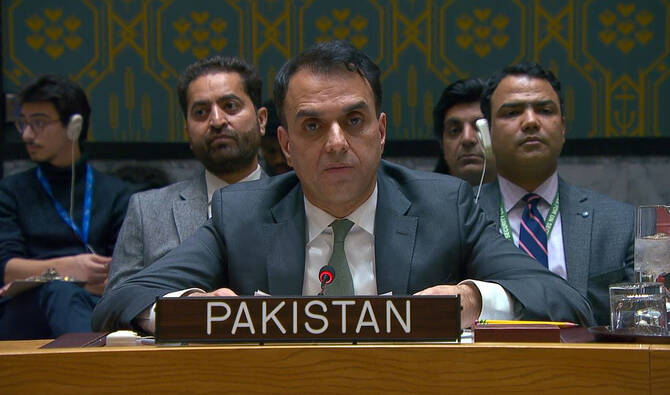
Pakistan's ambassador to the United Nations, Usman Jadoon (center), addressing the United Nations Security Council Meeting on the Situation in Sudan in New York, US, on December 22, 2025. (@PakistanUN_NY/X)
Short Url
Updated 23 December 2025
Follow

Pakistan demands political dialogue, immediate ceasefire as Sudan conflict rages on

  • Sudan’s civil war since April 2023 has killed over 40,000 people, displaced over 14 million people
  • Pakistan urges Security Council to reject parallel government entities undermining state institutions

ISLAMABAD: Pakistan’s UN envoy has demanded a political dialogue and an immediate ceasefire in Sudan, where fierce fighting has raged on for months between the military and a powerful paramilitary force.

Sudan plunged into chaos in April 2023 when a power struggle between the military and the Rapid Support Forces exploded into open fighting, with widespread mass killings and rapes, and ethnically motivated violence. This has amounted to war crimes and crimes against humanity, according to the UN and international rights groups.

Sudan’s Prime Minister Kamal Idris, who heads its transitional civilian government, proposed a peace plan on Monday. Idris said his plan includes a ceasefire monitored by the United Nations, African Union and Arab League, and the withdrawal of paramilitary forces from all areas they occupy, their placement in supervised camps and their disarmament.

“There is no military solution to the conflict in Sudan,” Usman Jadoon, Pakistan’s deputy ambassador at the United Nations, said on Monday. “The only durable path forward lies in a political dialogue and reconciliation.”

Jadoon said Pakistan supports all genuine efforts and political processes aimed at achieving an immediate cessation of hostilities and ceasefire, protecting civilians and providing unfettered humanitarian access to civilians. 

He called on the UN Security Council to support all efforts to safeguard Sudan’s territorial integrity and sovereignty and reject “so-called parallel government or structures” that undermine state institutions and risk the country’s fragmentation. 

The Pakistani envoy called for maintaining “zero tolerance” for war crimes, including attacks against UN peacekeepers and humanitarian workers, with credible investigations and accountability of the perpetrators.

“The brotherly people of Sudan have suffered beyond measure,” Jadoon said. “The guns must be silenced; hopes for a brighter future rekindled; with peace and normalcy visible on the horizon.”

The devastating war in Sudan has killed more than 40,000 people according to UN figures, but aid groups say the true number could be many times higher. 

The conflict has created the world’s largest humanitarian crisis, with over 14 million people displaced, disease outbreaks and famine spreading in parts of the country.


Pakistan court-appointed lawyer flags concerns over Imran Khan’s eye condition in jail report

Updated 36 min 42 sec ago
Follow

Pakistan court-appointed lawyer flags concerns over Imran Khan’s eye condition in jail report

  • Amicus curiae recommends independent ophthalmology review “without delay”
  • PTI party says court-ordered exam vindicates concerns over medical access

ISLAMABAD: A court-appointed lawyer has recommended that jailed ex-premier Imran Khan undergo an independent and urgent ophthalmological examination, warning of the “gravity” of his deteriorating eye condition in a written report submitted to the Supreme Court and seen by Arab News on Thursday.

Barrister Salman Safdar, appointed as amicus curiae earlier this week, visited Khan at Rawalpindi’s Adiala jail and later filed a detailed report on his living conditions and health. The report states that in view of the seriousness of Khan’s ocular condition, “it is imperative that the seriousness of the condition be independently ascertained without delay.”

“The undersigned recommends that the Petitioner be examined at the earliest by a team of expert ophthalmologists,” the report said.

Concerns about Khan’s health have resurfaced in recent weeks after authorities confirmed he had been briefly taken from prison to a hospital in Islamabad for an eye procedure. The government said at the time his condition was stable, while Khan’s family and his Pakistan Tehreek-e-Insaf political party complained they had not been informed in advance and alleged he was being denied timely and independent medical access.

The issue was then taken up by the Supreme Court earlier this week, which appointed Safdar as a “friend of the court” to visit Khan in prison and submit a written report.

According to a medical condition report from the Pakistan Institute of Medical Sciences (PIMS), dated Feb. 6, 2026 and referenced in Safdar’s court filing, Khan was diagnosed with “right central retinal vein occlusion” after reporting reduced vision in his right eye.

The report states that he underwent anti-VEGF intravitreal injection treatment at PIMS and was discharged with follow-up advice.

However, in his interaction with Safdar, Khan said he had experienced “rapid and substantial loss of vision over the preceding three months” and claimed his complaints had not been addressed promptly while in custody. He further stated that despite treatment, he had been left with “only 15 percent vision in his right eye.”

Safdar’s report notes that the former premier appeared “visibly perturbed and deeply distressed by the loss of vision and the absence of timely and specialized medical intervention.”

The amicus also recommended that the Supreme Court consider directing involvement of Khan’s personal physicians or other specialists of his choice, warning that “any further delay poses a serious risk to the Petitioner’s well-being.”

LIVING CONDITIONS 

Beyond medical concerns, the report addressed Khan’s confinement conditions, noting that he expressed “satisfaction regarding his safety and security within the cell-block,” as well as contentment with basic amenities and food provisions.

However, Safdar flagged several areas requiring intervention, including: Independent medical reassessment of his eye condition; restoration of regular access to legal counsel; permission to meet blood relatives and communicate with his sons; and improved mosquito control and provision of a refrigerator for food storage.

The report also recorded that Khan has been in solitary confinement for approximately two years and four months.

PTI REACTION 

Following the submission of the report, Khan’s PTI party said on Thursday that the Supreme Court had ordered a full eye examination to be completed before Feb. 16.

“The Supreme Court’s order for a complete eye check-up of Imran Khan vindicates the party’s longstanding concerns about his deteriorating health and denial of timely, independent medical care in custody,” the party said in a statement.

“This is bigger than one medical test. It is about whether the rule of law applies to political opponents, or only to protect those in power,” it added, demanding “immediate and transparent implementation of the Court’s order” and “unrestricted access to qualified specialists of his choice.”

Khan, 73, has been in custody since August 2023 in connection with multiple cases that he and his party describe as politically motivated. The government denies the allegation.

There was no immediate response from the government on Thursday to the findings and recommendations contained in Safdar’s report.