

Eight militants, five cops killed in ambush in northwest Pakistan

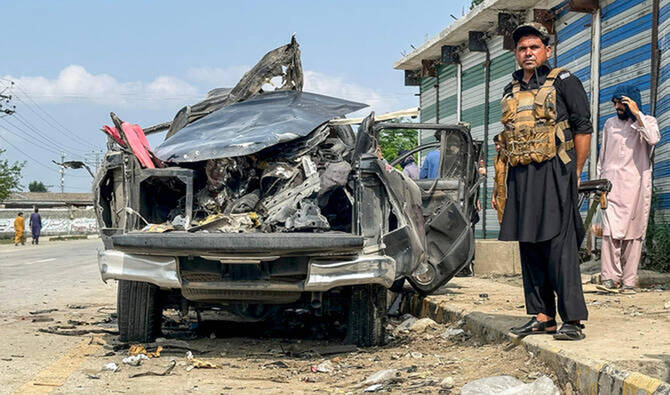
A security personnel stands guard beside the wreckage of a vehicle after a blast in Bajaur district of Khyber Pakhtunkhwa province, Pakistan, on July 2, 2025. (AFP/File)
Short Url
Updated 23 December 2025
Follow

Eight militants, five cops killed in ambush in northwest Pakistan

  • Over a dozen gunmen ambushed a police van in Khyber Pakhtunkhwa’s Karak district, police say
  • The northwestern Pakistani province has witnessed a surge in militant attacks in recent months

PESHAWAR: Eight militants and five cops were killed after when a group of gunmen ambushed a police van in Pakistan’s northwestern Khyber Pakhtunkhwa (KP) province, a police official said on Tuesday.

Over a dozen gunmen ambushed the police van in Gurguri area of the Karak district, killing five policemen, after which reinforcements were sent to the site, according to Karak police spokesperson Shaukat Khan.

Karak police, together with the counter-terrorism department (CTD), conducted a joint operation to chase the militants. Consequently, eight militants were killed in a gunfight with law enforcers in the nearby hills.

“The bodies of the terrorists have been shifted to hospital for post-mortem and the identification process is underway,” Khan told Arab News.

No group immediately claimed responsibility for the attack on the police van in Gurguri, which is home to a large gas field. However, similar attacks on police and security forces have been claimed in the past by the Tehreek-e-Taliban Pakistan (TTP) or the Pakistani Taliban.

Khan identified the slain policemen as Shahid Iqbal, Arif, Sami Ullah, Safdar and Muhammad Ibrar.

Pakistan has witnessed a surge in militant activities, particularly in KP that borders Afghanistan, in recent months.

Earlier this month, one police constable was killed while five others were injured in a suicide blast that targeted a police vehicle in the Lakki Marwat district. Similarly, three police personnel were killed in November when militants attacked a checkpost in Hangu city.

Pakistan has frequently blamed Afghanistan for facilitating cross-border attacks against its security forces and turning a blind eye to the TTP’s activities on its soil. Afghanistan rejects the allegations and says it cannot be held responsible for Islamabad’s security lapses.


Pakistan PM approves framework for National Energy Plan aimed at cutting power costs

Updated 4 sec ago
Follow

Pakistan PM approves framework for National Energy Plan aimed at cutting power costs

  • Electricity costs in Pakistan have been a major concern for both industries and domestic consumers
  • PM Shehbaz Sharif instructs authorities to expedite privatization of power distribution companies

ISLAMABAD: Prime Minister Shehbaz Sharif on Wednesday approved the framework for a National Energy Plan aimed at ensuring low electricity costs for industries and facilitating domestic consumers, Pakistani state broadcaster reported. 

The development took place during a meeting of the Cabinet Committee on Energy in Islamabad presided over by Sharif. The Pakistani prime minister directed all ministries and provincial governments to present a “workable and coordinated” strategy under the proposed plan.

Electricity costs in Pakistan have been a major concern for both industries and domestic consumers. Industrial users often face high tariffs that increase production cost while residential consumers struggle with rising bills that impact household budgets. 

“Prime Minister Shehbaz Sharif has given in-principle approval for the formulation of a comprehensive National Energy Plan in consultation with relevant ministries and provincial governments,” Radio Pakistan said in a report.

“He emphasized that the government’s top priorities include ensuring electricity supply to industries at the lowest possible cost and providing facilitation for domestic consumers.”

Sharif also approved the establishment of a dedicated secretariat for the National Energy Plan and gave approval to the framework guidelines for auctioning wheeling charges, it added.

Wheeling charges are fees paid for using another company’s power grid to transmit electricity from a generator to a consumer, covering the cost of transporting electricity over someone else’s network.

The report said Sharif instructed authorities to include the recommendations of the climate change, finance, industries and petroleum ministries into the plan. 

Sharif also gave instructions to expedite the privatization of power distribution companies (DISCOs) and urged competitive tariffs for industries to boost production capacity.

Fluctuations in fuel prices, inefficiencies in the power sector, and reliance on imported energy have contributed to high electricity costs in Pakistan in recent years, making energy affordability and stability a key focus for government policies and reforms.

Pakistan has pushed energy sector reforms to tackle long-standing issues like circular debt, power theft, and transmission losses, which have caused blackouts and high electricity costs. 

In February, Pakistan developed a new energy policy that it says will help the country attract $5 billion in investment through public-private partnerships.