

Pakistan concludes bidding for PIA privatization as Arif Habib Group clinches sale

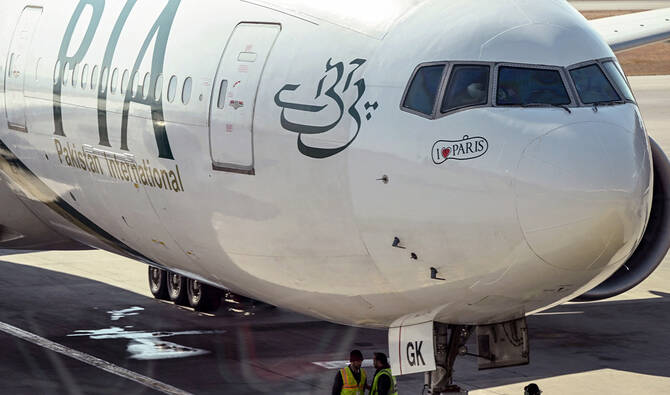
Ground staff stand next to the Pakistan International Airline (PIA) aircraft ahead of its takeoff for Paris at the Islamabad International Airport on January 10, 2025. (AFP/File)
Short Url
Updated 23 December 2025
Follow

Pakistan concludes bidding for PIA privatization as Arif Habib Group clinches sale

  • Arif Habib Group bids $486 million, defeating Lucky Group in the second round of the auction
  • Earlier, three prequalified bidders submitted their offers for a 75 percent stake in the airline

ISLAMABAD: Pakistan on Tuesday concluded bidding for the privatization of its loss-making national flag carrier, Pakistan International Airlines (PIA), with the Arif Habib Group emerging as the winner after a second round with a Rs135 billion ($486 million) bid, state television showed.

Three prequalified bidders submitted offers for a 75 percent stake in the airline, with the Arif Habib Group opening with a bid of Rs115 billion ($414 million), ahead of Rs101.5 billion ($365 million) from the Lucky Group and Rs26.5 billion ($95 million) from private airline Airblue.

The opening round developed into a prolonged head-to-head contest between the two leading bidders, with Lucky Group repeatedly matching higher offers before the Arif Habib Group finally pulled ahead with a Rs135 billion bid in the second round.

“We would like to congratulate the Arif Habib Consortium on winning,” a representative of the Lucky Group said, conceding after the final round.

The bids were opened and concluded in a live, televised ceremony in the presence of bidders and media representatives, part of what the government has described as an effort to ensure transparency in one of the country’s largest privatization transactions.

“It is extremely necessary to make this entire process transparent because this is the biggest transaction in the history of Pakistan,” Prime Minister Shehbaz Sharif said during a cabinet meeting earlier in the day.

“If the auction is held in a successful manner, then privatization will just take off,” he added.

Pakistan moved to privatize PIA while retaining its name and branding, according to the prime minister’s office.

The sale marks Islamabad’s most aggressive attempt in decades to reform the debt-ridden airline, which has accumulated more than $2.8 billion in losses.

Earlier, the government had prequalified four investor groups in July, but Fauji Fertilizer Company, part of a military-backed conglomerate, withdrew from the process before bidding began.

PIA’s sale is a central pillar of Pakistan’s economic reform agenda under a $7 billion bailout agreed last year with the International Monetary Fund.

This was Pakistan’s third attempt to privatize PIA, following a failed 2024 auction that attracted only one bid of $35 million, far below the government’s nearly $300 million valuation, according to Privatization Commission records.

Once considered among Asia’s leading airlines, PIA has struggled for decades with mismanagement, political interference, overstaffing and mounting debt.

A 2020 pilot licensing scandal led to bans on flights to the European Union, the United Kingdom and the United States, further shrinking revenues. However, those bans were recently lifted, giving fresh impetus to the government’s privatization drive.


Pakistan’s ‘Air Punjab’ faces scrutiny over Gulfstream jet purchase

Updated 6 sec ago
Follow

Pakistan’s ‘Air Punjab’ faces scrutiny over Gulfstream jet purchase

  • Punjab government calls luxury jet part of planned airline awaiting regulatory approval
  • Aviation experts question the viability of the 17-seat aircraft for commercial operations

ISLAMABAD: Aviation experts and an official on Saturday questioned the commercial viability of the move as the Punjab government said it had acquired a Gulfstream luxury aircraft as part of “Air Punjab,” an upcoming airline registered with the Securities and Exchange Commission of Pakistan (SECP) but yet to secure key regulatory approvals.

The development comes months after the federal government moved ahead with the privatization of Pakistan International Airlines (PIA), citing its inability to sustainably run the debt-ridden national carrier.

Air Punjab (Private) Limited was incorporated with the SECP on July 24, 2025, under registration number 0302317. The concept was first introduced by Punjab Chief Minister Maryam Nawaz in April 2025, with plans to launch operations within a year using leased aircraft. The provincial cabinet subsequently approved the airline’s establishment. However, an official told Arab News that the project remains at a preliminary stage.

“They have not got their license yet,” the official in the aviation department told Arab News on condition of anonymity, adding the airline still has to go through processes to be able to start operations.

The aircraft in question, a Gulfstream G500, registration N144S, arrived in Lahore from North America in December 2025 and began local flight operations on February 6, 2026. Online flight records show the jet was used at least 15 times between February 9 and February 18 for short trips to cities including Lahore, Rawalpindi, Sialkot, Dera Ghazi Khan and Faisalabad, with flight durations ranging from 14 to 37 minutes. It frequently used the call sign “Punjab 2.”

Responding to criticism that the aircraft had been inducted for the Punjab chief minister, the provincial information minister Azma Bukhari on Friday defended the purchase.

“For our ‘Air Punjab,’ we are buying various aircraft and some we will take on lease,” she said. “This means we have to build a fleet which will have all kinds of planes, and this is a part of that same link. Right now, as soon as the matters on this are finalized, I will definitely tell you.”

The aviation official said the aircraft was a 17-seater and couldn’t be used for commercial flights.

“The smallest aircraft used for commercial operations now is the ATR, which has around 48 [ATR 42-500] to 70 [ATR 72-500] seats. How can an airline be operated with a Gulfstream jet that is configured for VIP travel and has previously been used for executive flights? It is not commercially viable,” he said.

Speaking about the technical aspects, Afsar Malik, an independent aviation expert, said the provincial minister had probably been mistaken when she said the aircraft was for the upcoming airline.

“The Gulfstream is state aircraft and state aircraft cannot be used for commercial purpose,” he said. “Secondly, it’s not commercially viable. If Punjab information minister has said it, it would either be a slip of the tongue or ignorance.”

The planned launch of the provincial carrier comes as Pakistan’s aviation sector tries to recover from its deepest crisis in decades. The industry’s decline was interrupted in late 2025 by the federal government’s sale of the debt-ridden national carrier, Pakistan International Airlines (PIA), to a private consortium after the state could not sustain losses exceeding 800 billion rupees ($2.8 billion).

The private sector has proven equally volatile. Regulators recently suspended the license of Serene Air after its entire five-aircraft fleet was deemed “unserviceable,” leaving it with zero operational capacity.

“Twelve airlines have shut down since the sector’s inception,” said aviation consultant Irshad Ghani, noting that Serene Air joined a long list of failed carriers including Shaheen Air and Bhoja Air.

High capital requirements and rising airfares have hollowed out the domestic market, leaving ventures like Air Punjab facing immense skepticism in an industry Ghani describes as “fragile.”

Ghani, who heads an aviation consultancy firm, said PIA had operated 19-seater ATR turboprop aircraft in the past, particularly to serve smaller airports such as Sargodha where larger jets could not land. However, he drew a distinction between turboprops designed for commercial routes and executive jets.

“As far as the Gulfstream jet is concerned, it has been operated as a chartered aircraft, and it can also be used for charter operations by an airline. However, that would typically be the case for a well-established or large airline,” Ghani said.

He questioned the broader logic of the project.

“The question arises: when the federal government has just sold the national airline, acknowledging that the government could not successfully run it, how logical is it for a provincial government to operate its own airline?” he asked.

Ghani said he doubted it will be run successfully.

“If Punjab had the capacity to operate a public airline, why didn’t it consider purchasing PIA instead,” he wondered.

Minister Bukhari did not respond to Arab News queries regarding the Gulfstream and Air Punjab.
