

Hungary’s oldest library is fighting to save 100,000 books from a beetle infestation

1 / 3
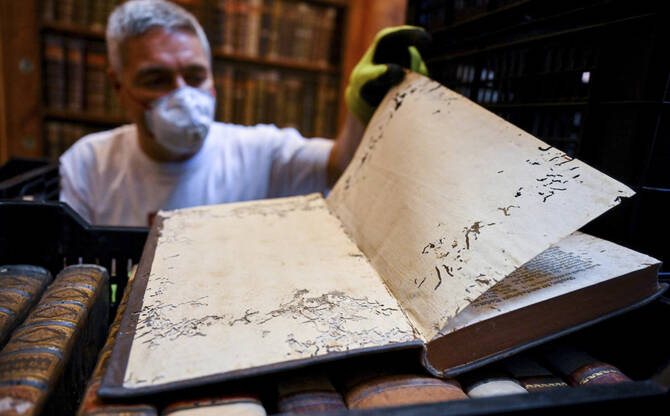
A restorer shows an old book with holes in its pages due to a drugstore beetle infestation at the Pannonhalma Archabbey’s library in Pannonhalma, Hungary on July 3, 2025. (Pannonhalma Archabbey via AP)
2 / 3
Structural damage of old books due to a drugstore beetle infestation, at the Pannonhalma Archabbey’s library in Pannonhalma, Hungary on July 3, 2025. (Pannonhalma Archabbey via AP)
3 / 3
Books are kept in hermetically sealed plastic sacks for disinfection at the Pannonhalma Archabbey’s library in Pannonhalma, Hungary on July 3, 2025. (AP)
Short Url
Updated 13 July 2025
Follow

Hungary’s oldest library is fighting to save 100,000 books from a beetle infestation

  • The 1,000-year-old Pannonhalma Archabbey is a sprawling Benedictine monastery that is one of Hungary’s oldest centers of learning and a UNESCO World Heritage site

PANNONHALMA, Hungary: Tens of thousands of centuries-old books are being pulled from the shelves of a medieval abbey in Hungary in an effort to save them from a beetle infestation that could wipe out centuries of history.

The 1,000-year-old Pannonhalma Archabbey is a sprawling Benedictine monastery that is one of Hungary’s oldest centers of learning and a UNESCO World Heritage site.

Restoration workers are removing about 100,000 handbound books from their shelves and carefully placing them in crates, the start of a disinfection process that aims to kill the tiny beetles burrowed into them.

The drugstore beetle, also known as the bread beetle, is often found among dried foodstuffs like grains, flour and spices. But they also are attracted to the gelatin and starch-based adhesives found in books.

They have been found in a section of the library housing around a quarter of the abbey’s 400,000 volumes.

“This is an advanced insect infestation which has been detected in several parts of the library, so the entire collection is classified as infected and must be treated all at the same time,” said Zsófia Edit Hajjdu, the chief restorer on the project. “We’ve never encountered such a degree of infection before.”

Abbey houses historical treasures

The beetle invasion was first detected during a routine library cleaning. Employees noticed unusual layers of dust on the shelves and then saw that holes had been burrowed into some of the book spines. Upon opening the volumes, burrow holes could be seen in the paper where the beetles chewed through.

The abbey at Pannonhalma was founded in 996, four years before the establishment of the Hungarian Kingdom. Sitting upon a tall hill in northwestern Hungary, the abbey houses the country’s oldest collection of books, as well as many of its earliest and most important written records.

For over 1,000 years, the abbey has been among the most prominent religious and cultural sites in Hungary and all of Central Europe, surviving centuries of wars and foreign incursions such as the Ottoman invasion and occupation of Hungary in the 16th century.

Ilona Asvanyi, director of the Pannonhalma Archabbey library, said she is “humbled” by the historical and cultural treasures the collection holds whenever she enters.

“It is dizzying to think that there was a library here a thousand years ago, and that we are the keepers of the first book catalogue in Hungary,” she said.

Among the library’s most outstanding works are 19 codices, including a complete Bible from the 13th century. It also houses several hundred manuscripts predating the invention of the printing press in the mid-15th century and tens of thousands of books from the 16th century.

While the oldest and rarest prints and books are stored separately and have not been infected, Asvanyi said any damage to the collection represents a blow to cultural, historical and religious heritage.

“When I see a book chewed up by a beetle or infected in any other way, I feel that no matter how many copies are published and how replaceable the book is, a piece of culture has been lost,” she said.

Books will spend weeks in an oxygen-free environment

To kill the beetles, the crates of books are being placed into tall, hermetically sealed plastic sacks from which all oxygen is removed. After six weeks in the pure nitrogen environment, the abbey hopes all the beetles will be destroyed.

Before being reshelved, each book will be individually inspected and vacuumed. Any book damaged by the pests will be set aside for later restoration work.

Climate change may have contributed

The abbey, which hopes to reopen the library at the beginning of next year, believes the effects of climate change played a role in spurring the beetle infestation as average temperatures rise rapidly in Hungary.

Hajjdu, the chief restorer, said higher temperatures have allowed the beetles to undergo several more development cycles annually than they could in cooler weather.

“Higher temperatures are favorable for the life of insects,” she said. “So far we’ve mostly dealt with mold damage in both depositories and in open collections. But now I think more and more insect infestations will appear due to global warming.”

The library’s director said life in a Benedictine abbey is governed by a set of rules in use for nearly 15 centuries, a code that obliges them to do everything possible to save its vast collection.

“It says in the Rule of Saint Benedict that all the property of the monastery should be considered as of the same value as the sacred vessel of the altar,” Asvanyi said. “I feel the responsibility of what this preservation and conservation really means.”


Turkish-language drama ‘Yellow Letters’ wins Berlin Film Festival’s top prize

Updated 22 February 2026
Follow

Turkish-language drama ‘Yellow Letters’ wins Berlin Film Festival’s top prize

  • The report ⁠did ⁠not say who was to blame for the attacks

BERLIN: “Yellow Letters,” a Turkish-language drama about what happens to a marriage put under extraordinary political pressure, ​won the Berlin Film Festival’s Golden Bear top prize on Saturday night.
The drama filmed in Germany but set in Turkiye follows a married actor and playwright who have to leave behind their comfortable lives after the husband is targeted by the state for posting critical content online.
“I know what (this win) means to my cast and crew who came from Turkiye, who now are getting a visibility that is on an international scale,” Turkish-German director Ilker Catak told Reuters after the award ceremony.
The director, whose previous Berlin entry “The Teachers’ Lounge” was nominated for an Oscar, said it was important that the film was not just about Turkiye, but Germany as well.
“There is a ‌sign that says ‌1933 and what we’ve seen in this country before, we must never ​forget,” ‌he ⁠said, referring ​to ⁠the year that Adolf Hitler came to power.
This year’s jury president, legendary German director Wim Wenders, praised the winner as “a movie that speaks up very clearly about the political language of totalitarianism.”
In total, 22 films had been in the running.

POLITICAL FESTIVAL
The festival maintained its reputation as the most overtly political of its peers, Venice and Cannes, with the war in Gaza in particular dominating public discussions about the films.
“If this Berlinale has been emotionally charged, that’s not a failure of the Berlinale, and it’s not a failure of cinema,” said festival director Tricia Tuttle at the opening ⁠ceremony, using the festival’s nickname.
Wenders used his final appearance as jury president to ‌urge filmmakers and activists to act as allies, not rivals, after ‌his comment that filmmakers should not be political caused Indian novelist Arundhati Roy ​to pull out.
Several award winners used their speech ‌to express solidarity with the Palestinians and other oppressed peoples.
“The least we can do here is to ‌break the silence and remind them that they are not really alone,” said Turkish filmmaker Emin Alper, whose film “Salvation” took the second-place Silver Bear Grand Jury Prize.
Palestinian-Syrian director Abdallah Al-Khatib, whose “Chronicles From the Siege” won the Perspectives section for emerging filmmakers, criticized the German government for its stance on Gaza despite concerns about crossing a red line.
“I was under a lot of ‌pressure to participate in Berlinale for one reason only, to stand here and say: ‘The Palestinians will be free,’” he said.

SANDRA HUELLER WINS AGAIN
German actor Sandra Hueller, ⁠who starred in 2024 Oscar-winning ⁠films “Anatomy of a Fall” and “Zone of Interest,” continued her winning streak by taking home best actor for the period piece “Rose,” in which she dresses as a man.
“To me, it’s special because I won my first-ever recognition as an actor in a film at this festival 20 years ago,” Hueller told Reuters, who won best actress in 2006 for “Requiem.”
“Queen at Sea,” a drama that follows French star Juliette Binoche as she deals with her mother’s advanced dementia and its effects on her marriage, won two prizes: the third-place jury prize and best supporting actor, shared by its two elderly performers, Anna Calder-Marshall and Tom Courtenay.
Director Lance Hammer, who last competed at the festival in 2008, said he hoped that maybe “people will see this and feel some comfort or relief that they’re not alone.”
Director Grant Gee won best director for “Everybody Digs Bill Evans,” a black-and-white biographical drama starring Norwegian actor ​Anders Danielsen Lie as the US jazz pianist.
“Nina ​Roza,” about an art curator who returns to Bulgaria to verify whether a child painting prodigy is genuine, won best screenplay while “Yo (Love is a Rebellious Bird)” took the prize for outstanding artistic contribution.