


ISLAMABAD: Pakistan’s Parliamentary Secretary for Information and Broadcasting Danyal Chaudhry said on Monday “national security is non-negotiable” and defended Islamabad’s recent cross-border strikes inside Afghanistan, which the United Nations (UN) said killed 13 civilians.
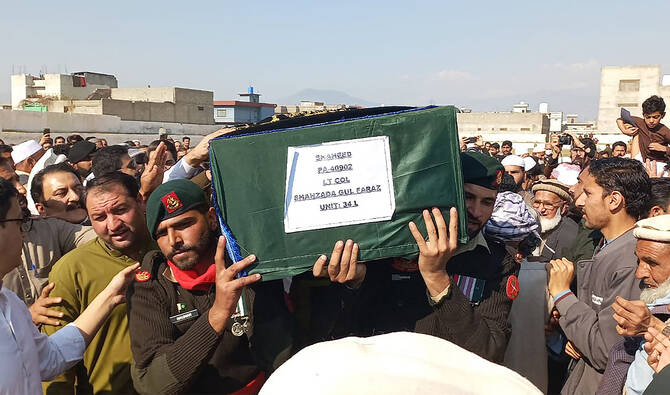
The remarks come after Pakistan said it launched “intelligence-based selective targeting” of seven militant camps along the Afghan border in response to a mosque bombing in Islamabad and violence in the northwestern border districts of Bajaur and Bannu, among other attacks.
Authorities say many of the assaults have been carried out by the Tehreek-e-Taliban Pakistan (TTP) and allied groups that Islamabad alleges are operating from sanctuaries in Afghanistan, whose government denies this.
Kabul has condemned Sunday’s strikes as a violation of its sovereignty and claimed civilians were killed. Pakistan has not responded to that allegation. Tensions between the two neighbors have escalated sharply despite a fragile ceasefire agreed after deadly clashes in October.
“Pakistan has always chosen the path of dialogue and peaceful coexistence. But when Afghan soil continues to be used for proxy attacks, we have no choice but to defend our homeland. National security is non-negotiable,” Chaudhry said in a statement.
He said the recent operation had “successfully neutralized militants involved in attacks on Pakistani soil,” adding that “every precaution was taken to protect innocent lives.”
Separately, the United Nations Assistance Mission in Afghanistan (UNAMA) said it had received "credible reports" that overnight Pakistani airstrikes on February 21–22 killed at least 13 civilians and injured seven in the Behsud and Khogyani districts of Nangarhar province, Reuters reported.
The reported toll adds to fears of a renewed cycle of retaliation between the neighbours, threatening the fragile ceasefire along their 2,600-km (1,600-mile) frontier and further straining ties as both sides trade blame over militant violence.
Pakistan has repeatedly accused Afghanistan’s Taliban rulers of allowing TTP militants and fighters linked to the Daesh (Islamic State) Khorasan Province, or ISKP, to operate from Afghan territory, claims Kabul denies.
Chaudhry referred to another recent UN report, saying militants from 21 countries were now operating from Afghan territory and posed a threat to regional stability.
Afghanistan’s defense ministry earlier condemned what it called a breach of international law and vowed a “measured response at a suitable time.” Its foreign ministry summoned Pakistan’s ambassador over what it described as violations of Afghan airspace.
Islamabad has also accused neighboring India of backing anti-Pakistan militant groups, a charge New Delhi has consistently denied.
The latest exchange has raised concerns of renewed instability along the 2,600-kilometer frontier, where repeated border closures have disrupted trade and strained diplomatic ties. Analysts say the escalation risks undoing recent efforts at de-escalation, including the Saudi-mediated release of three Pakistani soldiers earlier this month.


