

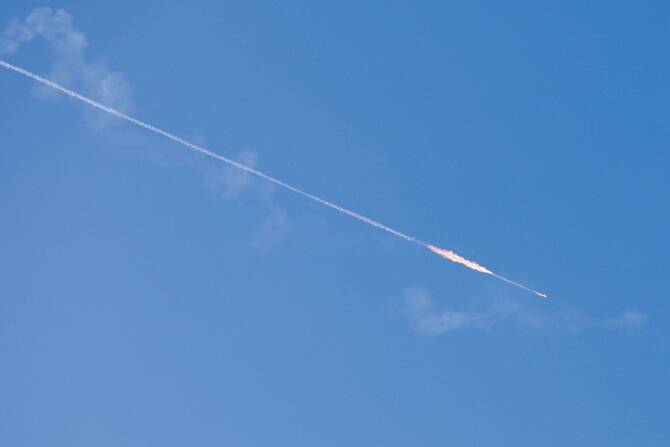
Israel says Iran fired cluster bomb-bearing missile

One of the small munitions struck a home in the central Israeli town of Azor, causing some damage, Times of Israel military correspondent Emanuel Fabian reported. (AFP)
Short Url
Updated 20 June 2025
Follow

Israel says Iran fired cluster bomb-bearing missile

  • Israeli military officials provided no further details

Iran fired at least one missile at Israel that scattered small bombs with the aim of increasing civilian casualties, the Israeli military said on Thursday, the first reported use of cluster munitions in the seven-day-old war.

Israeli military officials provided no further details.

Israeli news reports quoted the Israeli military as saying the missile’s warhead split open at an altitude of about 4 miles and released around 20 submunitions in a radius of around 5 miles  over central Israel.

One of the small munitions struck a home in the central Israeli town of Azor, causing some damage, Times of Israel military correspondent Emanuel Fabian reported. There were no reports of casualties from the bomb.

Cluster bombs are controversial because they indiscriminately scatter submunitions, some of which can fail to explode and kill or injure long after a conflict ends.

The Israeli military released a graphic as a public warning of the dangers of unexploded ordnance.

“The terror regime seeks to harm civilians and even used weapons with wide dispersal in order to maximize the scope of the damage,” Israel’s military spokesperson, Brig. Gen. Effie Defrin, told a briefing.

Iran’s mission to the United Nations and Israel’s embassy in Washington did not immediately respond to requests for comment.

“They are egregious weapons with their wide-area destruction, especially if used in a civilian populated area and could add to the unexploded ordnance left over from conflicts,” said Daryl Kimball, executive director of the Arms Control Association advocacy group.

Noting that Iranian missiles can be imprecise, he said that Tehran should know that cluster munitions “are going to hit civilian targets rather than military targets.”

Iran and Israel declined to join a 2008 international ban on the production, stockpiling, transfer and use of cluster bombs that has been signed by 111 countries and 12 other entities. After extensive debate, the US in 2023 supplied Ukraine with cluster munitions for use against Russian occupation forces. Kyiv says Russian troops also have fired them. The three countries declined to join the Convention Against Cluster Munitions.


Syria Kurds chief says ‘all efforts’ being made to salvage deal with Damascus

Updated 25 December 2025
Follow

Syria Kurds chief says ‘all efforts’ being made to salvage deal with Damascus

  • Abdi said the Syrian Democratic Forces (SDF), the Kurds’ de facto army, remained committed to the deal
  • The two sides were working toward “mutual understanding” on military integration and counter-terrorism

DAMASCUS: Syrian Kurdish leader Mazloum Abdi said Thursday that “all efforts” were being made to prevent the collapse of talks on an agreement with Damascus to integrate his forces into the central government.
The remarks came days after Aleppo saw deadly clashes between the two sides before their respective leaders ordered a ceasefire.
In March, Abdi signed a deal with Syrian President Ahmed Al-Sharaa to merge the Kurds’ semi-autonomous administration into the government by year’s end, but differences have held up its implementation.
Abdi said the Syrian Democratic Forces (SDF), the Kurds’ de facto army, remained committed to the deal, adding in a statement that the two sides were working toward “mutual understanding” on military integration and counter-terrorism, and pledging further meetings with Damascus.
Downplaying the year-end deadline, he said the deal “did not specify a time limit for its ending or for the return to military solutions.”
He added that “all efforts are being made to prevent the collapse of this process” and that he considered failure unlikely.
Abdi also repeated the SDF’s demand for decentralization, which has been rejected by Syria’s Islamist authorities, who took power after ousting longtime ruler Bashar Assad last year.
Turkiye, an important ally of Syria’s new leaders, sees the presence of Kurdish forces on its border as a security threat.
In Damascus this week, Turkish Foreign Minister Hakan Fidan stressed the importance of the Kurds’ integration, having warned the week before that patience with the SDF “is running out.”
The SDF control large swathes of the country’s oil-rich north and northeast, and with the support of a US-led international coalition, were integral to the territorial defeat of the Daesh group in Syria in 2019.
Syria last month joined the anti-IS coalition and has announced operations against the jihadist group in recent days.