

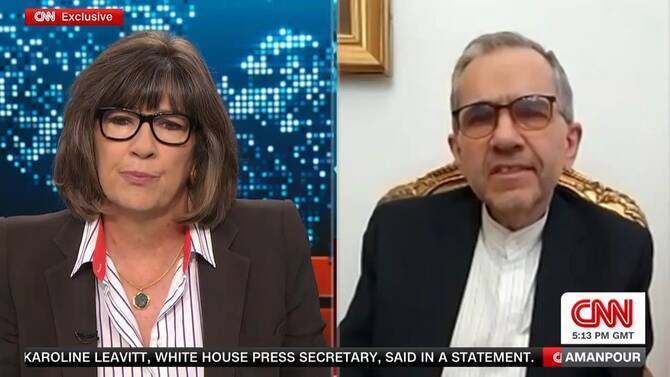

DUBAI / LONDON: Tehran would have “no choice” but to retaliate if the US decided to join Israel in attacking Iran, Iranian Deputy Foreign Minister Majid Takht Ravanchi has told CNN.
Ravanchi told CNN’s Christiane Amanpour: “If the Americans decide to get involved militarily, we have no choice but to retaliate. That is clear and simple because we are acting in self-defense.”
Ravanchi took part in the interview on the sixth day of conflict between his country and Israel.
Iran had been set to participate in a new round of talks on the nuclear issue with the US last Sunday, until Israel launched its attacks on Friday.
Ravanchi said that his country’s leadership doubted “the sincerity of the Americans” given the timing of Israel’s first attack.
He added: “Two days before the next round (of talks) started, the aggression took place. So, this is a betrayal of diplomacy; this is the betrayal of our trust of Americans.
“We should be the ones who should criticize the way that we were treated by the Americans, not vice versa.”
The deputy foreign minister said: “The Americans have been collaborating with the Israelis. Although they have said that they do not have anything to do with this conflict, it is not true. But if they decide to be engaged militarily, direct military involvement in this massacre, definitely we will do whatever necessary to protect ourselves.
“They (the Israelis) attacked residential areas, they attacked paramedics, they attacked citizens who were just sleeping in their homes. This is a crime against humanity, pure and simple.”
Israel’s targeting of Iran’s nuclear facilities was also a crime, he said, adding: “Fordow is another protected site based on IAEA (International Atomic Energy Agency) rules.
“So, that will be another instance of a crime which is being done, unfortunately by Israelis and Americans, which is prohibited under international law.”
He said: “These are safeguarded places. It is a crime in accordance with international law to attack a place which is safeguarded under IAEA rules. Unfortunately, the Americans and some Europeans have shielded the Israeli regime, (and it is) not to be criticized at the IAEA board of governors’ meeting and also at the UN Security Council. So it’s shame on all those who are protecting this regime.”
Ravanchi said that Tehran had not asked the US or Israel to resume nuclear talks since hostilities began, refuting US President Donald Trump’s earlier claim that Tehran had reached out to the White House.
He said: “We are not reaching out to anybody. We are defending ourselves. Although we have always promoted diplomacy … we cannot negotiate under threat. We cannot negotiate while our people are under bombardment every day. So we are not begging for anything; we are just defending ourselves.”
He claimed that the attacks had mobilized support for the government among Iranians, adding: “Now there is a very strong cohesion within Iranian society to resist aggression, to resist foreign interference in our domestic affairs.
“Ask the people who are in Tehran. You will understand that the Iranians are behind their government because they are facing a foreign aggression which will be resisted.”
Israeli officials have been urging Iranians to rise up against their government, arguing that now is the time for regime change with leaders in Tehran “weakened” by the attacks.
The Israeli strikes came as a result of increased tensions following the release of an IAEA report showing that Tehran had accelerated its uranium enrichment to 60 percent.
Ravanchi said: “IAEA inspectors were present in Iran. Different reports of the IAEA testify to the fact that we have been very straightforward in our nuclear program.
“There is no ban on 60 percent enriched uranium, which is being used in different places for peaceful purposes.”
He reiterated that Iran does not have nuclear weapons and does not intend to create them, adding: “Nuclear weapons have no place in our defensive doctrine. In fact, we believe that the world will be a better place without nuclear weapons.
“But who has the nuclear weapons in the Middle East? The Israeli regime. Who has the weapons, the most sophisticated weapons? The Americans. So, they are the ones who are responsible for all the chaos that is going on in different parts of the world.”
His views were mirrored Thursday by Iran’s deputy foreign minister who also warned against any direct US involvement in the conflict, saying Iran had “all the necessary options on the table,” in comments reported by Iranian state media.
“If the US wants to actively intervene in support of Israel, Iran will have no other option but to use its tools to teach aggressors a lesson and defend itself ... our military decision-makers have all necessary options on the table,” Gharibabadi said, according to state media.
“Our recommendation to the US is to at least stand by if they do not wish to stop Israel’s aggression,” he said.
(With Reuters)


