

Middle Eastern content creators unveil bold short films in collaboration with YouTube

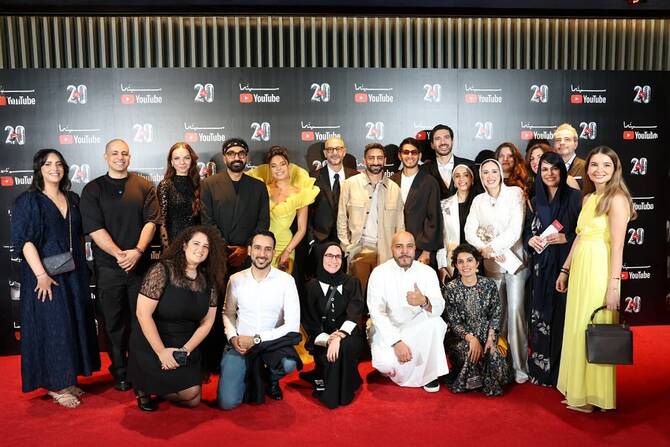
Some of the region’s most celebrated content creators — including Bahrain’s Omar Farooq, the UAE’s Anas Bukhash, Morocco’s Taha Essou, Palestine’s Haifa Beseisso and Egypt’s Sherif Nabil — have premiered powerful short films in collaboration with YouTube to mark the platform’s 20th anniversary.. (Supplied)
Short Url
Updated 17 June 2025
Follow

Middle Eastern content creators unveil bold short films in collaboration with YouTube

DUBAI: Some of the region’s most celebrated content creators — including Bahrain’s Omar Farooq, the UAE’s Anas Bukhash, Morocco’s Taha Essou, Palestine’s Haifa Beseisso and Egypt’s Sherif Nabil — have premiered powerful short films in collaboration with YouTube to mark the platform’s 20th anniversary.

“For years, creating and distributing entertainment was limited to major studios. Today, we’re at an inflection point — YouTube creators are the entertainment industry’s new startups,” said Tarek Amin, YouTube’s regional director for the Middle East, Africa and Turkiye, during the premiere in Dubai this weekend.

These creators, who amass billions of views across their channels, showcased deeply personal stories that transcend borders and languages, highlighting YouTube’s role as a platform for emotional storytelling and global connection.

The shift reflects a wider trend across the region with YouTube creators across the Middle East and North Africa rapidly becoming entertainment startups.

Companies such as Telfaz11, which has offices in Saudi Arabia and the UAE, have scaled from popular YouTube series to successful feature films.


A post shared by #ABtalks (@abtalks)

Bukhash’s signature charm and curiosity is reflected in his film “ABtalks Diaries: Korea Edition.” The work follows him on a journey through South Korea where he interviews chefs, artists, and members of the public.

Despite a glaring language barrier, Bukhash draws out surprisingly intimate moments, proving that vulnerability is a universal language. “We did this because we realized Arabs are obsessed with K-Pop,” Bukhash joked on stage.

In “Into the Dark,” Beseisso documents her four-day stay in a darkness retreat. Blending humor and reflection, her film becomes a deeply personal meditation on silence, emotion and reconnection — with herself and others.

“I heard about the darkness retreat from a friend and was intrigued,” she told Arab News. “I went, closed my eyes for three days, and it turned out to be one of my favorite experiences.”

In “Into the Fire: Mount Ijen,” Nabil documents the harsh realities of sulfur miners working in Indonesia’s active volcanic mountain. He exposes the conditions these workers face and the generational impact of their labor.

“YouTube gives you that intimacy,” Nabil said. “It’s a challenge, but it’s rewarding.”

The connection between these filmmakers lies in their ability to confront discomfort, explore untold stories, and share them with candor.

“This event is not for us,” Bukhash reflected. “It’s for the people at home wondering if they should start, and need that extra push.”

Rhea Seehorn opts for Elie Saab look in Los Angeles

Updated 11 January 2026
Follow

Rhea Seehorn opts for Elie Saab look in Los Angeles

DUBAI/ LOS ANGELES: US actress Rhea Seehorn attended this weekend’s American Film Institute Awards Luncheon in Los Angeles in a monochrome look by Lebanese designer Elie Saab.

The “Pluribus” and “Better Call Saul” actress opted for an ankle-length daytime dress from Saab’s Pre-Fall 2025 collection that featured a sharp collar, cap sleeves and two pockets placed on the bodice.

She was dressed by celebrity stylist Jessica Paster, who regularly works with the liked of Emily Blunt and Quinta Brunson.

US actress Rhea Seehorn attended this weekend’s American Film Institute Awards Luncheon in Los Angeles in a monochrome look by Lebanese designer Elie Saab. (Getty Images)

Other attendees at the luncheon event included Leonardo DiCaprio, Ryan Coogler, Timothee Chalamet and George Clooney.

According to The Associated Press’s Jonathan Landrum Jr., the institute celebrated the collaborative nature of film and television by honoring creative teams — in front of and behind the camera.

Inside the ballroom on Friday there were no acceptance speeches in the traditional sense and no suspense over envelopes. Instead, the AP reported, AFI’s ceremony unfolded as a series of thoughtfully written tributes: eloquent rationales for each honored film and television program, followed by brief clips designed to place the year’s work within a broader cultural and artistic context.

Films honored include “Avatar: Fire and Ash,” “Bugonia,” “Frankenstein,” “Hamnet,” “Jay Kelly,” “Marty Supreme,” “One Battle After Another,” “Sinners,” “Train Dreams” and “Wicked: For Good.”

Television shows recognized were “Adolescence,” “Andor,” “Death by Lightning,” “The Diplomat,” “The Lowdown,” “The Pitt,” “Severance,” “The Studio” and “Task.”

Closing the ceremony was US comedian and actress Carol Burnett, who delivered AFI’s annual benediction, celebrating the honorees’ achievements while reflecting on her own lifelong love of cinema and television.

“I’ve never lost the deep respect and love that I have for all the stories we tell through cinema and television and by all of those behind and in front of the camera,” Burnett said. “Creative collaboration has always remained at the heart of our work, and AFI brings us all together. The world is a better place for having heard your voices.”

The luncheon also featured AFI’s signature March of Time video montage, a sweeping look at cinematic and television milestones from decades past, situating this year’s honorees within the evolving history of the medium.