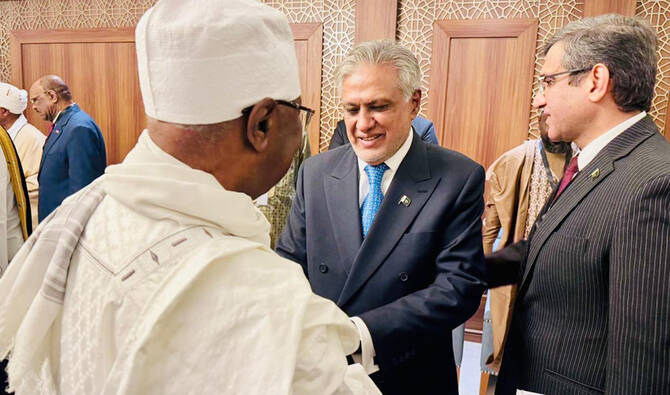

Islamabad: Pakistan’s Deputy Prime Minister and Foreign Minister Ishaq Dar on Sunday condemned Israel’s recent move to recognize Somaliland as political aggression at a high-level meeting of the Organization of Islamic Cooperation (OIC) in Jeddah, rejecting any plans to forcefully displace Palestinians from their homeland.
Dar arrived in Saudi Arabia on Friday to attend the 22nd OIC Council of Foreign Ministers held in Jeddah on Jan. 10 to discuss Israel’s move last month to recognize Somaliland, a breakaway region of Somalia, as a separate nation. The act has drawn sharp criticism from Muslim nations worldwide.
Muslim countries, including Pakistan, fear the move could be part of Tel Aviv’s plan to forcibly relocate Palestinian Muslims to Somaliland. Several international news outlets last year reported that Israel had contacted Somaliland over the potential resettlement of Palestinians forcibly removed from Gaza.
“We believe that such recognition of an integral part of a sovereign state is not a diplomatic act, but an act of political aggression that sets a perilous precedent, threatening peace and security in the Horn of Africa, the Red Sea region, and beyond,” Dar, who is also Pakistan’s foreign minister, told participants of the meeting in Jeddah.
He said Islamabad considers the move a flagrant violation of international law and a direct assault on the territorial integrity of Somalia. The Pakistani minister called on all states to refrain from engaging with Somaliland authorities.
“Pakistan fully aligns itself with the OIC’s call for all States and organizations to refrain from any form of formal, semi-formal, or informal engagement with the authorities of Somaliland, and to ensure that any engagement strictly respects the sovereignty and unity of the Federal Republic of Somalia,” Dar said.
The Pakistani deputy prime minister also rejected any proposal or plan linking the forceful displacement of Palestinians to Somaliland as an “illegal action.”
“Any action that advocates or implies the displacement or relocation of Palestinians not only violates international law but also undermines the prospect of a just and lasting peace in the region,” he said.
Somaliland broke away from Somalia unilaterally in 1991 as a civil war raged in the country. Somaliland has its own constitution, parliament and currency, a move that has infuriated Somalia over the years as it insists the region is part of its territory.
Pakistan earlier this week joined the OIC and 22 other Muslim states to condemn Israeli Foreign Minister Gideon Saar’s Jan. 6 visit to Somaliland, saying the move threatened regional stability.
Dar later met with OIC Secretary-General Hissein Brahim Taha and highlighted Pakistan’s unwavering support for the sovereignty, unity, and territorial integrity of Somalia.
“Categorically rejecting any proposal for dislocation of Palestinians, he reaffirmed Pakistan’s principled position on Palestine,” the Pakistani foreign ministry said.
“SG commended Pakistan’s consistent and constructive role at OIC in advocating for the causes central to the Muslim Ummah.”
Pakistan does not recognize Israel and has consistently called for an independent Palestinian state based on “internationally agreed parameters” and pre-1967 borders.
Dar also held a meeting with the Saudi Deputy Foreign Minister Waleed Elkhereiji on the sidelines of the OIC session.
“Both sides discussed strengthening Pakistan–Saudi strategic partnership and reaffirmed close cooperation within the OIC for peace, stability and security in the region,” the foreign ministry in Islamabad said.