

Northern Ireland hit by third night of violence but main flashpoint calmer

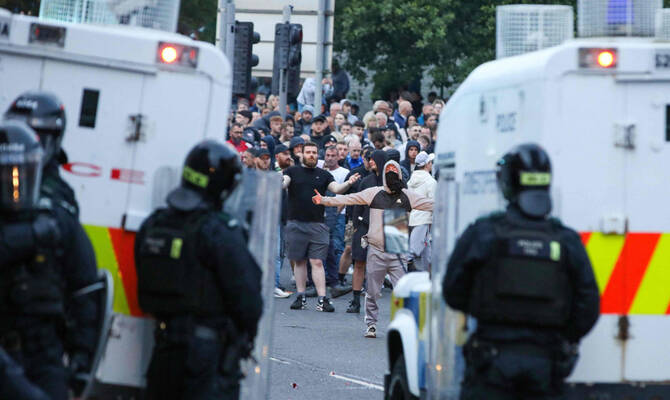
Riot Police stand guard buy armoured Police Land Rovers as protestors gather during a thrid night of anti-immigration demonstrations in Ballymena, Northern Ireland, on June 11, 2025. (AFP)
Short Url
Updated 12 June 2025
Follow

Northern Ireland hit by third night of violence but main flashpoint calmer

  • Hundreds of masked rioters attacked police and set homes and cars on fire in Ballymena, a town of 30,000 people
  • The violence flared on Monday after two 14-year-old boys were arrested and appeared in court earlier that day

BALLYMENA, Northern Ireland: Violence erupted in different parts of Northern Ireland for the third successive night on Wednesday, with masked youths starting a fire in a leisure center but unrest in the primary flashpoint of Ballymena was notably smaller in scale.

Hundreds of masked rioters attacked police and set homes and cars on fire in Ballymena, a town of 30,000 people located 45 kilometers (28 miles) from Belfast, on Tuesday night in what police condemned as “racist thuggery.”

The violence flared on Monday after two 14-year-old boys were arrested and appeared in court earlier that day, accused of a serious sexual assault on a teenage girl in the town.

The charges were read via a Romanian interpreter to the boys, whose lawyer told the court that they denied the charge, the BBC reported. Police are investigating the damaging of properties on Monday and Tuesday in Ballymena, which has a relatively large migrant population, as racially-motivated hate crimes.

Two Filipino families told Reuters they fled their home in Ballymena on Tuesday night after fearing for their safety when their car was set on fire outside the house.

A few dozen masked youths threw some rocks, fireworks and petrol bombs at police after officers in riot gear and armored vans blocked roads in the town on Wednesday evening.

Police deployed water cannon against the crowd for the second successive night but the clashes were nothing like the previous night that left 17 officers injured and led to five arrests.

Much of the crowd had left the streets before midnight.

A small number of riot police were also in the town of Larne 30 kilometers west where masked youths smashed the windows of a leisure center before starting fires in the lobby, BBC footage showed.

Swimming classes were taking place when bricks were thrown through the windows and staff had to barricade themselves in before running out the back door, a local Alliance Party lawmaker, Danny Donnelly, told the BBC.

Northern Ireland’s Communities Minister Gordon Lyons had earlier posted on Facebook that a number of people had been temporarily moved to the leisure center following the disturbances in Ballymena, before then being moved out of Larne.

The comments drew sharp criticism from other political parties for identifying a location used to shelter families seeking refuge from anti-immigrant violence. Lyons condemned the attacks on the center.

Police said youths also set fires at a roundabout in the town of Newtownabbey, a flashpoint for sectarian violence that sporadically flares up in the British-run region 27 years after a peace deal largely ended three decades of bloodshed.

Debris was also set alight at a barricade in Coleraine, the Belfast Telegraph reported.

The British and Irish governments as well as local politicians have condemned the violence.


Britain, Japan agree to deepen defense and security cooperation

Updated 7 sec ago
Follow

Britain, Japan agree to deepen defense and security cooperation

  • “We set out a clear priority to build an even deeper partnership in the years to come,” Starmer said
  • Takaichi said they agreed to hold a meeting of British and Japanese foreign and defense ministers this year

TOKYO: Britain and Japan agreed to strengthen defense and economic ties, visiting Prime Minister Keir Starmer said on Saturday, after his bid to forge closer links with China drew warnings from US President Donald Trump.
Starmer noted that Japan and Britain were the leading economies in a trans-Pacific that includes fellow G7 member Canada, as well as other international trade and defense pacts.
“We set out a clear priority to build an even deeper partnership in the years to come,” Starmer said as he stood beside Japan’s Prime Minister Sanae Takaichi after a bilateral meeting in Tokyo.
“That includes working together to strengthen our collective security, across the Euro-Atlantic and in the Indo-Pacific.”
Takaichi said they agreed to hold a meeting of British and Japanese foreign and defense ministers this year.
She said she also wanted to discuss “cooperation toward realizing a free and open Indo-Pacific, the Middle East situation and Ukraine situation” at a dinner with Starmer later on Saturday.
Starmer arrived on a one-day Tokyo stop after a four-day visit in China, where he followed in the footsteps of other Western leaders looking to counter an increasingly volatile United States.
Leaders from France, Canada and Finland have all traveled to Beijing in recent weeks, recoiling from Trump’s bid to seize Greenland and tariff threats against NATO allies.
Trump warned on Thursday it was “very dangerous” for its close ally Britain to be dealing with China, although Starmer brushed off those comments.
Tokyo’s ties with Beijing have deteriorated since Takaichi suggested in November that Japan could intervene militarily during a potential attack on Taiwan.
China regards the self-ruled democratic island as its territory.
Starmer met Chinese President Xi Jinping and Premier Li Qiang on Thursday, with both sides highlighting the need for closer ties.
He also signed a series of agreements there, with Downing Street announcing Beijing had agreed to visa-free travel for British citizens visiting China for under 30 days.
No start date for that arrangement has been given yet.
Takaich said the two leaders agreed during discussions on economic security that a strengthening of supply chains “including important minerals is urgently needed.”
There is concern that Beijing could choke off exports of the rare earths crucial for making everything from electric cars to missiles.
China, the world’s leading producer of such minerals, announced new export controls in October on rare earths and associated technologies.
They have also been a major sticking point in trade negotiations between China and the United States.
Britain, Japan and Italy are also developing a new fighter jet after Tokyo relied for decades on the United States for military hardware.