

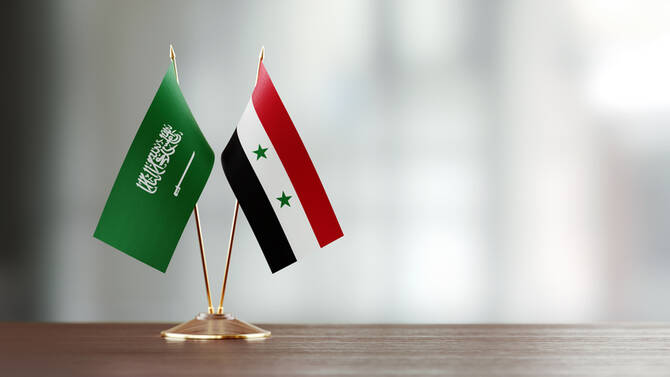
Saudi Arabia and Syria explore investment cooperation in bid to boost economic integration 

The talks are part of broader Saudi efforts to expand its global investment footprint and strengthen economic ties across regions. Getty
Short Url
Updated 05 June 2025
Follow

Saudi Arabia and Syria explore investment cooperation in bid to boost economic integration 

RIYADH: Saudi Arabia and Syria are set to advance economic cooperation following a virtual meeting between the Kingdom’s Minister of Investment Khalid Al-Falih and the Middle Eastern country’s Minister of Economy and Industry Mohammad Al-Shaar. 

The two sides reviewed prospects for investment partnerships and discussed opportunities to expand collaboration in both public and private sectors, according to a report by the Saudi Press Agency. 

The discussions focused on promoting high-quality investments across productive and service industries, with the goal of supporting Syria’s economic development and enhancing regional financial integration. 

The meeting also examined ways to build a favorable environment for cross-border investments that can contribute to long-term stability. 

Syria is undertaking significant efforts to revive its economy following years of conflict. The transitional government, led by President Ahmed Al-Sharaa, has initiated reforms, including the privatization of state enterprises, the lifting of import restrictions, and the encouragement of foreign investment. 

Notable developments encompass a $7 billion energy infrastructure agreement with a Qatari-led consortium, the reopening of the Damascus Securities Exchange, and a $300 million fiber-optic project involving Gulf telecom firms. 

“Al-Falih emphasized the importance of creating an enabling environment for expanding regional investment partnerships,” SPA said. 

He added that Saudi Arabia is keen to assist in stabilizing and developing the Syrian economy, which he described as essential for serving mutual interests and promoting regional economic prosperity. 

Additionally, the Kingdom and Qatar have pledged financial support for Syrian public sector salaries in May. 

These initiatives, alongside the easing of Western sanctions, aim to stabilize the economy and attract international investment. 

The talks are part of broader Saudi efforts to expand its global investment footprint and strengthen economic ties across regions. 

In May, Saudi Foreign Minister Prince Faisal bin Farhan visited Damascus, where he met Al-Sharaa and pledged Saudi-Qatari support for Syria’s public sector, with a particular focus on energy and infrastructure investments. 

The Kingdom has also ramped up high-level international engagements this year. Minister of Finance Mohammed Al-Jadaan participated in the Saudi-US Investment Forum in Riyadh in May to discuss cross-border investment opportunities. 

In April, Al-Jadaan met with Pakistan’s Finance Minister Muhammad Aurangzeb in Washington to deepen financial and economic cooperation. 

Additionally, Minister of Economy and Planning Faisal Alibrahim signed a memorandum of understanding with Spain on May 22 to promote trade diversification and new investment opportunities. 

Alibrahim also represented Saudi Arabia at the World Government Summit in Dubai in February to advance Vision 2030 partnerships. 


Acwa signs key terms to develop 5GW of renewable energy capacity in Turkiye

Updated 23 February 2026
Follow

Acwa signs key terms to develop 5GW of renewable energy capacity in Turkiye

JEDDAH: Saudi utility giant Acwa has signed key investment agreements with Turkiye’s Ministry of Energy and Natural Resources to develop up to 5 gigawatts of renewable energy capacity, starting with 2GW of solar power across two plants in Sivas and Taseli.

Under the investment agreement, Acwa will develop, finance, and construct, as well as commission and operate both facilities, according to a press release.

The program builds on the company’s first investment in Turkiye, the 927-megawatt Kirikkale Independent Power Plant, valued at $930 million, which offsets approximately 1.8 million tonnes of carbon dioxide annually, the statement added.

A separate power purchase agreement has been concluded with Elektrik Uretim Anonim Sirketi for the sale of electricity generated by each facility.

Turkiye aims to boost solar and wind capacity to 120GW by 2035, supported by around $80 billion in investment, while recent projects have already helped prevent 12.5 million tonnes of CO2 emissions and reduced reliance on imported natural gas.

Turkiye’s energy sector has undergone a rapid transformation in recent years, with renewable power emerging as a central pillar of its strategy.

Raad Al-Saady, vice chairman and managing director of ACWA, said: “The signing of the IA (implementation agreement) and PPA key terms marks a pivotal moment in Acwa’s partnership with Turkiye, reflecting the country’s strong potential as a clean energy leader and manufacturing powerhouse.”

He added: “Building on our long-standing presence, including the 927MW Kirikkale Power Plant commissioned in 2017, this step elevates our partnership to a new level,” Al-Saady said.

In its statement, Acwa said the 5GW renewable energy program will deliver electricity at fixed prices, enhancing predictability for grid planning and supporting long-term industrial investment.

By replacing imported fossil fuels with domestically generated clean energy, the initiative is expected to reduce Turkiye’s exposure to global energy market volatility, strengthening energy security and lowering long-term power costs.

The company added that the economic impact will extend beyond the anticipated investment of up to $5 billion in foreign direct investment, with thousands of jobs expected during the construction phase and hundreds of high-skilled roles created during operations.

The energy firm concluded that its existing progress in Turkiye reflects a strong appreciation for Turkish engineering, construction, and manufacturing capacity, adding that localization has been a strategic priority, and it has already achieved 100 percent local employment at its developments in the country.