Trump administration rescinds Biden-era guidance on emergency abortions

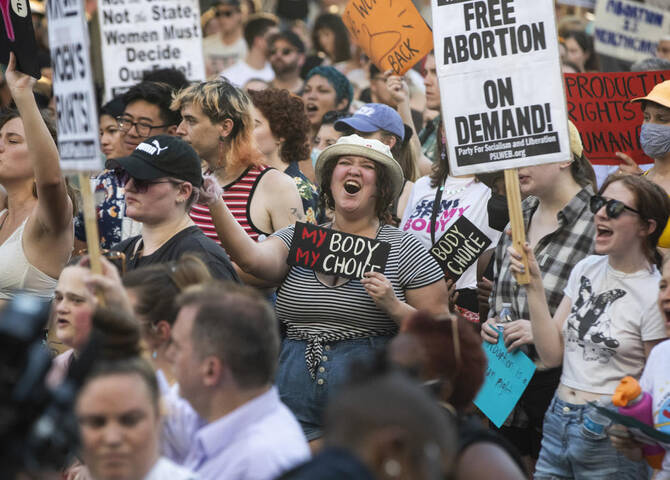
Abortion-rights supporters protest on the steps of the John Minor Wisdom United States of Appeals Fifth Circuit Building after the Supreme Court decision to overturn Roe v. Wade, in New Orleans on June 24, 2022. (The Times-Picayune/The New Orleans Advocate via AP)
Short Url
Updated 04 June 2025
Follow

Trump administration rescinds Biden-era guidance on emergency abortions

  • The Biden-era memo was issued in July 2022, weeks after the US Supreme Court struck down the constitutionally enshrined right to abortion

WASHINGTON: The Trump administration has revoked a Biden-era health guideline that protected emergency abortions when medically required, even in states that ban the procedure.

The Biden-era memo was issued in July 2022, weeks after the US Supreme Court struck down the constitutionally enshrined right to abortion.

As health providers suddenly found themselves embroiled in legal uncertainty over abortion, the memo provided an interpretation of the 1986 Emergency Medical Treatment and Active Labor Act (EMTALA), arguing it supersedes state abortion laws when needed to stabilize a pregnant patient.

The directive was fiercely contested by anti-abortion advocates.

In a letter Tuesday, the Centers for Medicare and Medicaid Services said the EMTALA guidance did not reflect the current administration’s policy.

“CMS is rescinding this memo ... effective May 29, 2025, consistent with Administration policy,” it said.

Offering its own interpretation, CMS said EMTALA provides the right for any hospital patient to receive “either stabilizing treatment or an appropriate transfer to another hospital.”

It said the US Health and Human Services would no longer enforce the Biden-era guidance.

The pro-abortion Guttmacher Institute said the Trump administration’s revocation of the EMTALA guidelines showed “callous disregard for the law and people’s lives.”

Lawrence O. Gostin, a health law expert at Georgetown University, wrote in the New York Times that the CMS letter “basically gives a bright green light to hospitals in red states to turn away pregnant women who are in peril.”

According to Guttmacher, 13 US states, mostly in the south and east of the country, have “a total abortion ban” as of May 28.

While these states generally provide narrow exceptions in the event of a threat to the mother’s life, it is unclear what constitutes a life-threatening condition in the eyes of the law.

Since returning to office, US President Donald Trump has taken a series of moves to restrict abortion access.

In his first week back in the White House, Trump revoked two executive orders protecting access to a pill widely used to terminate pregnancies and the ability to travel to states where the procedure is not banned.


New Trump strategy vows shift from global role to regional

Updated 8 sec ago
Follow

New Trump strategy vows shift from global role to regional

WASHINGTON: President Donald Trump’s administration said in a long-awaited new strategy document Friday that the United States will shift from its historic global role toward increasing dominance in Latin America and vigorously fighting migration.
The national security paper, meant to flesh out Trump’s norms-shattering “America First” worldview, signals a sharp reorientation from longstanding US calls to refocus on Asia, although it still identifies China as a top competitor.
The strategy also brutally criticized allies in Europe and said that the United States will champion opponents to European Union-led values, including on immigration.
Breaking with decades of attempts to be the sole superpower, the strategy said that the “United States rejects the ill-fated concept of global domination for itself.”
It said that the United States would also prevent other powers from dominating but added: “This does not mean wasting blood and treasure to curtail the influence of all the world’s great and middle powers.”
The strategy called for a “readjustment of our global military presence to address urgent threats in our Hemisphere, and away from theaters whose relative import to American national security has declined in recent decades or years.”
The strategy speaks in bold terms of pressing US dominance in Latin America, where the Trump administration has been striking alleged drug traffickers at sea, intervening to bring down leftist leaders including in Venezuela, and loudly seeking to take charge of key resources such as the Panama Canal.
The strategy cast Trump as modernizing the two-century-old Monroe Doctrine, in which the then young United States declared Latin America off-limits to rival powers, then from Europe.
“We will assert and enforce a ‘Trump Corollary’ to the Monroe Doctrine,” it said.

- Championing Europe ‘resistance’ -

Trump has sharply reversed many longstanding US principles since returning to office in January.
He rose to political prominence demanding sweeping curbs on immigration to the United States, fanning fears that the white majority was losing its status, and since taking office has ordered drastic and high-profile raids to deport undocumented people.
“The era of mass migration must end. Border security is the primary element of national security,” the strategy said.
The strategy made clear that the United States under Trump would aggressively pursue similar objectives in Europe, in line with far-right parties that have made strong gains in much of the continent.
In extraordinary language in speaking of close allies, the strategy said: “Cultivating resistance to Europe’s current trajectory within European nations.”
Germany quickly hit back, saying that it does not need “outside advice.”
The strategy pointed to Europe’s lower share of the global economy — which is the result largely of the rise of China and other emerging powers — and said: “This economic decline is eclipsed by the real and more stark prospect of civilizational erasure.
“Should present trends continue, the continent will be unrecognizable in 20 years or less.”
As Trump seeks an end to the Ukraine war that would likely favor Russia gaining territory, the strategy accused Europeans of weakness and said the United States should focus on “ending the perception, and preventing the reality, of NATO as a perpetually expanding alliance.”

- Less on Middle East and Africa -

The strategy paid comparatively little attention to the Middle East, which has long consumed Washington.
Pointing to US efforts to increase energy supply at home and not in the oil-rich Gulf, the strategy said: “America’s historic reason for focusing on the Middle East will recede.”
The paper said it was a US priority for Israel to be secure, but stopped short of the fulsome language on Israel used even in the first Trump administration.
On China, the strategy repeated calls for a “free and open” Asia-Pacific region but focused more on the nation as an economic competitor.
After much speculation on whether Trump would budge on Taiwan, the self-ruling democracy claimed by Beijing, the strategy made clear that the United States supports the decades-old status quo, but called on allies Japan and South Korea to contribute more to ensure Taiwan’s defense from China.
The strategy predictably puts little focus on Africa, saying the United States should transition away from “liberal ideology” and an “aid-focused relationship” and emphasize goals such as securing critical minerals.