
ISLAMABAD: Pakistan has finalized arrangements for its Hajj pilgrims in coordination with Saudi Arabia’s Al-Rajhi company, upgrading tents and amenities at key pilgrimage sites under a new agreement aimed at improving services for those traveling under the Government Hajj Scheme, an official confirmed Thursday.
The deal with Al-Rajhi, a licensed Tawafa company responsible for assisting foreign pilgrims in Mina, Arafat and Muzdalifah, marks a significant step in elevating standards traditionally reserved for private tour groups.
The move comes as Pakistan seeks to improve the experience for nearly 89,000 pilgrims performing Hajj this year under the state-run scheme.
In total, 114,698 Pakistanis are expected to perform Hajj beginning June 4, including 25,698 under private operators. As of Thursday, 84,638 government-sponsored pilgrims had arrived in Saudi Arabia on 329 flights, while 17,959 private pilgrims had also reached the kingdom.
Pre-Hajj flight operations are scheduled to conclude on May 31.
“An agreement was signed with the Tawafa company Al-Rajhi for Mina, Arafat and Muzdalifah, and all arrangements and facilities at the sacred sites are being finalized for this year’s Hajj,” Muhammad Umer Butt, a spokesperson for the Ministry of Religious Affairs, told Arab News from Makkah over the phone.

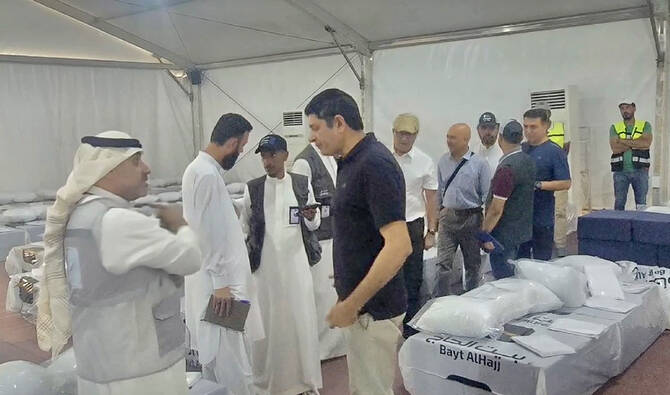
Officials from Pakistani Hajj Mission brief Pakistan’s Religious Affairs Minister Sardar Yousaf about this year’s Hajj arrangement at the Pakistani camps in Mina, Saudi Arabia on May 29, 2025. (Handout/MORA)
He said pilgrims under the Government Hajj Scheme will now benefit from upgraded camp infrastructure.
“Air conditioners and extra fans have been added to the tents along with air coolers,” he informed, adding that modern sofa-cum-beds with partitions on both sides have been introduced to prevent the spread of infections caused by breathing or sweating.
Additional improvements include luggage racks, sliding doors in place of traditional tarpaulin sheets, gypsum board tent walls, artificial grass carpeting in corridors, protective sunshades, fans along walkways and designated shoe racks.
For the first time, Pakistani medical teams will be stationed at each camp to provide support in addition to Saudi medical services.
“A first aid team will be added to every camp, where doctors and medical staff will be available at all times,” Butt said.
He said Pakistan’s Hajj mission had also worked closely with Saudi authorities and the Maktab system to implement a transport strategy across the sacred sites, or Mashair, to ensure smooth movement of pilgrims.
“Saudi authorities have issued special instructions to protect pilgrims from the extreme weather conditions, and our mission ensures that these instructions are communicated clearly and understandably to all Pakistani pilgrims,” he added.
A dedicated complaint management cell has been set up to address pilgrims’ concerns in real time.
“A total of 2,241 complaints were received regarding lost luggage, out of which 2,209 were resolved with the luggage delivered to the concerned pilgrims,” Butt said.
“In Madinah, 636 bags were misplaced during handling, of which 630 were recovered and returned,” he continued.
He said that around two dozen pilgrims who had gone missing from their groups in Makkah and Madinah were also successfully located and reunited.
More than 39,000 Pakistani pilgrims completed their visit to Riyad al-Jannah — the sacred area in Masjid al-Nabawi believed to be a garden from Paradise — mostly using the official Nusuk app in Madinah.
For those unfamiliar with the digital system, special permits were arranged for 14,000 individuals.
Butt praised Saudi Arabia’s digital Hajj infrastructure and logistical planning, which he said had greatly eased the pilgrimage experience for visitors from around the world.