

Qatar’s debt market to surpass $150bn on steady issuance, Fitch says 

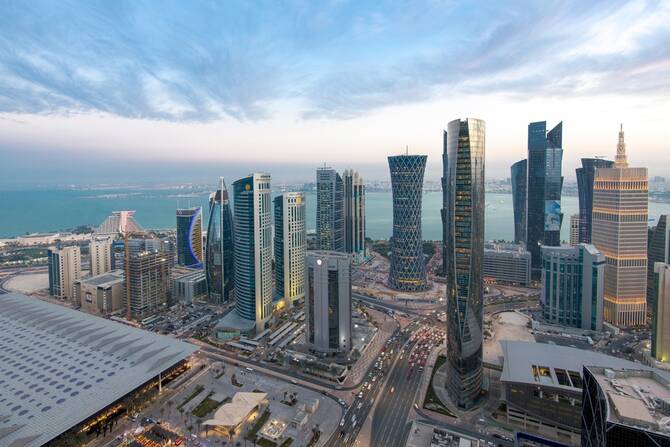
In its latest report, Fitch Ratings said the Qatari DCM expanded 13 percent year on year in the first four months of 2025, pushing outstanding volume to $131.8 billion. Shutterstock.
Short Url
Updated 29 May 2025
Follow

Qatar’s debt market to surpass $150bn on steady issuance, Fitch says 

  • Fitch Ratings said the Qatari DCM expanded 13% year on year in the first four months of 2025
  • Qatar ranks as the third-largest DCM source in the GCC

RIYADH: Qatar’s debt capital market is expected to exceed $150 billion in the medium term, supported by continued momentum in issuance across sovereign, bank, and corporate segments, according to a new analysis.

In its latest report, Fitch Ratings said the Qatari DCM expanded 13 percent year on year in the first four months of 2025, pushing outstanding volume to $131.8 billion.  

The analysis noted that sovereign issuers accounted for the majority with 60 percent, while banks and corporates contributed 26 percent and 14 percent, respectively. 

The study positions Qatar’s growth within broader Gulf Cooperation Council trends, where the region’s overall DCM surpassed $1 trillion as of November, driven by robust oil revenues. In a February update, Fitch projected that the GCC will continue to rank among the top emerging-market issuers of dollar-denominated debt through 2025.

On Qatar’s DCM growth, Fitch stated: “Sukuk, ESG (environmental, social, and governance), and Qatari riyal market penetration are on an upward trajectory. The potential development of digital government bonds, as part of the Qatar Central Bank’s Central Bank Digital Currency project, can support the market’s depth and sophistication.”  
 
The DCM, which involves the trading of securities like bonds and promissory notes, serves as a key mechanism for raising long-term capital for both businesses and governments. 

Qatar ranks as the third-largest DCM source in the GCC, holding a 13 percent regional share by the end of April. However, issuance volume dropped to $9.6 billion in the first four months of the year, a 36 percent decline from the same period in 2024. 
 
The share of sukuk in the DCM rose to 16.9 percent or $22 billion, but sukuk issuance slumped 86 percent year on year. Bond issuance fell 18 percent during the same period. 
 
“Fitch’s base case is that the government is going to refinance upcoming external market debt maturities and tap markets to cover a small budget surplus in 2025 under the assumption of a Brent oil price of $65 per barrel (excluding QIA investment income), while banks and corporates are likely to continue to diversify funding sources,” the report stated.  
 
While 67 percent of outstanding Qatari DCM remains US dollar-denominated, 28 percent is in riyals. In 2024, approximately 90 percent of the sovereign’s bond issuance and all sovereign bond sukuk were riyal-denominated. 

The report highlighted that ESG debt is becoming a key dollar funding tool, accounting for almost 30 percent of all dollar DCM issuance in 2024. ESG DCM volume hit $4.1 billion by April, rising 204 percent year on year, with sukuk accounting for 18 percent. 
 
Qatar’s debt-to-GDP ratio is expected to rise to 49 percent in 2025 before falling below 45 percent by 2027 on the back of increased gas output and associated budget surpluses. 

Fitch projects the US Federal Reserve will cut interest rates to 4.25 percent by the end of 2025, a trend the Qatar Central Bank is likely to follow. 

In a separate February report, the agency forecast Saudi Arabia’s DCM would hit $500 billion by end-2025, spurred by the Kingdom’s Vision 2030 diversification plan. 


Saudi Arabia offers 11 mining sites in Eastern Province to boost investment 

Updated 9 sec ago
Follow

Saudi Arabia offers 11 mining sites in Eastern Province to boost investment 

JEDDAH: Saudi Arabia has opened 11 mining sites at the Eastern Province’s Al-Summan Crushers Complex for competitive bidding, boosting investment, governance, and local community development. 

The sites are designated for the extraction of aggregates and crusher materials, covering 9 sq. km, according to a statement by the Ministry of Industry and Mineral Resources. 

The initiative forms part of the Kingdom’s drive to establish mining as the third pillar of its industrial economy, alongside oil and petrochemicals, leveraging mineral wealth now estimated at SR9.37 trillion ($2.5 trillion), a 90 percent increase from 2016 estimates of SR5 trillion. 

The increase follows comprehensive surveys of the Arabian Shield, which revealed new deposits beyond traditional mineralized belts. 

Jarrah bin Mohammed Al-Jarrah, the ministry’s official spokesperson, said applications for the mining sites will be accepted from Feb. 15 to March 5, via the Ta’adeen digital platform, which handles registration, qualification, bidding and the announcement of winning companies. 

“The Ministry aims to allocate mining complexes to encourage investment in the mining sector, strengthen governance, protect sites from illegal exploitation, and support development in neighboring areas,” the statement said. 

Saudi Arabia’s mining sector has demonstrated sustained growth, with the number of mining licenses rising from 1,985 in 2016 to 2,401 by the end of 2024, representing cumulative growth of 21 percent, according to the 2024 Mineral Wealth Statistics from the General Authority for Statistics. 

Building material quarries accounted for the largest share of permits, rising from 1,267 in 2021 to 1,481 by 2024. 

Exploration licenses also showed consistent growth, supporting the Kingdom’s broader strategy to develop its mineral resources and strengthen the mining sector as a key pillar of its industrial economy. 

Reforms in the sector have attracted $32 billion in investments for projects in iron, phosphate, aluminum, and copper. 

Recent surveys and discoveries, including rare earth elements, lithium, cobalt, and copper, as well as zinc and gold, highlight the Kingdom’s potential to expand into strategic industries such as electric vehicles, advanced technologies, and renewable energy. 

Strategic investments and international partnerships, including projects like the Jabal Sayid rare earths site and collaborations with companies such as MP Materials, position Saudi Arabia as a global hub for critical minerals and reinforce the Kingdom’s Vision 2030 industrial ambitions.