

Pakistan’s army chief hosts dinner for political leadership, praises their ‘foresight’ during India standoff

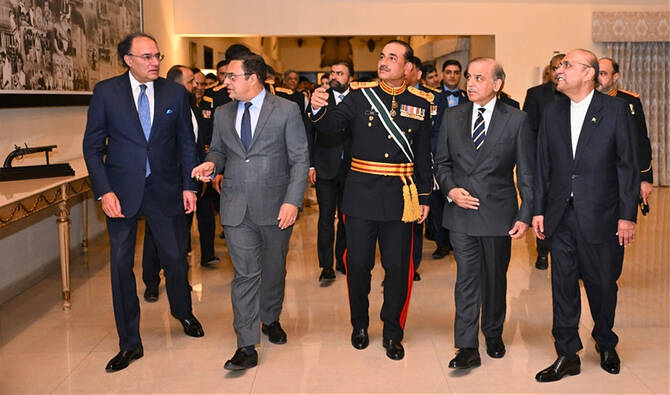
In this handout photograph released by Pakistan’s military media wing on May 24, 2025, President Asif Ali Zardari (left) and Prime Minister Shahbaz Sharif (second left) look on, during a dinner hosted by Chief of Army Staff General Syed Asim Munir (center) in Rawalpindi. (ISPR)
Short Url
Updated 24 May 2025
Follow

Pakistan’s army chief hosts dinner for political leadership, praises their ‘foresight’ during India standoff

  • The dinner was attended by President Zardari and Prime Minister Sharif along with other top officials
  • Field Marshal Asim Munir hails the military’s performance and the public’s resilience during the war

ISLAMABAD: Pakistan’s army chief praised the political leadership’s “strategic foresight” during a four-day military clash with India, according to an official statement on Saturday, as he hosted a dinner in their honor for their role in the conflict.

The event followed a brief but intense conflict earlier this month in which both nuclear-armed neighbors exchanged missile, drone and artillery strikes before agreeing to a US-brokered ceasefire.

As part of a series of honors marking Pakistan’s response, the government promoted the army chief, Syed Asim Munir, to the five-star rank of Field Marshal.

“In his remarks, the Chief of Army Staff expressed profound gratitude to the political leadership for their strategic foresight during Marka-e-Haq and lauded the seamless inter-services coordination that ensured operational success in Operation Bunyanum Marsoos,” Pakistan’s military media wing, ISPR, said in a statement.

The dinner brought together top political and military leaders including President Asif Ali Zardari, Prime Minister Shehbaz Sharif and service chiefs, as well as leaders from major political parties.

All the participants hailed the military’s performance and the public’s resilience during what officials described as a defining moment for the nation.

Munir also praised Pakistan’s youth and media for acting as a “steel wall” against what he called a disinformation campaign launched by India.

He further acknowledged the role of Pakistani scientists, engineers and diplomats, calling their efforts “critical” to the national response.

The gathering, according to the ISPR, served as a demonstration of unity and reaffirmed Pakistan’s collective resolve to move forward with “renewed strength and cohesion.”


Pakistan slashes power tariff for industries by Rs4.4 per unit to spur growth

Updated 6 sec ago
Follow

Pakistan slashes power tariff for industries by Rs4.4 per unit to spur growth

  • The development comes as Pakistan navigates a long path to economic recovery under a $7 billion IMF program
  • The reduction in electricity tariffs will allow exporters to offer more competitive prices, increase profits margins

ISLAMABAD: Prime Minister Shehbaz Sharif on Thursday announced a Rs4.4 cut electricity tariffs for industrial consumers, saying the move is aimed at lowering production costs and spurring economic activity in Pakistan.

Sharif made the announcement while addressing businessmen and exporters at a ceremony in Islamabad, at which he presented awards to business figures who made significant contributions to the national economy.

He said the government would devise all future economic policies in consultation with the business community and there was no alternative to export-driven economic growth.

“Four rupees and four paisas per unit are being reduced in electricity tariffs for industry,” the prime minister announced at the ceremony.

“If it were up to me, I would reduce it by another 10 rupees, but my hands are tied.”

The development comes as Pakistan, which has long struggled with boom-bust cycles, seeks to boost foreign investment and increase exports, navigating a long path to economic recovery under a $7 billion International Monetary Fund (IMF) program.

The reduction in electricity tariffs for industrial consumers is expected to lower production costs that will allow exporters to offer more competitive prices in international markets, increase profit margins and encourage higher capacity utilization at factories.

The prime minister announced lowering wheeling charges for industry by Rs9 per unit, noting the country’s economy had stabilized, inflation had come down to single digits and the policy rate stood at 10.5 percent.

In Pakistan, wheeling charges are fees paid by electricity consumers and generators to use the national grid’s transmission and distribution network to move electricity from suppliers to end-users under the Competitive Trading Bilateral Contracts Market (CTBCM).

“I think this should help you sell your power to neighboring industries,” he told businesspersons at the event.