

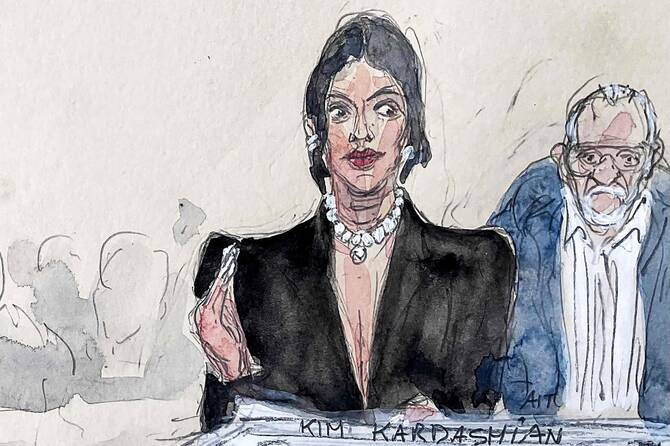
Defendants ask forgiveness ahead of Kardashian robbery verdict

Prosecutors have asked for a 10-year sentence. The loot was never found. (AFP)
Short Url
Updated 24 May 2025
Follow

Defendants ask forgiveness ahead of Kardashian robbery verdict

  • Aomar Ait Khedache, 69, accused of being the ringleader, begged to be forgiven
  • “All I have to offer you is regret. I am sorry. I take responsibility for what I have done,” said Yunice Abbas

PARIS: Defendants accused of stealing $10 million in jewelry from reality TV star Kim Kardashian in Paris in 2016 asked for forgiveness Friday as the court prepared to deliver its verdict.

Nine men and one woman have been standing trial since April, with prosecutors seeking the toughest jail terms — 10 years — for the four men accused of carrying out the robbery.

Kardashian, then 35, was robbed while staying at an exclusive hotel in the French capital on the night of October 2-3, 2016.

She was threatened with a gun to the head and tied up, with her mouth taped.

Aomar Ait Khedache, 69, accused of being the ringleader, begged to be forgiven in his final statement ahead of sentencing.

Khedache is now virtually mute and completely deaf, and his statement was read out by his lawyer.

Known as “Old Omar,” Khedache has admitted to tying up Kardashian but denies being the robbery mastermind.

“I ask for forgiveness. I can’t find the words. I am very sorry,” he wrote, asking for “a thousand pardons” from his son Harminy, who allegedly drove him and two accomplices the night of the theft and is also on trial.

“All I have to offer you is regret. I am sorry. I take responsibility for what I have done,” said Yunice Abbas, another of the four men risking 10 years in prison.

Others took a different tack, using the opportunity to reassert their innocence.

“I never, ever took part in the jewelry theft,” said a lawyer, reading a statement on behalf of Didier Dubreucq, another of the four.

Most of the stolen valuables were never recovered, including a diamond ring given to Kardashian by her then-husband, rapper Kanye West.

The ring alone was valued at 3.5 million euros ($3.9 million).

The robbery was the biggest against a private individual in France in 20 years.
Most of the accused are now in their 60s and 70s and have been dubbed the “Grandpa robbers” by French media.

They have underworld nicknames like “Old Omar” and “Blue Eyes” that resemble those of old-school French bandits of 1960s and 1970s films noirs.

But making the sentencing demands earlier this week, the prosecutor urged the judges and jury to remember that Kardashian was targeted by a violent attack and not to be “taken in” by the “wrinkles” of the defendants.

The American star testified at the trial last week, wearing a diamond necklace valued at $3 million, according to its New York-based creator Samer Halimeh.

Kardashian said she feared she would be raped and killed by the masked men who held her at gunpoint.

“I thought I was going to die,” said Kardashian, who is among the world’s most followed people on Instagram and X.

The trial has attracted huge media attention and crowds have flocked around the court in Paris’s historic Ile de la Cite area hoping for a glimpse of the celebrity.

The verdict is expected in the evening.

During the trial, Kardashian told the court she forgave Khedache after hearing a letter of apology from him.

“I forgive you for what has taken place but it does not change the emotion, the feelings, the trauma and the way my life changed,” she told Khedache.

None of the defendants are currently in detention and, even if convicted, their lawyers’ main aim will be to prevent their elderly clients going back to prison.

Khedache’s lawyer argued on Thursday: “At that age, a prison sentence is life imprisonment.”

Kardashian, sometimes described as “famous for being famous,” became well known in the early 2000s through TV reality shows, before launching fashion brands and appearing in films.



India rolls out strictest anti-pollution curbs as toxic smog engulfs Delhi

Demonstrator wearing an oxygen mask and holding oxygen tanks takes part in protest.
Updated 14 December 2025
Follow

India rolls out strictest anti-pollution curbs as toxic smog engulfs Delhi

  • Private monitors in several parts of northern Delhi recorded AQI spikes between 550 and 700s
  • Authorities invoked stage four of the capital region’s emergency pollution-control framework

NEW DELHI: India’s capital choked under a thick blanket of smog on Sunday, with the government imposing anti-pollution curbs after monitoring stations in some areas recorded extremely hazardous air quality.

Home to 30 million people, Delhi has not recorded a single “clean air” day in 2025, with Air Quality Index readings hitting high above the 50 score throughout the year.

On the AQI scale from 0 to 500, good air quality is represented by levels below 50, while levels above 300 are dangerous.

Worsening since late October, official records over the weekend were in the severe to severe-plus range of 400–500, but as 24-hour averages, they did not capture the peaks. Private monitors in several parts of North and North West Delhi recorded AQI spikes above 550 and even into the 700s in real-time.

On Saturday evening, the Ministry of Environment’s Commission for Air Quality Management invoked stage four — the highest level — of the Graded Response Action Plan for Delhi and surrounding areas.

To “prevent further deterioration of air quality in the region,” the commission suspended all non-essential construction, shut stone crushers and mining operations, stopped entry of trucks into the capital region, and ordered schools to shift to hybrid classes or online, where possible.

While authorities blamed the pollution on “adverse meteorological conditions,” residents have been demanding more government action.

“The situation is so bad in Delhi that we don’t have any option but to force kids to do online classes. The government has failed us; it has not done anything to address the issue,” said Nabanita Nayak, who decided for her teenage children to attend school online only, despite concerns over their screen addiction.

“If the kids are too much in front of laptops, that’s also an issue. As a mother, I am worried.” 

Delhi’s pollution has been worsening since Diwali in late October, when the average AQI has been above 370, or “very poor.” Since mid-November, it has been over 400, which means “severe” air quality, with certain areas recording 500 and above, which is classified as a “hazardous” level.

“I don’t feel proud living in Delhi. It’s the capital city of the country … We talk about being a developed nation by 2047 — we have deadlines,” said Jagriti Arora, who is keeping her 7-year-old daughter at home to prevent allergy flare-ups caused by air pollution.

“The government has to do something … China had a big problem with pollution, but now they’ve managed to bring it down.”

Delhi’s air quality deteriorates in winter due to local emissions and seasonal weather conditions. Cold temperatures and low wind speeds result in a temperature inversion, which traps pollutants close to the ground instead of letting them disperse. This allows emissions from millions of vehicles, ongoing construction, and nearby industrial activity to accumulate in the air. Urban waste burning and dust from construction sites further add to it.

“This is not a new thing. This has been happening now for over 10 years,” Arora said. “You can see it. You don’t need to actually look at an AQI meter to see how bad the pollution is these days.”